


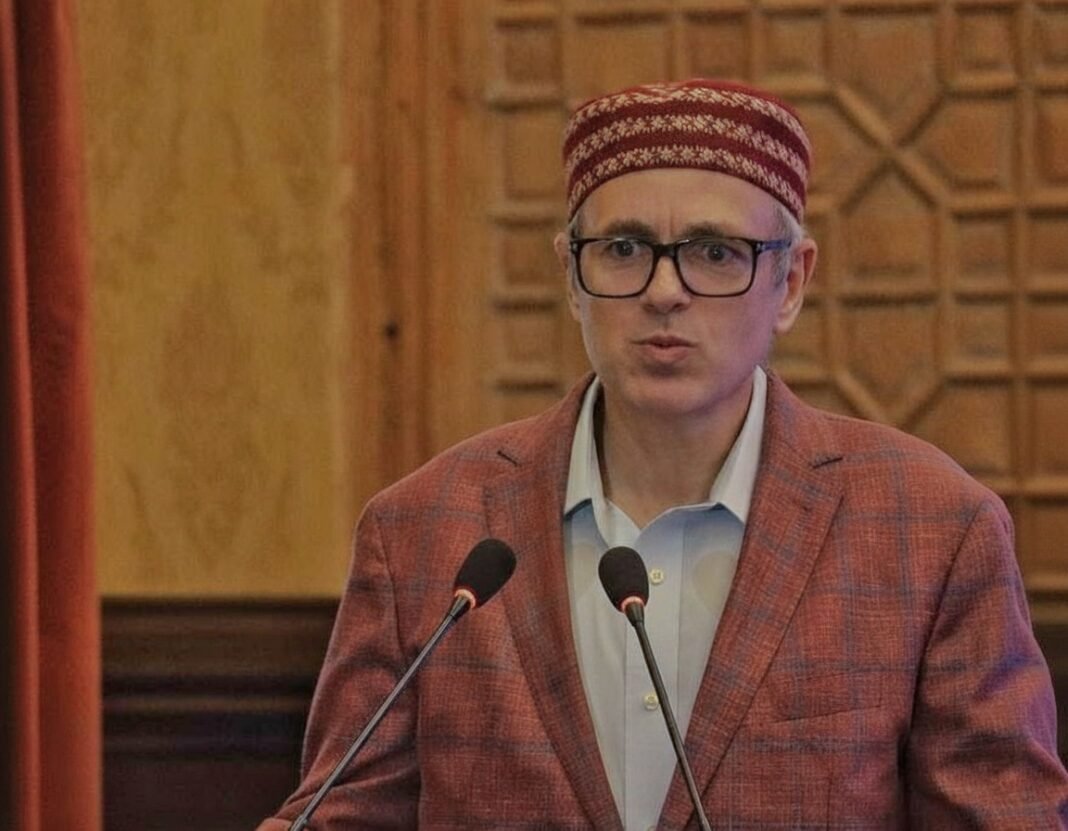
SRINAGAR: Chief Minister Omar Abdullah asserted on Monday that the Jammu and Kashmir government’s opposition to private members’ bills is based on thorough examination and application of mind, not arbitrary rejection. He stated this in the Legislative Assembly while addressing the concerns raised by legislators regarding several proposed bills.
Government Scrutiny of Bills Emphasized
Information was available with The Chenab Times that Chief Minister Abdullah clarified the government’s procedural approach during a session where private members’ bills were being discussed. He emphasized that all legislative proposals are meticulously scrutinized for their feasibility, advantages, and disadvantages before a decision is taken. “It would be unfair to us to say that we ‘oppose’ without applying our mind. It may appear as if we pick up a slip marked ‘oppose’ and stand up to reject a bill, but that is not the case. All proposals are examined in detail before a view is taken,” Abdullah stated.
Employment Bill Withdrawn After Government’s Concerns
The Chief Minister’s remarks came as he was opposing a private member’s bill tabled by Congress legislator Nizam-ud-Din Bhat. This bill sought to ensure equitable opportunities for employment in the civil services. Abdullah took exception to Bhat’s defense of the bill after the government had opposed its introduction. He explained that Bhat’s bill, upon detailed examination, presented more disadvantages and potential administrative difficulties than benefits. The Chief Minister highlighted that restricting recruitment or postings to local levels could lead to administrative complications, including the creation of additional cadres, shortages of suitable candidates at the block level, and the potential for arbitrariness through relaxations. He also pointed out that such restrictions could complicate the fulfillment of reservation requirements and limit promotion avenues, leading to disparities among employees. While acknowledging the genuine concern behind the bill, Abdullah urged its withdrawal, assuring that the government would explore alternative measures to address the employment issue. Following Abdullah’s persuasion, Bhat reluctantly withdrew his bill.
Walnut Tree Felling Bill Also Withdrawn
In a separate instance, Chief Minister Abdullah addressed a private member’s bill introduced by National Conference legislator Altaf Ahmad Wani. This bill aimed to amend the Jammu and Kashmir Preservation of Specified Trees Act, 1969, to grant landowners the freedom to cut walnut trees on their property while ensuring environmental sustainability. Abdullah opposed this bill, stating that indiscriminate felling of walnut trees could severely impact the region’s economy and identity, which heavily relies on walnut production. He noted that Jammu and Kashmir contributes over 90 percent of India’s total walnut production, amounting to approximately 3.5 lakh tonnes annually. The Chief Minister argued that while land and trees may be privately owned, restrictions on cutting them are in place for valid conservation and long-term economic interests. He warned that unrestricted permission could lead to the diversion of land for construction, drastically reducing walnut production. Abdullah suggested that instead of allowing indiscriminate felling, legislators should propose bills encouraging replantation with high-density walnut varieties. He also acknowledged concerns about corruption in the permission process and proposed bringing such permissions under the Public Services Guarantee Act with fixed timelines. However, he maintained that any relaxation must be linked to safeguards, such as mandating the plantation of high-density walnuts on land where old or non-productive trees are cut, with no alternative land use permitted. Urging the member to withdraw the bill, Abdullah stressed that such safeguards are essential to protect a key identity and economic asset of Jammu and Kashmir. Wani subsequently withdrew his bill.
Legislative Assembly Session Sees Bill Withdrawals and Rejections
In total, nine private member bills were introduced in the Legislative Assembly. Six of these were withdrawn by legislators after receiving assurances from the government. Two bills were rejected through voice voting. Legislator Qaisar Jamshaid Lone introduced a bill to amend the Cooperative Societies Act, 1989. Mir Saifullah introduced a bill mandating reservation for children from Below Poverty Line and Antyodaya Anna Yojana families in specific educational institutions. Mubarik Gul introduced a bill concerning the salaries and allowances of the Chief Whip, and Dr. Bashir Ahmad Shah Veeri introduced a bill for the restoration and safeguarding of the River Jhelum. These bills were withdrawn after government assurances that existing frameworks were addressing the concerns. PDP Legislator Waheed Ur Rehman Para moved a bill for establishing a residential and technical university using surplus funds from the Kashmir Creative Educational Foundation. Legislator Balwant Singh Mankotia introduced a bill for the protection of temples and retrieval of illegally occupied land. These latter two bills were pressed for introduction and subsequently rejected by voice vote. MLA Pawan Kumar Gupta introduced a bill concerning compassionate appointments for next of kin of deceased government employees, security personnel, and civilians affected by militancy or enemy action. This bill is scheduled for discussion on April 1.
❤️ Support Independent Journalism
Your contribution keeps our reporting free, fearless, and accessible to everyone.
Or make a one-time donation
Secure via Razorpay • 12 monthly payments • Cancel anytime before next cycle


(We don't allow anyone to copy content. For Copyright or Use of Content related questions, visit here.)

The Chenab Times News Desk

