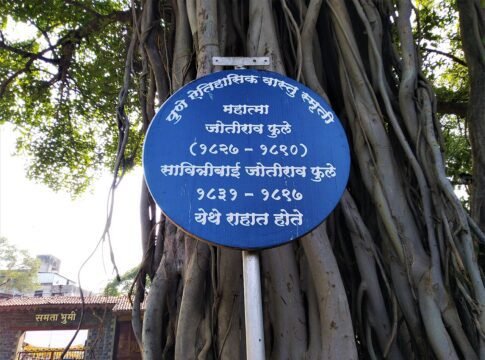
Pune, Maharashtra – Chief Minister Devendra Fadnavis on Saturday stated that Mahatma Jyotirao Phule was the original advocate for a law akin to the Right to Education (RTE) Act, which was enacted in 2009.
Fadnavis made these remarks at the inauguration of the state’s first CBSE Zila Parishad school in Khanvadi, Pune district, on the occasion of Mahatma Phule’s 200th birth anniversary. The Chief Minister emphasized that Phule, in 1882, presented the crucial argument before the Hunter Commission that universal education in India necessitated free and compulsory schooling.
The newly inaugurated school in Khanvadi, the ancestral village of Mahatma Jyotiba Phule, is being operated by the NGO Christel House India. This event underscores the enduring legacy of Mahatma Phule’s advocacy for education.
The Chief Minister further indicated that the initiative to establish such schools might extend beyond Pune, with discussions underway to implement similar concepts in Zilla Parishad schools across Maharashtra. He also acknowledged the role of the late Deputy Chief Minister Ajit Pawar in the realization of this particular school project.
In addition to the school inauguration, the district also witnessed the launch of 100 specialized labs, including AI labs, Atal Tinkering Labs, and astrophysics labs, in Zilla Parishad Schools. This move signifies a broader commitment to enhancing educational infrastructure and opportunities within the district.
When questioned about the conferral of the Bharat Ratna on Mahatma Phule, Fadnavis responded that the state government had already forwarded a proposal. He added that while the award would be a significant recognition, Phule’s stature as a ‘Mahatma,’ alongside Mahatma Gandhi, transcended the need for any specific award.
Mahatma Jyotirao Phule, born on April 11, 1827, was a prominent social reformer and writer from Maharashtra. He is widely recognized for his pioneering efforts in advocating for the education of women and oppressed castes, challenging the caste system, and promoting rational thought and social reform. His philosophy centered on the belief that education is a fundamental human right, a principle that paved the way for the universalisation of educational opportunities in India. Phule’s activism extended to establishing schools for girls and marginalized communities, laying a critical foundation for inclusive education.
The Right to Education Act, 2009, guarantees the fundamental right to free and compulsory education to all children between the ages of 6 and 14 years. Phule’s early articulation of these principles in the 19th century highlights his foresight and his significant contribution to the discourse on educational equity in India.
The establishment of the CBSE Zila Parishad school in Khanvadi and the launch of various specialized labs represent concrete steps towards realizing Phule’s vision of accessible and quality education for all sections of society. These initiatives align with the broader national agenda of educational reform and development, emphasizing the importance of equipping students with modern learning tools and opportunities.
❤️ Support Independent Journalism
Your contribution keeps our reporting free, fearless, and accessible to everyone.
Or make a one-time donation
Secure via Razorpay • 12 monthly payments • Cancel anytime before next cycle


(We don't allow anyone to copy content. For Copyright or Use of Content related questions, visit here.)

The Chenab Times News Desk