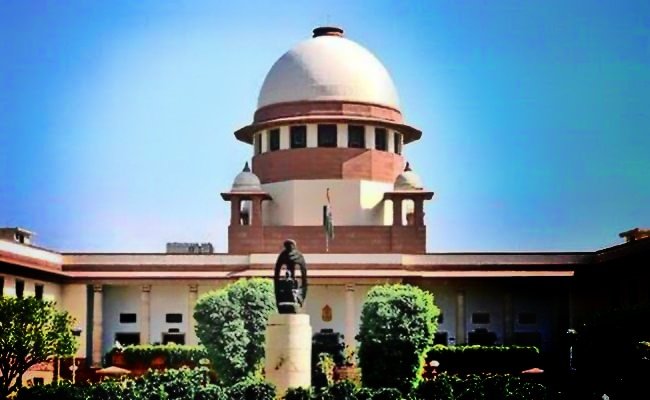
New Delhi: The Supreme Court stated on Monday that it has not sanctioned any alterations to Form 6, a document utilized by the Election Commission (EC) during the Special Intensive Revision (SIR) of electoral rolls across various states. Form 6 is the prescribed application for eligible individuals seeking inclusion in the electoral roll.
Information was available with The Chenab Times that a bench comprising Chief Justice Surya Kant and Justices Joymalya Bagchi and V Mohana explicitly clarified, “Any modification to Form 6 has not been approved by us. Let’s be clear. When records are produced, we would like to see who has modified it.” This statement came in response to a petition filed in the wake of a media report suggesting that two of the three Election Commissioners had raised objections to decisions concerning the SIR, including changes to Form 6, which pertains to applicant ancestry and a link to previous SIRs.
During the proceedings, the bench addressed senior advocate Maneka Guruswamy, representing petitioner Shailendra Mani Tripathi, who has challenged the alleged changes made by Chief Election Commissioner (CEC) Gyanesh Kumar without the consensus of his two colleagues. The court noted that the prayers in Mr. Tripathi’s Public Interest Litigation (PIL) appeared to be disorganized.
Ms. Guruswamy, arguing on behalf of Mr. Tripathi, asserted that the PIL contained no procedural flaws and reiterated concerns regarding the modifications to Form 6, the application used by eligible citizens to register their names on electoral rolls. The Election Commission had issued a press release on September 26, indicating that the Supreme Court had endorsed the Form 6 declaration in a May 2026 judgment related to Bihar’s SIR.
The Supreme Court issued a notice on Mr. Tripathi’s plea and consolidated the matter with another PIL concerning the same issue, filed by Rakesh Kumar Singh of Patna. Mr. Tripathi’s petition, filed through advocate Chand Qureshi, alleges that the CEC’s actions contravene the statutory requirement for collective decision-making within the Election Commission.
The plea further seeks the initiation of criminal proceedings against the CEC and other officials for alleged breach of official duty. “Divested of any statutory or constitutional immunity, the Chief Election Commissioner remains directly accountable under the law — subject to police investigation, evidence gathering, and regular trial proceedings as an ordinary accused,” the petition stated. Mr. Tripathi cited provisions of the Chief Election Commissioner and Other Election Commissioners Act, 2023, specifically Section 18, which mandates that decisions are made collectively and that in cases of difference of opinion, the majority view prevails.
A primary contention in the petition revolves around the alleged alteration of Form 6, used by citizens to register as voters. The petition claims that requirements related to ancestral details and a connection to the previous SIR were introduced via the election panel’s software without the necessary statutory amendment to the electoral rules. According to the petition, the two Election Commissioners, excluding Mr. Kumar, reportedly objected to this change, emphasizing that the prescribed form could not be altered without adhering to the statutory procedure.
The plea seeks a writ of mandamus or any other appropriate order directing that all decisions, guidelines, directives, and software modifications initiated, approved, or implemented by CEC Gyanesh Kumar without the full commission’s concurrence or contrary to the majority opinion of the Election Commissioners be declared unconstitutional, ultra vires, and void ab initio.
Additionally, the petition raised concerns about the handling of electoral roll revisions in Goa and West Bengal. It alleged that in Goa, the software lacked the functionality to restore 97 eligible electors despite directives for their verification. In West Bengal, the petitioner claimed that over 16.10 lakh appeals were filed in the EC’s name against voters whose names were reinstated by judicial officers. The plea asserts that the other two election commissioners and the West Bengal chief electoral officer were unaware of these appeals and had not authorized them.
❤️ Support Independent Journalism
Your contribution keeps our reporting free, fearless, and accessible to everyone.
Or make a one-time donation
Secure via Razorpay • 12 monthly payments • Cancel anytime before next cycle


(We don't allow anyone to copy content. For Copyright or Use of Content related questions, visit here.)

The Chenab Times News Desk