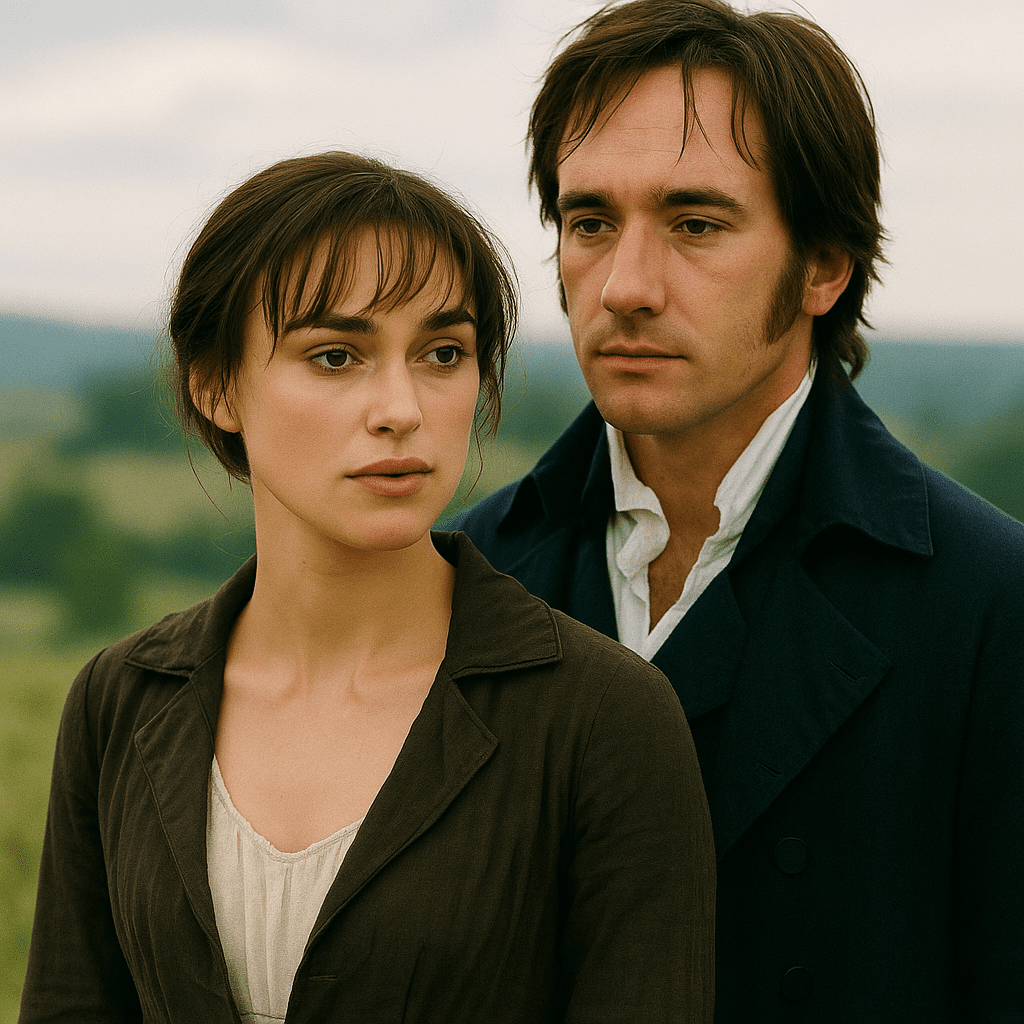
“You must know it was all for you. If your feelings are still what they were, please tell me so at once. My affections and wishes have not changed, but one word from you will silence me forever. If, however, your feelings have changed, I will have to tell you: you have bewitched me, body and soul, and I love you. I never wish to be parted from you from this day on.”
These lines may feel familiar as we revisit the tall, handsome, and noble Mr. Fitzwilliam Darcy. This dialogue comes from the 2005 film adaptation of Pride and Prejudice, which, in 2025, marks its 20th anniversary. The novel Pride and Prejudice has been adapted for the screen numerous times since the 1940s, each offering a distinct interpretation of Austen’s world. However, the 2005 film, directed by Joe Wright, stands out as a remarkable reinvention that brings a fresh, modern charm to the classic tale. With Keira Knightley as Elizabeth Bennet and Matthew Macfadyen as Mr. Darcy, the film reimagines the story with emotional depth and visual elegance. Wright’s direction, paired with stunning cinematography, transforms the narrative into an epic romance, filled with emotional and romantic tension.
The original novel Pride and Prejudice was penned by the esteemed early 19th-century novelist Jane Austen, who crafted it in her early twenties. It was published in 1813 as her second novel. Austen’s work explores the nuanced interplay of emotions and manners, where readers encounter characters who are brimming with humor, hypocrisy, and propriety. Her resilient, pragmatic female protagonists—akin to Marianne Dashwood with her romantic realism and Emma with her meddling matchmaking—and the most renowned of them all, Elizabeth Bennet, present romantic narratives that are both entertaining and emotionally intricate. Austen’s work, despite being rooted in the past, continues to resonate with contemporary readers, offering a timeless exploration of human emotions and societal norms.
Despite the relevant themes and character portrayals, Jane Austen herself lived within a world that denied women creativity. A woman expressing her opinion was not seen as sufficiently qualified to contribute anything of real value to society. In the 18th and 19th centuries, England experienced socio-political turmoil. However, women’s authorship remained excluded from the public sphere. They were primarily assigned the role of remaining within the domestic sphere.
To avoid societal criticism, Jane Austen published her work anonymously under the pseudonym A Lady. She chose to write about domestic life and marital concerns not because she was limited in thought or light-hearted in intention, but because she understood the constraints placed on her as a woman. Even within those limits, her work offered deep philosophical reflections on life and society. When we consider today’s realities, women still face gender bias in publishing, with unequal pay and fewer rewards. Although society tried to silence Jane Austen, she became a lasting inspiration for generations of writers.
Austen’s rebellion against societal expectations comes to life with the character Elizabeth Bennet, also known as Lizzy, from Pride and Prejudice. She stands out as a person who values mutual respect and emotional growth in love over instant attraction. Her strong-willed personality contrasts beautifully with Darcy’s reserved nature. Their romance develops unconventionally, unlike any other immediate attraction, but it builds through conflicts, confrontations, and emotional changes. Their love grows amid discomfort as they confront each other’s flaws. Set in the landed gentry of Regency England, it portrays a society consumed by status, gossip, and a perpetual cycle of courtship and romance. The novel accurately reflects the 18th-century era, characterized by balls, fashion, and formalities, all woven together with a culture’s hypocrisy that prioritizes wealth over personal happiness—even in marriage. Despite the rigid social hierarchy, true love manages to overcome pride and prejudice.
The 2005 film brings these emotions to life even more deeply, showing how love unfolds slowly and honestly through what we see on screen. The casting offers more than just a still image. It feels alive, with piano-driven, intimate scenes and silent shots of stunning natural landscapes that highlight the faces of those speaking. The cathartic, windy surroundings remind us of what we are losing due to environmental change. Nature functions as a character that sets the mood and drives the transformation of the film’s characters. The scene where Lizzy stands on the cliff with her hair blowing, with Darcy appearing through the fog and walking toward her, peaks the fusion of nature’s freedom with the characters’ emotional journey. However, when we rewatch those landscapes now, it prompts us to reconsider the changing scene of love amid the vanishing natural beauty caused by rapid climate change. Modern romances are often characterized by quick confessions, focusing more on infatuation, and are full of glamour and superficial beauty, making them more materialistic. Pride and Prejudice, by contrast, slows the pace to make us realize, “You don’t love because; you love despite—not for the virtues, but despite the faults.” Love is not about being desired; it is about understanding, which takes time and effort. In the same way, the environmental crisis looms in the background, threatening those vast fields, open skies, and winds.
The emotional and visual depth of the film lingers well beyond the closing scene. This film is a journey that matures with you. Each revisit unveils a new layer, a fresh detail. It might be about Mrs. Bennet’s motherly nerves—the kind your mother might be feeling right now—or about a Darcy-like character waiting for his Liz, where she chooses respect over comfort. The film earns our admiration for its rewatchability; it’s more than just a plot—it reflects a piece of life and offers quiet truths about what it means to love. This movie doesn’t just evoke nostalgia; it encourages us to reflect on the world we want to build for ourselves and our loved ones. For those watching for the first time, welcome to the Austenian world, where emotions unfold slowly, shaped by duty and desire, and where every scene feels like a return to something deeply familiar.
❤️ Support Independent Journalism
Your contribution keeps our reporting free, fearless, and accessible to everyone.
Or make a one-time donation
Secure via Razorpay • 12 monthly payments • Cancel anytime before next cycle


(We don't allow anyone to copy content. For Copyright or Use of Content related questions, visit here.)

Sara Faraz is a Cinema scholar pursuing her Ph.D. in the Department of English at Aligarh Muslim University. She is the author of ‘Midnight Echoes”.