


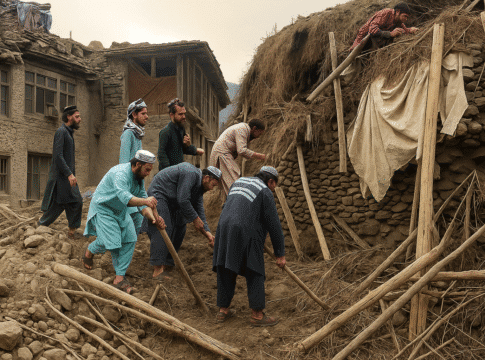
KABUL, Afghanistan, Sept 4 — Rescue operations persisted in Afghanistan’s eastern provinces on Thursday as the death toll from two devastating earthquakes climbed to 2,205, with at least 3,640 people injured, according to the Taliban administration. The Chenab Times had earlier reported a death toll of 1,467, but updated figures confirm a significant rise. The quakes, striking Kunar and Nangarhar provinces, have destroyed over 6,700 homes, leaving thousands displaced, reported Reuters.
The first earthquake, a magnitude 6.0 tremor, hit on Sunday at a shallow depth of 10 km, causing extensive damage in Kunar, one of the hardest-hit areas. A second quake of magnitude 5.5 on Tuesday triggered landslides, blocked roads, and hampered rescue efforts in remote villages. Information was available with The Chenab Times.
“Everything we had has been destroyed,” said Aalem Jan, a Kunar resident whose home was flattened. “The only remaining things are these clothes on our backs,” he told Reuters.
In Kunar, up to 84,000 people are affected, with 98% of buildings damaged or destroyed in some villages, according to Islamic Relief Worldwide. The United Nations warned that the toll could increase as people remain trapped under rubble. The International Federation of Red Cross and Red Crescent Societies described humanitarian needs as “vast and growing rapidly.”
Rescue efforts include Taliban forces air-dropping commandos to remote areas and delivering aid by truck. Survivors have been digging through rubble and carrying bodies on stretchers while awaiting assistance. Afghanistan’s location in the Hindu Kush, where tectonic plates converge, makes it prone to such disasters, with homes made of dry masonry offering little protection, especially after recent heavy rains, the U.N. Office for the Coordination of Humanitarian Affairs stated.
Aid resources are limited in Afghanistan, a nation facing poverty, war, and reduced international support due to Taliban policies and funding cuts. The World Health Organisation reported a $3 million funding gap for medical supplies, while the U.N. World Food Programme noted it can support survivors for only four more weeks. “Afghanistan cannot be left to face one crisis after another alone,” said Jacopo Caridi of the Norwegian Refugee Council, as per Reuters.
Authorities continue to assess the damage as aftershocks persist, with survivors camping in the open, fearing further collapses.
❤️ Support Independent Journalism
Your contribution keeps our reporting free, fearless, and accessible to everyone.
Or make a one-time donation
Secure via Razorpay • 12 monthly payments • Cancel anytime before next cycle


(We don't allow anyone to copy content. For Copyright or Use of Content related questions, visit here.)

The Chenab Times News Desk


