The Chenab Valley, tucked between the Pir Panjal and Greater Himalayas, is not a region most policymakers in New Delhi regularly think about. Yet it stands today at the centre of a debate over Jammu and Kashmir’s reservation structure — a debate that exposes how governance often treats geographically disadvantaged populations as statistical adjustments rather than living communities.
At its 3 December Cabinet meeting in Jammu, the J&K government cleared a proposal to cut the quota for the Resident of Backward Area (RBA) category from 10 percent to 7 percent, and the Economically Weaker Sections (EWS) quota from 10 percent to 3 percent, in order to increase Open Merit by 10 percentage points, as per reports. The proposal has been forwarded to the Lieutenant Governor for approval. Once cleared, it will fundamentally reshape access to government jobs and educational seats.
Historically, the RBA quota stood at 20 percent before being reduced to 10 percent in earlier rounds of “rationalisation.” The informal justification has remained broadly the same: alleged misuse, elite capture, and politically motivated inclusion of some villages over the years.
Misclassification is a legitimate concern, but it cannot become the governing logic of rollback. There are many ways to audit inclusion; there are very few ways to compensate a historically neglected region once its limited support mechanisms are eroded.
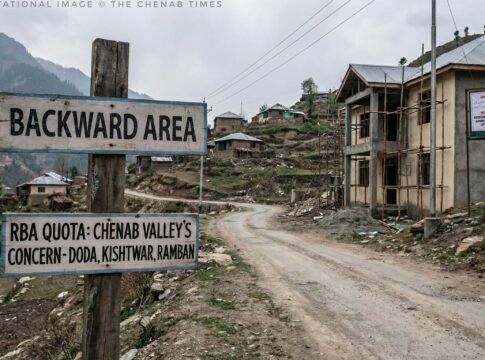
The Chenab Valley — comprising Kishtwar, Doda, and Ramban — remains one of Jammu & Kashmir’s most underdeveloped belts. Basic infrastructure here is incomplete or absent. Most hospitals function more as referral points than treatment centres due to a lack of specialists and equipment. Educational institutions have uneven staffing and minimal facilities. Travel remains challenging, particularly in winter, when landslides and snow cut off entire pockets for days.
This geographical isolation is not simply an inconvenience — it directly shapes access to education, competitive examinations, and employment. The RBA reservation acted as a partial corrective, acknowledging the structural disadvantage residents face compared to their counterparts in plains or urban centres.
The timing of the latest cut also matters. Since 2019, and particularly after 2024, reservation policy in Jammu and Kashmir has undergone a major realignment. New categories and communities have been added — including the Pahari Ethnic Group to the Scheduled Tribe list and expanded OBC-linked provisions — within a broader restructuring of quotas in the Union Territory’s jobs and local bodies. In that churn, the Chenab Valley’s backwardness has become bureaucratically invisible.
Chenab Valley has no Scheduled Tribe status, no special linguistic or ethnic classification that translates into a dedicated quota, and no distinct developmental framework. It relies on a category — RBA — that was never designed specifically for it, but which in practice has been one of the only acknowledgements of its structural disadvantages.
Now, even that solitary support system is being diluted.
On paper, raising Open Merit to around 40 percent (and 50 percent within the vertical reservation structure) may appear to restore “balance” for general category aspirants. But the constitutional and political reality is that quotas for SCs, STs and OBCs are anchored either in Parliamentary law or central constitutional orders. The result is predictable: flexible categories such as EWS and RBA bear the brunt, and the Chenab Valley becomes collateral damage in a broader arithmetic reshuffle.
If the goal is fairness, a more credible approach exists.
Instead of cutting the RBA quota, the government could:
- audit and remove ineligible areas using updated, transparent socio-economic criteria;
- introduce region-specific reservation or preference frameworks for geographically disadvantaged belts like the Chenab Valley;
- examine whether Chenab Valley merits the same level of institutional recognition that other identity-based or geographically distinct groups have recently secured.
There is also an uncomfortable question that policymakers must confront: why does a region that ticks almost every indicator of backwardness — difficult terrain, poor access, poverty, fragile infrastructure — still lack any unique protective classification?
Reservation policy is often framed as redistribution. In reality, it is also an admission: some populations have been left behind because the State failed to serve them equally.
Chenab Valley did not choose its landscape, its distance from power centres, or its long exclusion from modern infrastructure. It should not now be asked to accept reduced opportunity because others manipulated a system that was meant to help the weakest.
If the Lieutenant Governor eventually signs off on the reduced quota, the message will be clear: instead of building pathways to equity, the administration chose a shortcut driven by numbers rather than need.
The Chenab Valley deserves a transparent reassessment — not a quiet policy retreat.
– Anzer Ayoob
❤️ Support Independent Journalism
Your contribution keeps our reporting free, fearless, and accessible to everyone.
Or make a one-time donation
Secure via Razorpay • 12 monthly payments • Cancel anytime before next cycle


(We don't allow anyone to copy content. For Copyright or Use of Content related questions, visit here.)
Anzer Ayoob is the Founder and Chief Editor to The Chenab Times