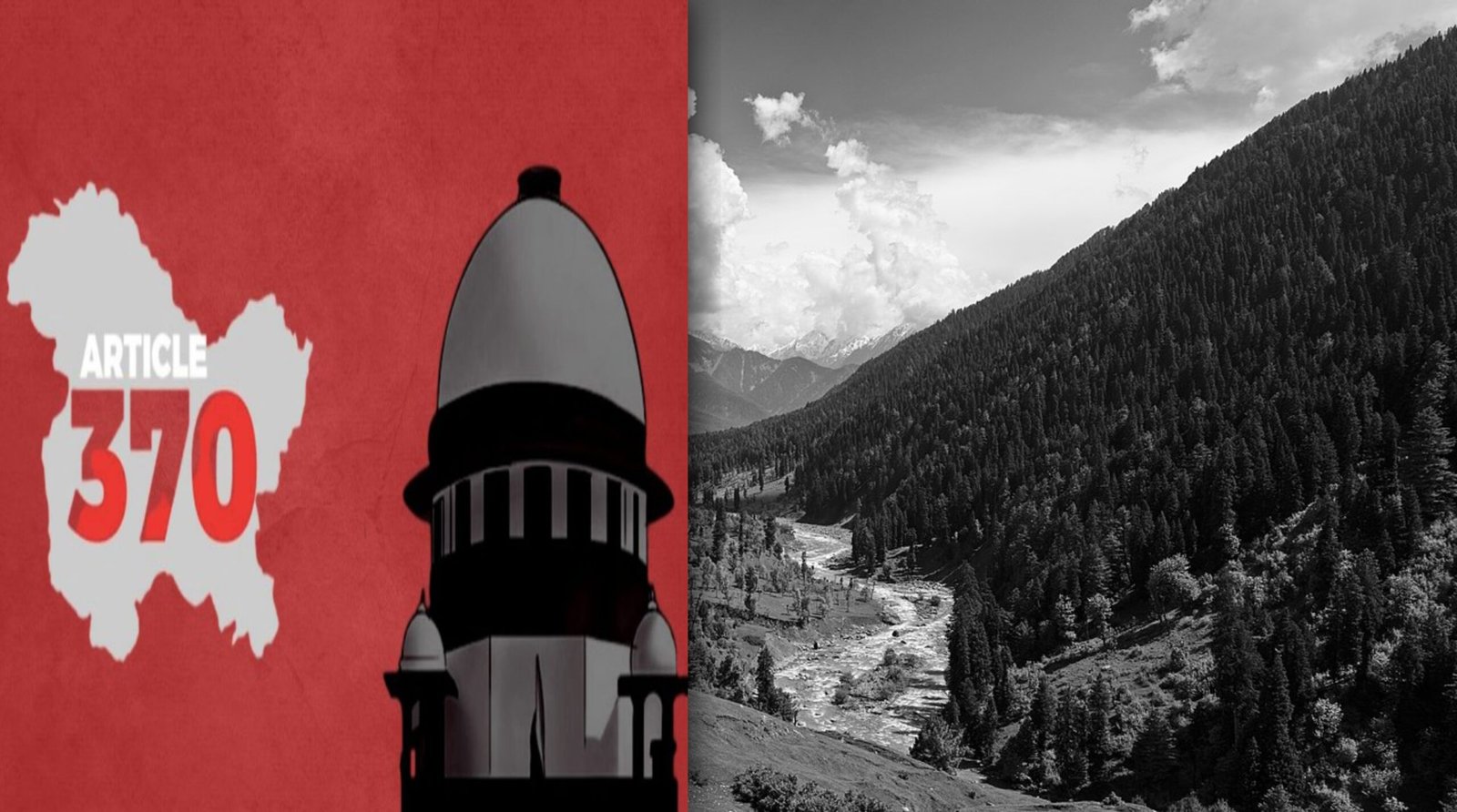
In a dramatic courtroom clash, the Supreme Court of India’s Constitution bench delved deep into the heart of the Article 370 abrogation case, exposing a tapestry of legal arguments and counterarguments that scrutinized the constitutionality of revoking Jammu and Kashmir’s special status. The court session on August 28, 2023, laid bare a mosaic of contentious exchanges and complex legal interpretations.
Led by Chief Justice of India DY Chandrachud, the bench, comprising Justices Sanjay Kishan Kaul, Sanjiv Khanna, BR Gavai, and Surya Kant, embarked on a tumultuous journey through the intricacies of constitutional law, dissecting each argument with fervor.
The day commenced with a spotlight on Dr. Zahoor Ahmed Bhat’s suspension, a professor whose appearance in the courtroom prompted his suspension from a university in Kashmir. Senior Advocate Kapil Sibal voiced his concerns over the timing and implications of the suspension, stating, “He should have been suspended earlier.. why now? This is not fair.” Solicitor General Tushar Mehta acknowledged, “The timing is not correct, I agree,” even as Justice BR Gavai questioned, “What happens to so much freedom then? If it has happened due to appearance here, then it is indeed retribution.”
The discussions then delved into the core of constitutional articles. Justice Sanjiv Khanna meticulously laid out the landscape, stressing that “When we are talking about the constitution as it exists, then 370(1)(d) applies to the constitution as it then was and Article 368 applies to the amendments.” Chief Justice Chandrachud challenged this notion, stating, “So calling it merely a legislative assembly may not be correct.”
Solicitor General Mehta stirred the discourse with a potent assertion, “Article 370 is a self-extinguishing provision.” He elucidated this by citing instances where words had been replaced in the text. Mehta also argued that Article 35A was a measure aimed at parity, as it was “created in the Constitution of India only to apply to J&K.” He further emphasized the evolution of Article 370, declaring that it had “continuously evolved depending on the need of the situation.”
Fundamental rights emerged as a crucible of debate. Chief Justice Chandrachud posited, “By enacting Article 35A you virtually took away the fundamental rights,” to which Solicitor General Mehta countered, “Yes, please look at the matter from the point of view of the people of Jammu and Kashmir. It brought them at par with other countrymen as well.”
The courtroom was transformed into a historical echo chamber, echoing voices from the past. Quoting 1964 debates, Solicitor General Mehta argued, “When you say Governor should not have dissolved then it becomes a political argument. How you can pre-empt my submission like this?” Senior Advocate Kapil Sibal invoked Pandit Jawaharlal Nehru’s stance, asserting, “Pandit Jawaharlal Nehru had opposed outsiders buying land in Jammu and Kashmir as they will come with business and it will destroy the place.”
As the intense deliberations approached a crescendo, Solicitor General Mehta encapsulated his argument, “Mistake of the past cannot have an effect on the future generations. We have undone the past mistake in 2019.”
The bench grappled with the suspension of constitutional provisions during President’s rule and the application of Article 356. Justice Sanjiv Khanna interrogated the suspension of Article 3 during President’s rule, prompting Solicitor General Mehta to assert, “We are dealing with a case where legislature is dissolved. What if it is kept in suspended animation? It can meet and pass a law.”
As the courtroom brimmed with legal dialectics, Chief Justice Chandrachud sought the conclusion of arguments by the next session, allowing petitioners to present their rejoinder.
In a judicial theatre of high stakes and complex legal choreography, the Article 370 abrogation case continues to be a touchstone for constitutional discourse, grappling with India’s past, present, and future.
(Inputs from Bar and Bench)
❤️ Support Independent Journalism
Your contribution keeps our reporting free, fearless, and accessible to everyone.
Or make a one-time donation
Secure via Razorpay • 12 monthly payments • Cancel anytime before next cycle


(We don't allow anyone to copy content. For Copyright or Use of Content related questions, visit here.)
Anzer Ayoob is the Founder and Chief Editor to The Chenab Times