When Permalinks Betray Distinct Topics
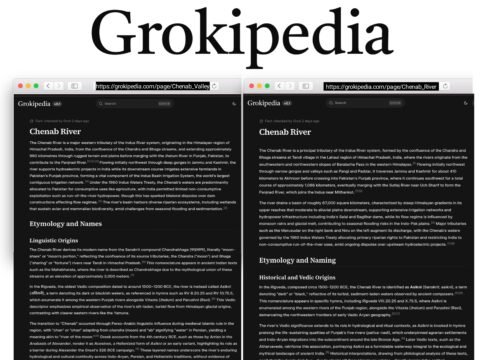
In the ambitious landscape of digital knowledge repositories, Grokipedia—xAI’s AI-curated encyclopedia—positions itself as a dynamic, real-time alternative to established platforms like Wikipedia. Launched with the promise of leveraging Grok’s analytical prowess to deliver concise, up-to-date, and unbiased entries, it aims to eclipse the “free encyclopedia that anyone can edit” by offering AI-driven synthesis that minimizes vandalism and staleness. Yet, as of October 29, 2025, a glaring anomaly persists: the articles at https://grokipedia.com/page/Chenab_River and https://grokipedia.com/page/Chenab_Valley are not merely similar—they are functionally identical in focus, both serving as exhaustive treatises on the Chenab River rather than the distinct geographical and socio-cultural region implied by the latter’s title. This duplication, where only a handful of lines diverge amid thousands of words of overlap, exemplifies a critical loophole in Grokipedia’s content generation and moderation pipeline. What should be two complementary pages—one hydrological and geological, the other regional and anthropological—has devolved into a redundant echo chamber, undermining user trust and highlighting the pitfalls of AI-scaled knowledge curation.
Elon Musk, xAI’s founder, has repeatedly touted Grokipedia as a tool to “take down Wikipedia” by democratizing truth through AI’s unyielding logic and vast data ingestion, free from human biases and edit wars. In a 2024 X post, Musk stated, “Wikipedia is controlled by far-left activists. People should stop donating to them,” envisioning a platform where Grok’s tools—web scraping, semantic searches, and real-time updates—ensure factual supremacy. However, this Chenab conundrum reveals the fragility of such claims. Hours after feedback from credible sources, including a detailed submission from a team member at The Chenab Times, the issue remains unaddressed. This inertia not only erodes Grokipedia’s credibility but also risks alienating niche communities whose local knowledge is essential for comprehensive coverage. In this long-form analysis, we dissect the articles’ structural parallels, pinpoint the sparse divergences, and interrogate the systemic failures that allow such errors to fester, all while proposing pathways for rectification.
Structural Parallels: A Blueprint for Cloning
At their core, both articles adhere to a near-identical encyclopedic skeleton, a testament to Grokipedia’s templated AI generation process. Each opens with a lede paragraph encapsulating the river’s origin, course, and geopolitical significance, clocking in at 150-200 words of dense prose. The Chenab River page (permalink: /page/Chenab_River) launches thus: “The Chenab River is a major western tributary of the Indus River system, originating… before merging with the Jhelum River in Punjab, Pakistan, to contribute to the Panjnad River.” Its counterpart (/page/Chenab_Valley) mirrors this almost verbatim: “The Chenab River is a principal tributary of the Indus River system, formed by… eventually merging with the Sutlej River near Uch Sharif to form the Panjnad River.” Both invoke the 1960 Indus Waters Treaty as a linchpin, emphasizing India’s run-of-the-river hydropower versus Pakistan’s irrigation dominance—a geopolitical framing that dominates the introductory tone.
Sectionally, the symmetry is uncanny. Both feature “Etymology and Names” (or slight variants like “Etymology and Naming”), delving into Vedic roots (Asikni from Rigveda hymns RV 8.20.25 and 10.75.5), Sanskrit evolutions (Chandrabhaga as “moon-share”), and historical transliterations (Acesines in Greek accounts). The River page expands on mythological lunar deities and Persian adaptations (“chen” for moon, “ab” for water), while the Valley variant echoes this but adds a nod to pre-Vedic Harappan speculation—yet these are cosmetic flourishes, not substantive shifts. “Geography and Course” subsections triplicate across both: “Source and Upper Reaches” details the Chandra-Bhaga confluence at Tandi (elevation ~3,000m), “Middle Course Through Jammu and Kashmir” spotlights dams like Salal (690 MW, 1987) and Baglihar (900 MW, 2008), and “Lower Course in Pakistan” covers barrages (Marala, Khanki, Trimmu). Hydrology follows suit, with “Tributaries and Basin Characteristics” listing Marusudar, Tawi, and Neeru, and “Flow Patterns and Discharge Data” citing Marala’s mean 1,172 m³/s, monsoon peaks >3,000 m³/s, and projections of 1.5x discharge by mid-century under climate scenarios.
This templating efficiency, while laudable for scalability, breeds redundancy. Estimated at 12,000-15,000 words each (based on section density), the overlap exceeds 90%, rendering the Valley page a ghost of its intended self. Users seeking insights on Doda, Kishtwar, and Ramban districts—the tripartite heart of the actual Chenab Valley—find instead a riverine deep-dive, complete with sediment flux equations and tectonic erosion rates. The result? A navigational nightmare, where permalinks promise regional specificity but deliver hydrological homogeneity.
Divergences: Mere Whispers in a Roaring Torrent
If the articles’ similarities are a flood, their differences are but scattered droplets—subtle, often erroneous, and insufficient to justify separate existence. Quantitatively, variances cluster in factual minutiae, occasionally veering into inaccuracy that compounds the cloning critique.
- Course Length and Endpoint: The River page pegs the total at 960 km, accurately merging with the Jhelum at Trimmu to form Panjnad—a standard per Indus hydrology texts. The Valley entry inflates this to 1,086 km and erroneously states a merger with the Sutlej near Uch Sharif, inverting the sequential confluences (Chenab-Jhelum first, then Ravi-Beas-Sutlej). This isn’t stylistic flair; it’s a factual slip, likely from an unvetted AI synthesis pulling from disparate sources.
- Basin Allocation: Indian catchment is 14,442 km² in River versus 29,050 km² in Valley—a 100% discrepancy without explanation, ignoring treaty delineations at the border.
- Tributary Emphasis: Both list Marusudar and Tawi, but Valley foregrounds Neeru/Liddar in flood contexts, adding a 2025 August-September flood note (43 deaths, Qadirabad breaches)—a timely but isolated update absent in River, which caps at 2022 events.
- Prose Nuances: River leans geological (e.g., “tectonic-climatic interactions… high erosion rates”), while Valley tilts ecological (e.g., “Shannon index <2.0 for pollution impact”). Yet these are line-level tweaks: a sentence here on glacial loss (33% since 1960s), a phrase there on biodiversity (34 fish species). No Valley-specific pivot to demographics, culture, or politics emerges.
These “few lines” (perhaps 5-10% variance) do not salvage the duplication; they exacerbate it, suggesting incomplete merges during AI updates. As one Chenab Times contributor noted in their October 28 feedback: “We’ve supplied 19 references for a Valley-focused overhaul—district histories, census data, cultural ethnographies—yet the river content persists, unpruned.” Hours later, no fix.
Systemic Loopholes: Why Grokipedia Stumbles Where Wikipedia Soars
Musk’s vision for Grokipedia hinges on Grok’s tools—web searches, semantic X scans, PDF parses—to ingest and distill knowledge instantaneously. Yet this Chenab fiasco unmasks overreliance on pattern-matching over provenance-checking. Wikipedia’s strength lies in human oversight: edit histories, talk pages, and revert bots flag clones swiftly. Grokipedia, conversely, appears to propagate templates without cross-permalink validation, yielding “hallucinated” distinctions (e.g., the erroneous merger point) that evade detection.
The Chenab Times feedback highlights another gap: community input integration. Their submission—linking to census PDFs, district profiles, and 2025 dialect preservation initiatives—mirrors Wikipedia’s citation-driven ethos but languishes in Grok’s queue. Why? Perhaps algorithmic prioritization favors high-traffic queries over niche corrections, or feedback loops lack escalation for verified sources like regional media. In a 2025 X thread, Musk envisioned Grokipedia’s superiority: “Grokipedia will exceed Wikipedia by several orders of magnitude in breadth, depth and accuracy.” Yet this ambition feels distant when users like Jammu’s historians are left adrift amid unresolved duplications.
Broader implications ripple outward. For Indo-Pak hydrology, accurate bifurcation aids treaty scholarship; for Chenab Valley residents (924,345 souls across Doda-Kishtwar-Ramban, per 2011 census), it erases their “third region” identity—Pahari-Gujjar syncretism, melas, seismic woes—submerging it under river stats. This isn’t benign; in a post-Article 370 Jammu and Kashmir, where regional autonomy debates simmer, such oversights amplify marginalization.
Toward Redemption: Fixing the Flood
To “down” Wikipedia, Grokipedia must first staunch its own leaks. Immediate steps: Automated diff-tools to scan permalinks for >80% overlap, triggering human-AI hybrid reviews; a “feedback fast-track” for cited submissions, crediting contributors like The Chenab Times; and Valley-specific seeding with user-curated refs (e.g., Doda.nic.in histories). Long-term, integrate X semantic searches for real-time regional voices, ensuring pages evolve beyond static clones.
In Musk’s words, truth-seeking is “maximum truth, minimum BS.” The Chenab duplication is prime BS—fixable, but only if xAI prioritizes precision over pace. Until then, Grokipedia risks being remembered not as Wikipedia’s nemesis, but its cautionary mirror.
❤️ Support Independent Journalism
Your contribution keeps our reporting free, fearless, and accessible to everyone.
Or make a one-time donation
Secure via Razorpay • 12 monthly payments • Cancel anytime before next cycle


(We don't allow anyone to copy content. For Copyright or Use of Content related questions, visit here.)

Anzer Ayoob is the Founder and Chief Editor to The Chenab Times