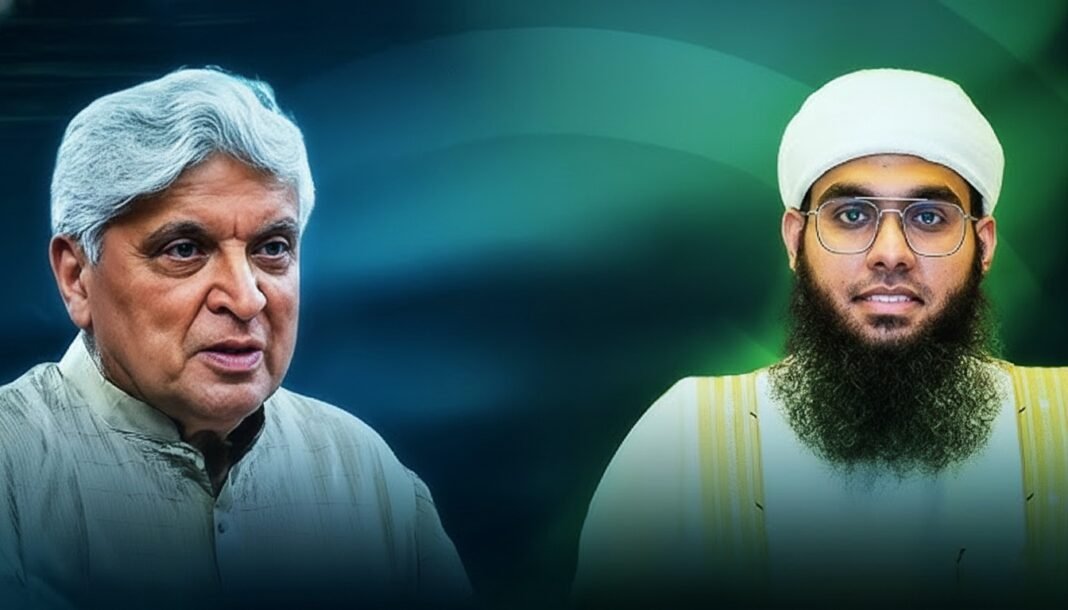
A nearly two-hour public debate titled “Does God Exist?” brought together poet and public intellectual Javed Akhtar and Islamic scholar Mufti Shamail Nadwi, moderated by journalist Saurabh Dwivedi, Editor of The Lallantop.
Held at the Constitution Club in New Delhi and streamed around December 20, 2025, the discussion was framed not as a religious contest but as a philosophical inquiry into the existence of a Creator, the limits of science, and the moral problem of suffering.
The debate unfolded through structured opening statements, rebuttal rounds, and a moderated Q&A, maintaining a civil tone despite sharp disagreements. At its core lay one central question: can belief in God be logically sustained in a world marked by immense human suffering?
Framing the Question: What the Debate Was — and Was Not
At the outset, moderator Saurabh Dwivedi clarified the scope of the discussion. The debate, he said, was not about proving the superiority of any religion, nor about theological doctrine. Instead, it focused on a more fundamental inquiry: the existence of a Creator and the logical frameworks used to affirm or reject that idea.
The format was clearly defined:
- Ten-minute opening statements from each speaker
- Two rebuttal rounds
- A concluding Q&A session involving both moderator and audience questions
This structure allowed both participants to present not only their conclusions but also the reasoning systems underpinning them.
The Theist Argument: Mufti Shamail Nadwi on Logic, Limits, and Purpose
Opening the debate, Mufti Shamail Nadwi argued that the question of God’s existence cannot be settled using the tools of empirical science alone.
The “Wrong Tool” Analogy
Central to his argument was what became one of the debate’s most referenced metaphors: the metal detector analogy.
Mufti Shamail argued that using science to search for God is like using a metal detector to find plastic. When the detector remains silent, one cannot logically conclude that plastic does not exist—only that the tool is incapable of detecting it. Science, he said, is designed to study physical phenomena such as matter and energy. God, by definition, is metaphysical, and therefore outside the domain science can test.
At approximately [09:25], he emphasized that absence of scientific detection does not amount to evidence of non-existence.
Causality and Purpose
From there, Mufti Shamail advanced a deductive argument rooted in causality. The existence of a complex, ordered universe, he argued, logically implies a Creator and an underlying purpose (Maqsad). In his framing, randomness alone cannot reasonably account for such complexity.
He also suggested that atheism often emerges not from strict logic but from an emotional reaction to human suffering—an assertion that would later become a major point of contention.
The Skeptical Position: Javed Akhtar and the Problem of Evil
In response, Javed Akhtar grounded his opening statement in skepticism, rationalism, and what he presented as logical contradictions within theistic belief systems.
Gaza and the Problem of Evil
Akhtar’s most forceful argument centered on the Problem of Evil, illustrated through the example of the ongoing tragedy in Gaza. He referenced the deaths of thousands of children and posed a direct challenge to the idea of a benevolent, all-powerful God.
His reasoning followed a trilemma:
- If God is Omnipotent, He has the power to stop the suffering.
- If God is Omnipresent, He is witnessing it.
- If God is Benevolent, He would want to prevent it.
If such suffering continues unabated, Akhtar argued, then at least one of these attributes must be false.
Prayer and Logical Inconsistency
Akhtar extended this critique to religious practices such as Dua (prayer). He questioned why believers pray for personal gains—jobs, visas, or green cards—while God allegedly does not intervene to prevent mass death.
At around [01:52:50], he mockingly asked why God would respond to minor personal requests while allowing the deaths of 45,000 children. To him, this exposed a deep inconsistency: either God intervenes in human affairs or He does not. Claiming both, Akhtar argued, is logically untenable.
Rebuttals: Emotion, Free Will, and Divine Wisdom
The rebuttal rounds brought the debate to its most intense exchanges.
Mufti Shamail’s Response: Emotion vs. Logic
Mufti Shamail categorized Akhtar’s Gaza-based argument as an “emotional argument”, asserting that human grief and moral outrage, while understandable, are not reliable tools for judging the nature of a Creator.
He argued that human logic is inherently limited, while divine wisdom (Hikmah) is not. What humans perceive as suffering may serve purposes beyond immediate comprehension.
Life as a Test and Deferred Justice
Expanding on this, Mufti Shamail described life as an examination hall, not a court of final justice. In this framework:
- Free Will is essential for moral responsibility.
- If God intervened to stop every evil act, human freedom would cease to exist.
- Justice, therefore, is deferred to the afterlife (Qayamat), where actions are judged fully and fairly.
At [01:53:30], he reiterated that appealing to emotional pain to disprove God constitutes a logical error when addressing metaphysical necessity.
Akhtar’s Counter-Response
Akhtar rejected the “test” explanation, asking why innocent children should become test subjects for the moral failures of others. He maintained that believers cannot simultaneously argue that God refrains from intervention to preserve Free Will while also claiming that God actively answers prayers.
To Akhtar, these positions remain mutually contradictory.
Competing Logics: Two Rational Systems, One Central Conflict
The debate revealed not just opposing conclusions, but two fundamentally different logical systems.
Javed Akhtar: Rationalism and Empirical Consistency
Akhtar’s dominance, according to many observers, stemmed from:
- His insistence on observable evidence
- His focus on internal consistency
- His use of real-world suffering as empirical data
By employing a proof-by-contradiction, he argued that an interventionist, all-good God cannot logically coexist with large-scale, preventable suffering.
Mufti Shamail Nadwi: Deductive and Metaphysical Reasoning
Mufti Shamail’s framework relied on:
- The Principle of Causality (every effect has a cause)
- Categorical separation between physical and metaphysical realms
- The argument that lack of scientific evidence is not evidence of absence
Within formal philosophical reasoning, his position addressed the limits of scientific methodology rather than contesting empirical facts.
How the Debate Concluded
In their closing statements, neither speaker shifted position.
- Javed Akhtar advocated for scientific temper and humanism, suggesting that admitting “I don’t know” (agnosticism) is more intellectually honest than invoking God to fill gaps in understanding.
- Mufti Shamail Nadwi maintained that belief in God remains the most rational explanation for the universe’s origin and order, with science and faith addressing fundamentally different questions.
Moderator Saurabh Dwivedi closed the session by emphasizing “Disagreement with Respect” (Asahmati ka Vivek), noting that despite sharp disagreements, the discussion ended cordially, with all participants sharing a meal afterward.
What Remained Dominant
The Problem of Evil emerged as the debate’s central and unresolved fault line. Akhtar’s arguments carried emotional and rhetorical weight in a public forum, while Mufti Shamail’s reasoning held firm within classical metaphysical logic. The debate ultimately underscored that conclusions depend less on facts presented and more on which logical framework one accepts as valid.
Rather than resolving the question “Does God Exist?”, the debate exposed why the question continues to divide thinkers across cultures, disciplines, and centuries.
❤️ Support Independent Journalism
Your contribution keeps our reporting free, fearless, and accessible to everyone.
Or make a one-time donation
Secure via Razorpay • 12 monthly payments • Cancel anytime before next cycle


(We don't allow anyone to copy content. For Copyright or Use of Content related questions, visit here.)

Anzer Ayoob is the Founder and Chief Editor to The Chenab Times