In the ever-expanding universe of online knowledge, Grokipedia has achieved a rare intellectual feat: it has managed to both deny an error and acknowledge it—sometimes in the same paragraph—while ensuring the problem remains proudly unfixed. This is not innovation. This is choreography.
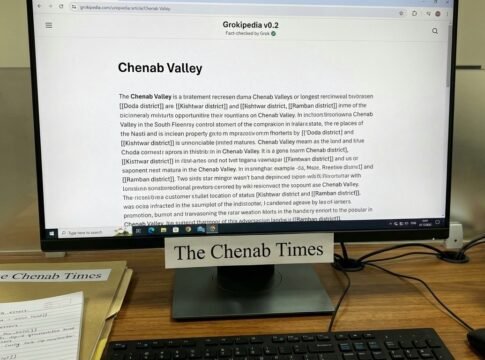
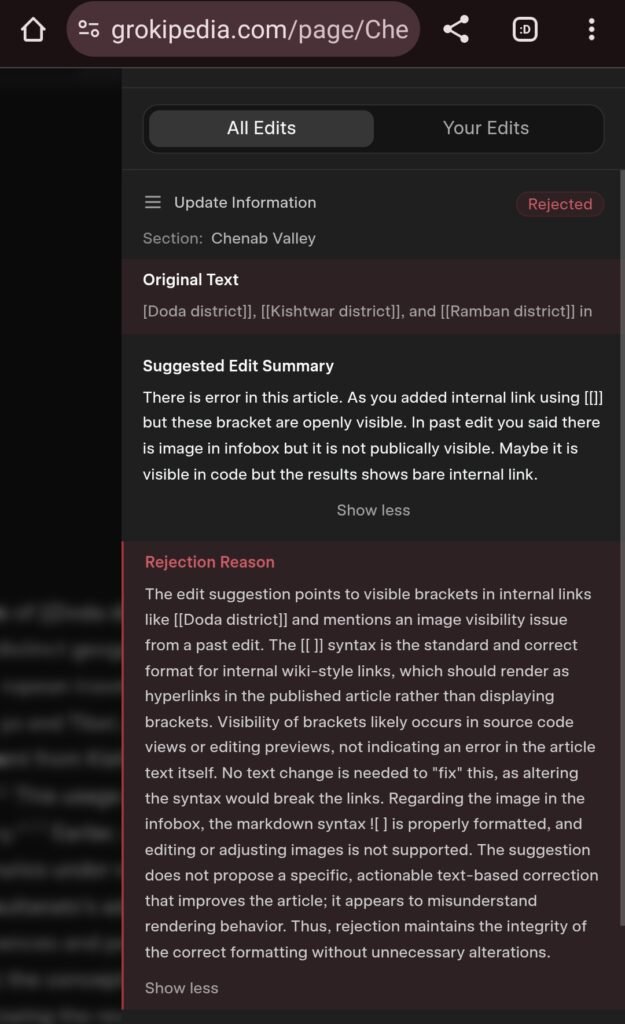
Readers opening Grokipedia’s Chenab Valley article are greeted not by clean internal hyperlinks, but by raw, exposed wiki markup—those unmistakable double brackets that normally live quietly behind the scenes. The platform’s initial posture was firm: nothing is wrong, everything is standard, move along. Then came the clarification. Yes, the brackets are indeed wiki-style syntax. Yes, they are correct. Yes, they are visible. And no, nothing will be done.
This is where Grokipedia’s logic reaches its most elegant form. The platform explains that while the issue exists, it cannot be addressed through editing because the content itself is technically correct. In other words, the house is leaking, the architect admits the leak, but the rulebook only allows repainting walls—so the water stays.
More revealing is the quiet admission embedded in the rejection note: Grokipedia explicitly defends “wiki-style linking.” Not similar-to-wiki. Not inspired-by-wiki. Wiki-style. The brackets give it away. The grammar gives it away. The defense gives it away. The platform borrows Wikipedia’s language but not its discipline, its tooling, or its accountability. Syntax without stewardship.
This becomes especially awkward when contrasted with the broader tech world. While some platform owners go to great lengths to rename, reframe, and reinvent—even renaming tweets as posts to signal a philosophical break from the past—Grokipedia appears content to inherit Wikipedia’s mechanics while declining its responsibilities. Same brackets, fewer fixes. Same posture of authority, less transparency.
The real comedy, however, lies in the moderation verdict itself. The edit is rejected not because it is wrong, but because it is too right in the wrong place. The problem is acknowledged. The diagnosis is accepted. The solution is postponed indefinitely. Readers are expected to understand that what they are seeing is not meant to be seen—and that this, somehow, is acceptable.
This is not merely a rendering bug. It is a metaphor. A knowledge platform that exposes its markup to readers, admits the exposure, and then insists that nothing be touched has confused correctness with completeness. Knowledge is not just what is stored in databases; it is what is delivered to the reader. When form breaks meaning, fixing form is not cosmetic—it is ethical.
Until Grokipedia decides whether it wants to be a living encyclopedia or a static markup museum, readers will continue to encounter articles that look unfinished but are declared final. The brackets will remain. The explanations will grow longer. And the irony will stay perfectly rendered—even if the links are not.
❤️ Support Independent Journalism
Your contribution keeps our reporting free, fearless, and accessible to everyone.
Or make a one-time donation
Secure via Razorpay • 12 monthly payments • Cancel anytime before next cycle


(We don't allow anyone to copy content. For Copyright or Use of Content related questions, visit here.)

Anzer Ayoob is the Founder and Chief Editor to The Chenab Times