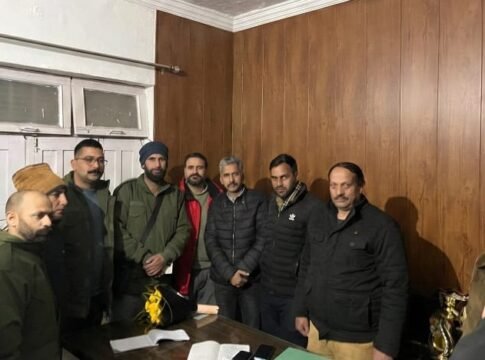
For years, frontline forest field staff in Jammu & Kashmir have been performing some of the most hazardous and technically demanding public duties in the State (now Union Territory)—often without fixed working hours, adequate compensation, or institutional recognition of risk.
Forest Guards and Foresters (Block Forest Officers), who form the backbone of forest protection, wildlife conservation and environmental security, are now seeking redressal of what they describe as long-standing and systemic service-related injustices: pay anomaly, denial of risk allowance, and non-recognition of round-the-clock duties.
24×7 Duties in Hostile Terrain
Unlike most government employees with fixed schedules, frontline forest staff operate continuously—day and night, Sundays and gazetted holidays included. Their work spans vast forest areas, often ranging between 800 and 2,000 hectares, covering multiple villages and remote regions marked by difficult terrain and extreme climatic conditions.
Their responsibilities include forest and wildlife protection, prevention and control of forest fires, anti-encroachment drives, prevention of poaching and illicit felling, surveillance against timber smuggling, and enforcement of forest and environmental laws. Many are also involved in technical tasks such as GPS-based survey and demarcation, geo-referencing, National Forest Inventory (NFI) and Continuous Forestry Inventory (CFI) exercises.
Despite the technical and statutory nature of these duties, Forest Guards and Foresters continue to be officially classified as “non-technical.”
Pay Parity Anomaly
At the core of the grievance lies a pay disparity that forest staff say is both discriminatory and illogical.
Forest Guards were initially placed in Pay Level-2 alongside Village Level Workers (VLWs), Patwaris and Junior Assistants. Over time, the government upgraded the pay levels of VLWs, Patwaris and Junior Assistants to Level-4. Forest Guards, however, remain at Level-2, despite having statutory powers, law enforcement responsibilities, and significantly higher occupational risk.
Foresters, who supervise forest compartments and in many cases function as in-charge Block Officers across multiple tehsils and police jurisdictions, are seeking an upgrade to Level-6.
The comparison is stark: while other cadres with fixed hours and minimal field risk have seen pay progression, forest frontline staff handling law enforcement, fire control and wildlife conflict remain stagnant.
Risk Without Risk Allowance
The nature of forest duty in J&K exposes staff to constant life-threatening situations. These include wildlife attacks, forest fires, confrontations with timber mafias and smugglers, hazardous terrain such as stone-slide zones, and past militant threats in dense forest areas.
Official records of the J&K Forest Department acknowledge the sacrifices involved. As documented in the department’s “Green Hearts” publication, more than 130 forest personnel have lost their lives in the line of duty and are recognised as Forest Martyrs.
Recent fatalities during fire-fighting operations and field duties further underline the risks involved. Yet, frontline forest staff receive no dedicated risk allowance.
The Demand for 2½ Days Additional Salary
Forest Guards and Foresters argue that continuous duty without weekly offs or holiday compensation warrants recognition through a 2½ days additional salary, similar to provisions available in other emergency or essential services.
Currently, despite working through nights, emergencies, fires and holidays, they receive neither overtime compensation nor compensatory leave.
Beyond Pay: Resource Gaps
Adding to the strain is the lack of basic field resources. Uniforms, shoes, rain gear, torches, fuel and communication tools are often arranged by staff from their own salaries. This, they say, leads to financial stress and declining morale in a service already marked by physical danger.
What the Staff Are Seeking
The demands raised by frontline forest field staff across Jammu & Kashmir are focused and specific:
- Rectification of pay anomaly by upgrading Forest Guards from Level-2 to Level-4 and Foresters to Level-6
- Grant of 2½ days additional salary for round-the-clock duties
- Introduction of a risk allowance reflecting the hazardous nature of forest work
- Formal recognition of forest frontline staff as technical personnel
For the staff, the issue is not merely about salaries but about institutional acknowledgment of the risks they shoulder daily to protect forests, wildlife and environmental assets.
As climate pressures, forest fires and human–wildlife conflicts intensify, the question now confronting policymakers is whether those guarding J&K’s forests will continue to do so under a framework that many within the service say no longer reflects ground realities.
❤️ Support Independent Journalism
Your contribution keeps our reporting free, fearless, and accessible to everyone.
Or make a one-time donation
Secure via Razorpay • 12 monthly payments • Cancel anytime before next cycle


(We don't allow anyone to copy content. For Copyright or Use of Content related questions, visit here.)

The Chenab Times News Desk