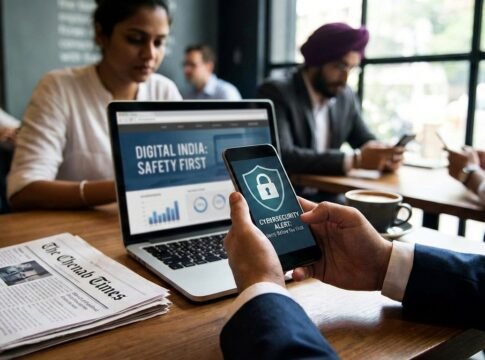
India’s digital life has expanded at a scale unmatched anywhere else. UPI transactions have crossed billions per month, Aadhaar authentication has become routine, and smartphones have reached the remotest villages. This rapid adoption brings convenience, but it also opens the door to financial fraud, identity theft, phishing attempts, SIM swapping attacks, and endless scams that thrive on ignorance and speed. Every Indian—whether a student, professional, senior citizen, or small business owner—now faces the same digital risks. Cybercrime does not target a specific class; it targets opportunity.
In 2026, online scams have become more sophisticated. Fraudsters imitate official helplines, clone customer support pages, manipulate KYC processes, and use AI-generated voices to impersonate family members. A single mistake—clicking the wrong link, sharing an OTP, or ignoring a suspicious message—can drain a bank account within minutes. As more services shift online, digital privacy is no longer an optional skill; it is a survival requirement.
Why India Faces Higher Cybersecurity Risks
India’s digital revolution happened faster than its digital literacy. Millions came online without understanding how cyberattacks work. People freely share personal details, download unverified apps, trust unknown callers, or respond to random “KYC update” messages. This creates perfect conditions for fraud. Scammers exploit gaps in awareness, using the very technologies that were meant to empower users.
UPI, for example, has transformed payment habits, but many still believe that money can be “pulled” from their account if they accept a request. Aadhaar is widely used for verification, yet people casually share photocopies or screenshots without understanding how identity misuse works. Smartphones hold an entire life’s data—photos, documents, passwords, chats—but most users never enable screen locks beyond a four-digit PIN.
Attackers exploit this imbalance. They know most people have no habit of verifying links, checking senders, or identifying social engineering tactics. In rural and semi-urban areas, people often consider every digital interaction legitimate if it contains official logos or government references. Even educated users fall for fraud when urgency or fear is created—especially in cases involving bank accounts, tax warnings, or blocked SIM cards.
The Reality of UPI Fraud in India
UPI’s simplicity is its strength and its weakness. The interface is quick, intuitive, and widely used. But the moment a user misunderstands the difference between “Pay” and “Collect,” they become vulnerable. Fraudsters typically send a “collect request” pretending to pay the victim. Believing money will come into their account, the victim approves the request and unknowingly sends money to the scammer. The problem intensifies because UPI apps store QR codes, contacts, and payment history—anyone with temporary access to the phone can manipulate these features.
Another form of UPI fraud involves fake customer care numbers listed on Google or social media. Scammers create entire support ecosystems—Telegram channels, WhatsApp bots, and websites—to lure confused users who search for help. Once engaged, scammers demand screen-sharing, which gives them full visibility of the victim’s financial apps.
The rate of UPI fraud is likely to rise as digital payments penetrate deeper. The solution lies not in avoiding digital payments, but in understanding how they work. Awareness is the strongest defence.
SIM Swapping: The Silent Threat Most Indians Ignore
SIM swapping is one of the most dangerous forms of identity theft because it bypasses a user’s phone entirely. In this attack, fraudsters convince a mobile operator to issue a duplicate SIM for someone else’s number. Once activated, the victim’s phone loses network, and the attacker receives all SMS-based OTPs. This grants access to bank accounts, UPI apps, email, and social media.
Many Indians assume that SIM-related fraud is rare, but telecom operators regularly warn about growing cases. The vulnerability lies not in the SIM card itself, but in human error—call centre agents who approve requests without proper verification, or individuals who unknowingly reveal personal details that allow scammers to impersonate them.
When a phone suddenly loses network for no reason, people rarely suspect foul play. Most assume it is a network issue. That small delay gives attackers enough time to empty accounts or lock users out of their own data.
Aadhaar Misuse and India’s Identity Problem
Aadhaar is deliberately designed with layered security, but the weakest link is always the user. Identity theft in Aadhaar-related frauds usually occurs because people share Aadhaar numbers or photocopies casually. Scammers use these details to apply for loans, issue SIM cards, or create fake digital identities.
Aadhaar-enabled Payment System (AePS) fraud has also grown. Attackers use fingerprints collected from unsuspecting individuals—often through scams disguised as “free schemes” or “KYC updates”—and carry out withdrawals in rural areas. The victims never know until they check their account.
The solution is awareness: Aadhaar biometric lock, secure sharing practices, and verifying every authentication request. The technology is robust; the user habit is not.
Phishing: India’s Most Common Cybercrime
Phishing remains the oldest and most successful cyberattack in India. Scam emails, cloned websites, fake WhatsApp messages, and SMS alerts claiming “your account is suspended” or “your PAN is blocked” create panic and push users to click harmful links. Attackers steal login credentials, install spyware, or redirect victims to payment portals that mimic original bank pages.
The rise of AI-generated text and cloned voices has made phishing more convincing. Messages now sound authentic. Calls mimic official tones. Fraudsters no longer rely on broken English; they craft messages that appear flawless.
The only defence is scepticism. A link must never be clicked simply because it appears official. Banks do not ask for personal details through SMS. Government agencies do not threaten instant punishment through WhatsApp messages. And no legitimate entity asks for OTPs.
How Indians Can Protect Their Digital Privacy
Digital privacy is not a single action; it is a habit. Most cyberattacks succeed because the victim ignores early warning signs—unusual login attempts, random OTPs, suspicious notifications, unknown app installations, or unexpected “UPI collect” requests. Staying safe means recognising these signals before damage occurs.
Phones must be treated like personal safes. Screen locks, biometric authentication, app locks, and secure backup settings reduce exposure. Public Wi-Fi should never be used for financial transactions because attackers can intercept data. Passwords must be unique and strong—recycling the same password across banking, email, and social media invites disaster.
Two-factor authentication (2FA) must be enabled on every critical service. Banking apps already require it, but email, social media, and cloud storage often leave it optional. Email is the backbone of digital identity; if it is compromised, everything else falls.
Indians must also rethink how they share personal information. Posting phone numbers publicly, sharing Aadhaar copies casually, using unknown apps for scanning documents, installing modded APKs, and clicking unknown links create vulnerabilities. Scammers thrive on scattered digital footprints.
The rise of AI tools makes personal data even more valuable. Deepfake videos, cloned voices, and manipulated images are becoming mainstream. Securing digital identity is no longer optional; it is a necessity.
Recognising Early Warning Signs of Fraud
Every scam produces signals. Sudden network loss could indicate SIM swapping. Multiple OTPs arriving without initiating a login attempt could signal someone trying to access accounts. Unknown devices linked to email or social media accounts indicate unauthorised access. Unexpected “your account will be closed” messages are almost always fraudulent.
Most victims later admit that they ignored subtle signs. A moment of doubt or quick verification would have saved them. Digital habits must evolve to treat every unexpected message, call, or link with suspicion unless verified.
Why Digital Literacy Must Grow With Digital Adoption
India’s digital transformation is impressive, but the pace of adoption has outstripped awareness. Digital literacy programs often focus on technical operations—how to use UPI, how to install apps—but rarely touch on privacy, threat detection, or safe online behaviour. As services shift fully online—banking, taxation, welfare schemes, ticketing, education—the risk of fraud grows.
Cybersecurity must be taught at the school level. Banks and telecom operators need clearer communication strategies. Users must move away from dependency on random “customer care” numbers found on the internet. And government platforms must continue promoting secure digital practices.
The Road Ahead: Building a Safer Digital India
India is moving rapidly toward a future driven by digital identity, instant payments, and online services. With this evolution comes responsibility. Scammers will refine their methods; fraud will not disappear. But awareness, education, and responsible usage can drastically reduce vulnerability.
A safer digital India starts with ordinary users—people who learn to verify before they trust, secure their devices, protect their data, and treat digital platforms with the same seriousness they treat physical assets. Cybersecurity is not a domain reserved for experts. It is a shared responsibility shaped by every individual who participates in the digital ecosystem.
Digital convenience has transformed India. The next step is ensuring that this transformation remains safe for everyone who depends on it.
❤️ Support Independent Journalism
Your contribution keeps our reporting free, fearless, and accessible to everyone.
Or make a one-time donation
Secure via Razorpay • 12 monthly payments • Cancel anytime before next cycle


(We don't allow anyone to copy content. For Copyright or Use of Content related questions, visit here.)

The Chenab Times News Desk