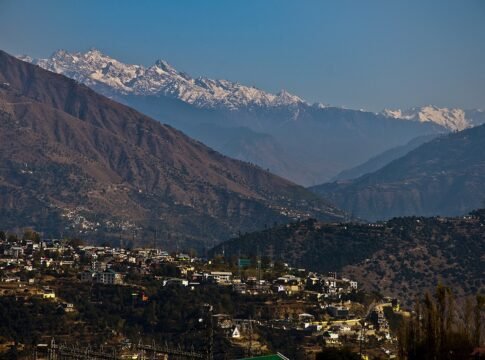
In any kingdom, the capital city was not merely a political headquarters; it was the symbolic heart of sovereignty, administration, culture, and economic control. From the capital, rulers dispensed justice, collected revenue, managed military affairs, and patronized religion and the arts. The choice of a capital was therefore strategic — influenced by geography, climate, security, trade routes, and accessibility.
In mountainous regions especially, several principalities adopted a seasonal administrative shift between two capitals — one for summer and another for winter. This was not a modern innovation but a practical response to environmental realities. Harsh winters in high-altitude regions often made governance difficult due to heavy snowfall, blocked passes, and limited communication. Therefore, rulers relocated to lower-altitude towns during the winter months to ensure smoother administration, military mobility, and economic continuity.
Since 1872, Jammu and Kashmir followed a seasonal capital system, with Jammu serving as the winter capital and Srinagar as the summer capital. Instituted during Dogra rule under Maharaja Ranbir Singh, the Darbar began shifting between the two cities — a practice later known as the “Darbar Move.”
Some may assume that this practice began during the British period or that it is a modern administrative concept. However, in Kashmir, its roots are much older. References in classical texts such as the Rajatarangini by Kalhana and the Nilamata Purana indicate that seasonal shifts in political centers were known in early Kashmir.
Kalhana writes that in ancient times, Poonch functioned as the winter capital of Kashmir during the reign of King Abhimanyu. Some scholars suggest that his winter seat may have been located in Rajouri instead, but the broader idea of seasonal relocation remains evident.
Winter Capital of Kishtwar
It is said that Doda’s ancient name was Nagri, and it once served as the capital of the Saraz region. Saraz later lost its separate political identity after it was annexed by Kishtwar, and the area subsequently came under the control of the Kishtwar rulers.
According to historian D. C. Sharma, “Doda used to be the winter capital of the Kishtwar Rajahs.” Similarly, Mohan Lal Aash, in his book Cultural History of Doda, J&K, writes:
“Doda: Winter capital for kings of Kishtwar, principal city of Siraj.”
He further mentions that Raja Sujjan Singh (1778–81) constructed a fort at Doda specifically for use as his winter capital.
Why Was Doda Chosen?
The reason lies primarily in geography and altitude. Much of Kishtwar consists of high-altitude terrain. Kishtwar town itself stands at approximately 1,600 meters above sea level — comparable to the altitude of the Kashmir Valley plains. Doda, however, lies at around 1,100 meters, creating a difference of nearly 500 meters.
This relatively lower elevation meant milder winters, reduced snowfall, and better accessibility. For a ruler, this ensured uninterrupted governance, easier movement of troops, and continued communication with surrounding regions. Thus, climatic and topographical factors directly influenced the decision to designate Doda as the winter capital.
Aftermath
In 1821, Kishtwar was annexed by the Dogra rulers, and its last ruler, Mohammad Tegh Bahadur, was taken into custody and imprisoned in Lahore. Following its incorporation into the Dogra state, Kishtwar was reorganized administratively as a tehsil under Udhampur. It later became part of Doda district in 1948 and was finally elevated to the status of a separate district in 2007–08.
Therefore, the practice of maintaining separate summer and winter capitals in the region is not merely a colonial or modern administrative device — it is deeply rooted in the historical and geographical realities of the Himalayan polity.
❤️ Support Independent Journalism
Your contribution keeps our reporting free, fearless, and accessible to everyone.
Or make a one-time donation
Secure via Razorpay • 12 monthly payments • Cancel anytime before next cycle


(We don't allow anyone to copy content. For Copyright or Use of Content related questions, visit here.)
Firdous Ahmad Lone is a contributor to The Chenab Times and a postgraduate student of History whose research focuses on Kashmir’s past, its rich folklore traditions, and the region’s linguistic heritage.