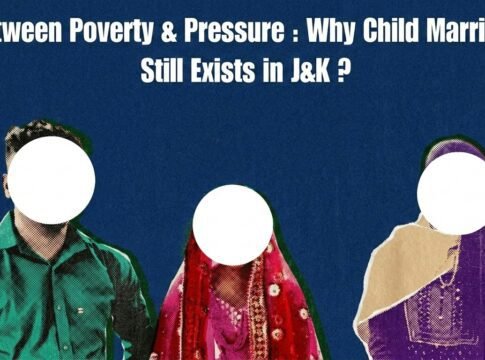
Child marriage may be declining in official records, but on the ground it continues to shape the lives of many girls. In parts of Jammu and Kashmir — particularly in rural and economically marginalised communities — early marriage has not disappeared. According to the National Family Health Survey (NFHS-5, 2019–21), around 5% of women aged 20–24 in Jammu and Kashmir were married before the legal age of 18, a drop from previous years. The median age at first marriage for women aged 25–49 now stands at 23.6 years, reflecting gradual improvement.
The numbers show progress, but statistics alone cannot reveal the emotional cost carried by girls whose education and childhood end prematurely.
A Visit to Village Korga, Dansal (Jammu)
During field visits to one of the most backward rural pockets of Jammu district — Village Korga in Dansal — we met a young woman who agreed to share her story. She had been a student at Government Girls School, Korga, studying in Class 11. As the eldest child, she carried responsibilities far beyond her age. Her younger sister, 15, is speech-impaired, and her brother is 13.
She remembered the day everything changed.
“One day after school, I came home and saw everyone smiling at me,” she said. “I asked my mother what had happened. She replied, ‘We have fixed your marriage.’ My father then showed me the groom’s photo.”
When she saw the picture, she froze.
“He looked my father’s age. He was 37 — almost double my age. I went into shock. I left the kitchen and went to my room. That night, I cried a lot. I had dreams for my life. I wanted to study, maybe go to college. But everything collapsed in that moment.”
When she asked her mother why such a decision was taken, her mother broke down and said, “I don’t know how many years I will live. Before I die, I want to marry you with my own hands.”
Her father struggled with alcohol and smoking and rarely cared about the children. Her mother worked in households to earn whatever she could. Poverty and insecurity shaped every decision.
“I accepted it after that. I never asked again,” she said quietly.
Poverty, Pressure, and Silence
The family couldn’t afford the wedding. They sought assistance from the Shri Mata Vaishno Devi Shrine Board, which provided financial support. The government’s marriage assistance scheme gave them ₹50,000. Neighbours contributed ration and small household items.
“No one came to ask why they were marrying me at this age,” she said. “No one questioned it.”
She recalled another painful moment on the wedding day.
“The groom asked for a gold ring. We didn’t have money even for basic expenses. My mother somehow arranged it. I left my home with many questions in my heart.”
She became a mother at 18. Today, she has a baby girl.
“Life goes on,” she said, her voice cracking. “But sometimes I think — if I had been born in a rich family, maybe I would be in college now.”
At that point, tears rolled down her face, and the interview had to stop.
Why Early Marriage Still Happens
Her experience reflects harsh realities still present in some communities:
• Poverty: Families struggling for survival often see marriage as reducing responsibility.
• Parental insecurity: Illness or fear of the future pushes parents to marry daughters early.
• Addiction and neglect: Substance abuse among fathers leaves mothers to make desperate decisions.
• Silence of society: Neighbours and relatives avoid intervening.
• Cultural pressure: Marriage is prioritised over education, especially for girls.
Awareness campaigns under initiatives like Bal Vivah Mukt Bharat and Beti Bachao Beti Padhao are active in many villages of the Jammu division. Departments and NGOs conduct seminars on the legal age of marriage, the importance of consent, and the dangers of teenage pregnancy. These efforts have helped reduce rates, yet stories like the one from Korga show how slow social change can be.
The Larger Context
Historically, child marriage has been more prevalent in rural India. A 2009 report by the Registrar General of India recorded higher rates in states like Jharkhand, West Bengal, Bihar, Uttar Pradesh, and Assam. Jammu and Kashmir reports comparatively lower numbers today, but isolated cases still occur.
The concern isn’t just the age of marriage. It’s the power imbalance, the lack of consent, and the emotional trauma. When a 16-year-old girl is married to a man twice her age, the issue becomes one of lost childhood and denied agency.
Moving Forward
Reducing child marriage further requires continuous, consistent effort:
• Ongoing community dialogue: Parents need repeated engagement, not one-time lectures.
• Strengthening school retention: Girls must be supported to complete higher secondary and pursue college.
• Economic support for vulnerable families: Poverty pushes early marriage more than culture does.
• Encouraging intervention: Silence from neighbours and relatives must stop.
• Listening to girls: Consent must be real, not symbolic or forced.
NFHS-5 shows that Jammu and Kashmir is moving in the right direction. The challenge is making sure progress reaches every household.
As the young woman from Korga said before we left, “If parents understand what early marriage does to a girl’s life, they will think differently.”
Her voice represents countless others who never get the chance to speak.
Disclaimer: To report a child marriage, call Childline 1098 or Police Helpline 100.
The author is a contributor to The Chenab Times. This report was filed by him under Population First’s Laadli Media Fellowship 2026.
❤️ Support Independent Journalism
Your contribution keeps our reporting free, fearless, and accessible to everyone.
Or make a one-time donation
Secure via Razorpay • 12 monthly payments • Cancel anytime before next cycle


(We don't allow anyone to copy content. For Copyright or Use of Content related questions, visit here.)