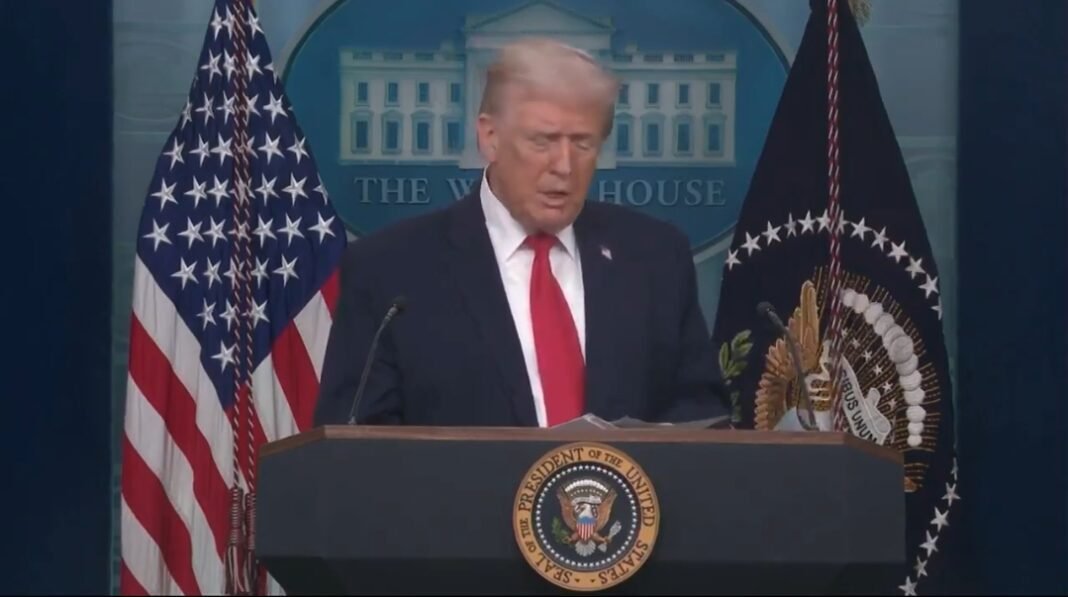
President Donald Trump has intensified his criticism of European allies regarding maritime security in the Strait of Hormuz and access for American aircraft, urging the United Kingdom to independently secure its oil resources.
The Chenab Times has learned that the president’s sharp remarks followed recent reports indicating that several European nations were increasing restrictions on American flights traversing their airspace. This diplomatic friction adds another layer to ongoing international discussions about security in the crucial waterway that connects the Persian Gulf to the open sea.
The Strait of Hormuz is a vital chokepoint for global oil shipments, with a significant portion of the world’s crude oil passing through it daily. Concerns over the potential disruption of these shipments, particularly from Iran, have led to increased international attention and naval presence in the region. The United States has been a leading proponent of forming a maritime coalition to ensure freedom of navigation and deter any aggressive actions by Iran.
President Trump’s public pronouncements have often been direct and unvarnished, a characteristic style that has frequently characterized his foreign policy approach. His latest comments suggest a growing impatience with what he perceives as insufficient support from European partners in addressing regional security challenges and upholding international maritime law. The specific mention of the United Kingdom and its need to “get its own oil” signals a desire for individual nations to take more direct responsibility for their energy security and contribute more robustly to collective defense efforts.
The tensions appear to be multifaceted, encompassing both military security in the Strait of Hormuz and broader bilateral or multilateral aeronautical agreements. Restrictions on American aircraft in European airspace, if confirmed and widespread, could be interpreted as a retaliatory or cautionary measure by those countries, potentially in response to broader geopolitical disagreements or specific trade disputes. Such actions can have tangible implications for diplomatic relations, military logistics, and commercial air travel.
The administration has consistently advocated for a unified front among its allies to counter what it describes as destabilizing activities in the Middle East. However, the differing national interests and strategic priorities of various European countries can lead to varied approaches to such complex international security issues. While the U.S. has pushed for a robust, perhaps militarized, response to potential threats in the Strait, some European nations have favored diplomatic solutions and de-escalation, seeking to maintain open channels of communication with Iran.
President Trump’s latest public commentary underscores a potential divergence in strategy and commitment between the United States and its European allies. This divergence could pose challenges for the effectiveness of any international coalition aimed at ensuring security and stability in the Persian Gulf region. The president’s direct appeals to specific allies, like the UK, also indicate an effort to galvanize support and potentially exert pressure on those countries to align more closely with U.S. objectives.
The context of these remarks also involves the broader geopolitical landscape, including the ongoing tensions between the U.S. and Iran, the repercussions of U.S. withdrawal from the Iran nuclear deal, and the role of international sanctions. European nations, while sharing concerns about Iran’s ballistic missile program and regional influence, have largely sought to preserve the nuclear deal and maintain economic ties, creating a point of contention with Washington. The Strait of Hormuz issue is thus intertwined with these larger diplomatic and economic considerations.
The implications of President Trump’s statements extend beyond the immediate concerns of maritime security and airspace access. They highlight the evolving dynamics of transatlantic relations and the challenges of maintaining allied unity in the face of diverse national interests and evolving global threats. The president’s direct and often confrontational style of diplomacy continues to shape international discourse and influence the conduct of foreign policy among both allies and adversaries.
Further developments are anticipated as European nations respond to the president’s latest remarks and as the U.S. continues its efforts to build consensus on regional security strategies. The administration’s emphasis on burden-sharing and independent national responsibility for securing critical resources, such as oil, signals a potential shift in the traditional frameworks of international cooperation and mutual defense.
❤️ Support Independent Journalism
Your contribution keeps our reporting free, fearless, and accessible to everyone.
Or make a one-time donation
Secure via Razorpay • 12 monthly payments • Cancel anytime before next cycle


(We don't allow anyone to copy content. For Copyright or Use of Content related questions, visit here.)

Global Affairs Desk at The Chenab Times covers international developments, global diplomacy, and foreign policy issues through fact-based reporting, explainers, and analytical pieces. The desk focuses on major geopolitical events, diplomatic engagements, and international trends, with an emphasis on verified information, multiple perspectives, and contextual understanding of global affairs.