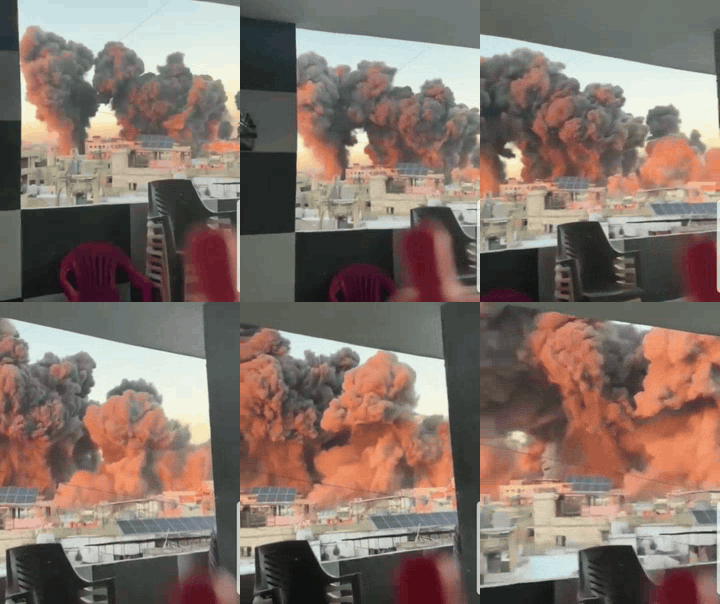
The Israeli military announced on Saturday that its forces killed several members of the Hezbollah group during an operation in southern Lebanon. The announcement followed an overnight clash in the Ali Taher Ridge area, a region where the military has been monitoring a significant Hezbollah tunnel system.
According to a statement from the Israel Defense Forces (IDF), an Israeli combat officer was moderately injured during the engagement and subsequently received medical treatment. The IDF stated that its forces carried out a strike that eliminated the Hezbollah fighters after the gunfight. There was no immediate comment from Lebanese authorities or Hezbollah regarding the reported incident.
The Ali Taher Ridge area, near Nabatieh, has been a focus of Israeli military attention due to the suspected presence of dozens of Hezbollah operatives within an extensive tunnel network beneath the ridge. However, reports indicate that a ceasefire agreement has prevented the IDF from fully capturing these underground passages. Despite these restrictions, Israel has continued to operate in other parts of southern Lebanon.
This latest reported exchange of fire comes amidst an ongoing escalation of tensions along the Israel-Lebanon border. In late June 2026, a US-sponsored framework agreement aimed at ending hostilities was signed by Lebanon and Israel. This agreement reportedly included provisions for the Lebanese army to disarm Hezbollah. However, high-intensity fighting reportedly continued until June 20, 2026, despite the initial cessation of hostilities agreed upon on April 16, 2026.
The conflict between Israel and Hezbollah, which has intensified since the October 7, 2023, attacks on Israel by Hamas, is part of a broader regional conflict. Hezbollah launched strikes against Israel in solidarity with Palestinians following the Gaza war. The conflict has precipitated a humanitarian crisis in Lebanon, with reports indicating over 4,000 deaths from Israeli strikes and the displacement of more than one million people by March 2026.
The IDF has previously conducted operations aimed at degrading Hezbollah’s capabilities. In late May 2026, the IDF reported expanding ground operations in parts of southern Lebanon, extending beyond the designated security zone. These operations, alongside intensified Israeli Air Force (IAF) airstrikes, aimed to push Hezbollah forces farther north and reduce the threat of drone attacks on northern Israeli communities. Reports indicated that troops were conducting targeted raids north of the Litani River, focusing on areas where Hezbollah maintained infrastructure.
Hezbollah, designated as a terrorist organization by the United Kingdom, has been accused of re-establishing itself in southern Lebanon. The Lebanese government agreed to a plan to disarm Hezbollah in 2025, and by January 2026, the Lebanese Armed Forces (LAF) had reportedly established “operational control” over parts of southern Lebanon. Following Hezbollah’s attacks on Israel in March 2026, the Lebanese government banned military activity by the group and requested the Iranian ambassador to leave the country.
Historical context of the conflict includes Operation Northern Shield (2018-2019), an Israeli military operation to locate and destroy Hezbollah tunnels crossing the Blue Line from Lebanon into northern Israel. More recently, Operation Northern Arrows, conducted in early 2026, targeted Hezbollah’s military infrastructure across Lebanon, resulting in numerous strikes and the elimination of thousands of Hezbollah operatives, including senior commanders.
International efforts have been made to de-escalate the situation. The UK has called for the swift implementation of UN Security Council Resolution 1701, which aims to maintain a weapons-free zone in southern Lebanon and calls for the disarmament of all armed groups. However, UNIFIL, the United Nations Interim Force in Lebanon, has been criticized for failing to prevent Hezbollah’s buildup in southern Lebanon.
The conflict has had significant humanitarian consequences. Rising levels of food insecurity have been projected in Lebanon, affecting a substantial portion of the population. Meanwhile, in northern Israel, most of the civilians evacuated during previous conflicts have reportedly returned to their homes.
❤️ Support Independent Journalism
Your contribution keeps our reporting free, fearless, and accessible to everyone.
Or make a one-time donation
Secure via Razorpay • 12 monthly payments • Cancel anytime before next cycle


(We don't allow anyone to copy content. For Copyright or Use of Content related questions, visit here.)

Global Affairs Desk at The Chenab Times covers international developments, global diplomacy, and foreign policy issues through fact-based reporting, explainers, and analytical pieces. The desk focuses on major geopolitical events, diplomatic engagements, and international trends, with an emphasis on verified information, multiple perspectives, and contextual understanding of global affairs.