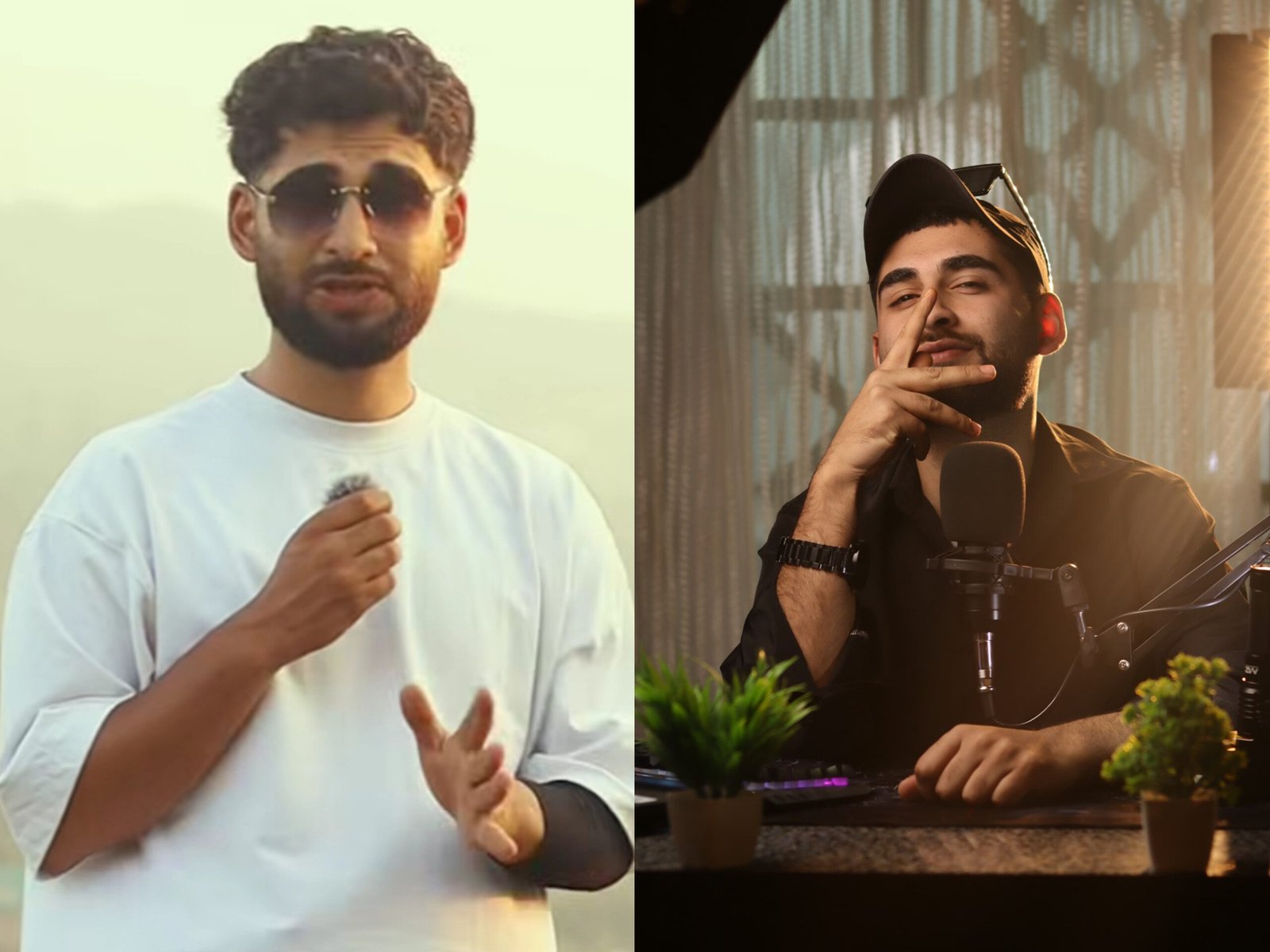
In the quiet dawn of Baramulla, before the Pir Panjal shakes off its fog and the river Jhelum finds its silver light, Nayeem Mir leans out of his window. The streets below his home in Dardpora village are empty, the morning air brisk, and the silence sits heavy—like a presence, not an absence.
“This,” he says, nodding toward the river that cuts through the town, “is where I learned everything—about pain, about beauty, about silence. And it’s the same place I am trying to heal, one story at a time.”
At 24, Mir carries ambitions that stretch far beyond his modest room. In a valley where stories are often trapped in the language of conflict, his mission is radical in its simplicity: to tell stories of Kashmir that mend, rather than wound.
The Backbencher Who Spoke Through a Diary
Mir’s childhood unfolded in a house where dreams often bent beneath the weight of modest means. At school, he was not the boy raising his hand with answers, but the one sinking into the back row. “Depression, anxiety, bullying—they were all part of my school life,” he recalls. His voice is steady, but his eyes betray memories of bruises that no classroom wall could hide.
At 13, he found an escape in poetry. He chose the pen name Afnaan and filled a diary with Urdu verse. He titled it Mein Tanha—“I Am Alone.”
It was more than a notebook; it was a secret lifeline. “I would write for hours. It was the only place I could be completely honest,” Mir says. He still remembers telling a classmate one afternoon: This place will kill my dreams. I want something bigger.
The first thing he ever shared publicly was not a poem, but a hand-written note slipped under his cousin’s door. On it he had scribbled a question: Did you like the song I recorded? He laughs when he tells the story. “It was awkward, yes. But I think I’ve always needed feedback to keep going.”
Beats, Frames, and the First Breakthrough
By 2019, with a broken phone and a restless dream, Mir uploaded his first rap track to YouTube under the name Axstar. “Friends mocked me,” he says with a shrug. “But at least I tried.”
The shift from music to film happened by accident, or perhaps necessity. When he enrolled in a multimedia and mass communication course in 2020, he began experimenting with short films.
His first big project, Schizophrenia – The Misunderstood, confronted the stigma of mental illness. It went on to win first prize at Sarhad’s inaugural J&K International Film Festival. “That film wasn’t just for the audience,” he says. “It was for the 13-year-old me, who needed someone to say mental illness is real and it matters.”
Then came When It’s Too Late, Kashmir’s first post-apocalyptic short film. With special permission, he and a handful of friends filmed in public squares, turning familiar lanes into landscapes of imagined catastrophe. “We wanted to prove we could tell world-class stories right here, without leaving home,” Mir explains.
By 2023, every rupee he had saved—around ₹20,000—went into a new film called Come Home. Alongside, he began documenting child labor in Kashmir, an experience that left him both shaken and resolute. Around that time, he met Anzar Bashir, another aspiring filmmaker. “We just clicked,” Mir says. “Same vision, same hunger.”
The Laptop That Died, and a Dream Almost Buried
The momentum crashed with a machine. One morning, Mir’s laptop refused to start. Three years of work—scripts, footage, edits—were gone. “I felt like my entire journey had burned to ashes again,” he says. He tried everything: technicians, forums, even dubious data-recovery schemes that left him scammed and broke.
What saved him was a single sentence from Bashir: Bro, let’s begin again. Nothing’s broken yet.
He pulls out a sketchbook from a drawer as he remembers that moment. It’s filled with rough charcoal drawings. “Not many people know this,” he says softly. “But before poetry, before cameras, I drew. That’s how I first learned to tell stories—with shadows.”
Family, Illness, and the Long Pause
Just as Mir began to rebuild, another curveball came: his grandmother was diagnosed with cancer. “Work didn’t matter then,” he says. “Family came first.”
Months slipped away in hospital corridors. Nights were spent half-awake, reading travel blogs to escape. “I’ve never left Kashmir,” he admits. “But I’ve visited a hundred cities in my head. Someday, I’ll film in Istanbul.”
By mid-2024, with his grandmother stable, he and Bashir scraped together money through odd jobs—weddings, advertisements, small shoots. Eventually, they bought their first camera. “No studio, just my bedroom,” Mir recalls. “But we had the fire.”
Thirty Days, Thirty Reels
On February 15, 2025, the pair posted their first Instagram reel. Weeks later, with Ramadan approaching, they set themselves a challenge: 30 reels in 30 days.
“It was exhausting,” Mir admits. “But life-changing.”
The experiment struck a chord. Within weeks, their following surged to 10,000. By August 11, the number stood at 74,000. “The numbers weren’t the point,” he says. “The messages were. People wrote to us saying our videos gave them hope to keep living.”
One message, he recalls, came from someone who had once shared his classroom. “They said they remembered me as the boy who never spoke. Now I’m the one speaking to thousands. Life’s funny like that.”
Stories that Hold a Mirror
Today, their Instagram presence is anchored by three series:
- Rooh – “for the ones who feel invisible.”
- Aayina – “to hold a mirror to society’s problems.”
- K-Town Tales – “a journey into Kashmir’s untold stories.”
Each is a blend of cinematic visuals and grounded detail. A shop sign from his neighborhood. The smell of kangri charcoal in winter. Children’s games from the lanes of Dardpora.
“If I can’t make you feel Kashmir,” Mir says, “I haven’t done my job.”
Beyond the Screen
The impact often goes beyond art. “I’ve had people tell me our videos stopped them from ending their life,” he says, his voice soft. “You don’t forget that.”
Few know his private ritual before filming: listening to a Kashmiri lullaby his grandmother once sang. “It reminds me why I tell stories—to protect memories before they vanish.”
His mission, he insists, is larger than algorithms or festivals. “My aim is to ensure Kashmir is remembered for its beauty, its culture, its people—not just the headlines.”
The Will to Begin Again
Looking out at the Jhelum, Mir reflects on the arc of his journey—from a diary titled I Am Alone, to a broken laptop, to reels that reach millions.
“Life can erase your work,” he says. “But it can’t erase your will to start again.”
Beside him, Bashir grins. “And maybe it can’t erase two stubborn dreamers either.”
For Mir, success is measured not in views but in messages—from Kashmiris abroad who rediscover home through his films, or from neighbors who say they’ve learned something new about their valley.
His stories, he hopes, are small stitches in a fabric long torn. Proof that in a place often defined by conflict, there is still room for beauty, for resilience, for the healing that comes when someone dares to tell a story.
❤️ Support Independent Journalism
Your contribution keeps our reporting free, fearless, and accessible to everyone.
Or make a one-time donation
Secure via Razorpay • 12 monthly payments • Cancel anytime before next cycle


(We don't allow anyone to copy content. For Copyright or Use of Content related questions, visit here.)