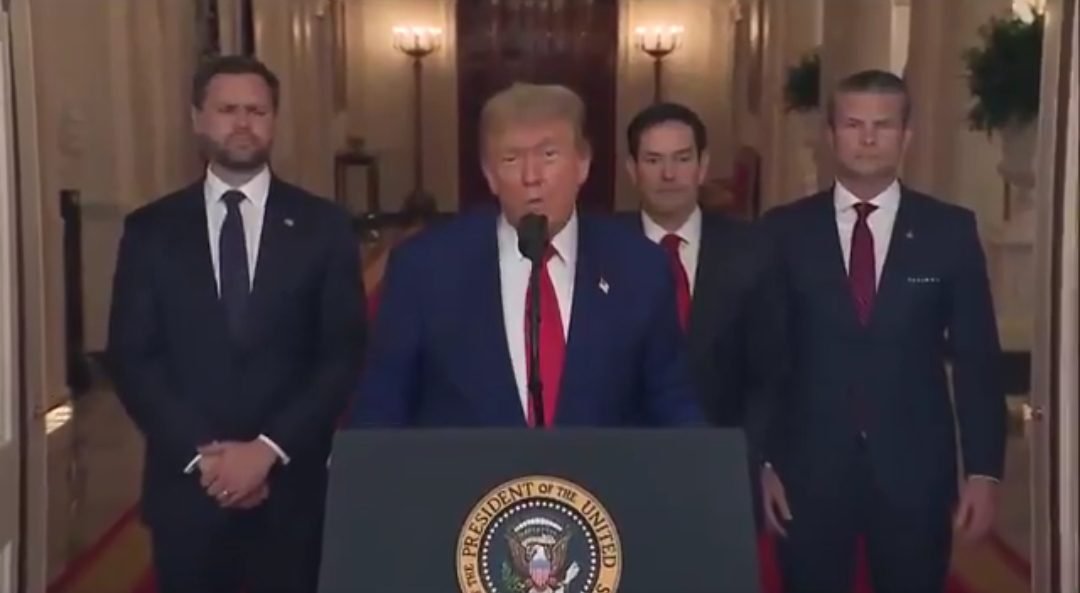
Washington/Tehran – In a dramatic escalation of tensions in West Asia, the United States on Sunday carried out airstrikes targeting three key Iranian nuclear sites at Fordow, Natanz, and Isfahan, with President Donald Trump hailing the operation as a “spectacular military success.”
Addressing the nation shortly after the strikes, Mr. Trump asserted that the mission had “obliterated” Iran’s nuclear enrichment capabilities and warned that future strikes would be “far greater” if Tehran did not yield to U.S. demands for peace.
“Our objective was the destruction of Iran’s nuclear enrichment capacity and a stop to the nuclear threat posed by the world’s number one state sponsor of terror,” the U.S. President said. Flanked by Vice President JD Vance, Secretary of State Marco Rubio, and Defence Secretary Pete Hegseth, Mr. Trump claimed that the operation represented one of the most significant military strikes in decades.
The Iranian government confirmed the attacks but sought to downplay their impact. Officials stated that the Fordow facility had been evacuated long ago and suffered only surface-level damage. Iran’s Atomic Energy Organization reported that no radioactive contamination was detected at any of the targeted sites, a claim also echoed by Saudi Arabia, which said no abnormal radiation levels were recorded in the Gulf region.
Strikes Follow Israeli Campaign
The strikes come amidst heightened hostilities following an Israeli offensive against Iranian positions on June 13. Israeli Prime Minister Benjamin Netanyahu, under indictment by the International Criminal Court for alleged war crimes in Gaza, lauded the U.S. operation as a “bold decision” and affirmed that the attacks had been executed in “full coordination” with Israel.
“In full operational coordination between the IDF and the United States military, the U.S. attacked Iran’s three nuclear facilities,” Mr. Netanyahu said in a statement, claiming the operation fulfilled a longstanding Israeli commitment to neutralise what it views as an existential threat.
The Israeli Airports Authority subsequently announced a closure of Israeli airspace “due to recent developments,” although land crossings with Egypt and Jordan remained operational.
Criticism and Constitutional Questions
The strikes have provoked sharp criticism from multiple quarters. Hakeem Jeffries, House Democratic Leader, accused Mr. Trump of bypassing congressional approval and warned that the risk of a broader regional war had “dramatically increased.” He asserted that Mr. Trump “shoulders complete and total responsibility” for any consequences.
Similarly, DAWN, a U.S.-based advocacy group founded by slain journalist Jamal Khashoggi, called the strikes “unprovoked and unauthorized,” alleging they violated both international law and the U.S. Constitution.
Military analysts have also cautioned against the assumption that such strikes would lead to peace. Harlan Ullman, Chairman of the Killowen Group, compared the move to previous U.S. interventions, including the 1964 Gulf of Tonkin incident and the 2003 invasion of Iraq. “History has shown that such decisions often backfire,” he told Al Jazeera.
Iranian Response and Regional Implications
While the full extent of the damage remains unclear, Iranian authorities maintain that the country’s nuclear programme remains intact. Manan Raisi, a parliamentarian representing Qom—where the Fordow facility is located—claimed the damage was “superficial” and “restorable.”
Shahram Akbarzadeh, Director of the Middle East Studies Forum at Deakin University, warned of retaliatory action from Iran’s regional allies. “There are so many Iranian allies and proxies who may not wait for an official order from Tehran,” he noted, raising fears of a widening regional conflict.
Yemen’s Houthi movement has already issued a warning that the strikes on Iran mark “not the end of the war, but the beginning,” holding the U.S. responsible for the consequences.
UN Chief Warns of ‘Catastrophic Consequences’
UN Secretary-General Antonio Guterres described the strikes as a “dangerous escalation” that could spiral out of control. In a statement, he urged all parties to exercise maximum restraint, warning of “catastrophic consequences for civilians, the region, and the world.”
The full implications of the strikes remain uncertain, with officials on all sides offering conflicting accounts of the operational outcomes. What is clear, however, is that the situation in West Asia has entered a new and perilous phase, with the potential for a wider military confrontation now a very real possibility.
Further briefings are expected from U.S. defence officials later on Monday, as both the White House and Pentagon continue to monitor the fallout from one of the most consequential U.S. military actions in recent memory.
With inputs from agencies
❤️ Support Independent Journalism
Your contribution keeps our reporting free, fearless, and accessible to everyone.
Or make a one-time donation
Secure via Razorpay • 12 monthly payments • Cancel anytime before next cycle


(We don't allow anyone to copy content. For Copyright or Use of Content related questions, visit here.)

The Chenab Times News Desk