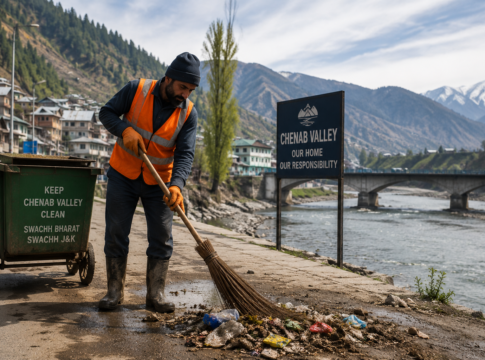
In the bustling towns and quiet villages of Jammu and Kashmir, the day often begins before dawn for one set of workers: sanitation workers. They sweep our streets, unclog our drains, remove the filth we ourselves generate, and stand as the first line of defence against epidemics. Yet, even as we rely on them to keep our surroundings habitable, we rarely acknowledge their rights, dignity, or safety.
An honest discussion about sanitation in Jammu and Kashmir in general, and the Chenab Valley in particular, cannot stop at blaming “the authorities” or “the system.” It must confront our own civic sense, our constitutional obligations, and the way we collectively treat those who handle our waste.
Sanitation Workers: Essential Yet Invisible
Sanitation workers are among the most essential public health workers in the country.
Their daily labour prevents the outbreak of diarrhoeal diseases, vector-borne illnesses, and other infections that thrive in filth and stagnant water. When drains are cleaned before the monsoon or garbage is removed from lanes, it is not merely “cleaning”; it is disease prevention and life protection.
Despite this, many sanitation workers face hazardous working conditions: lack of safety gear, exposure to toxic gases, manual handling of waste, and social stigma tied to caste and class. The recurring strikes by sanitation workers in many towns and cities of Jammu and Kashmir—including smaller regions like the Chenab Valley—are not acts of irresponsibility but cries for fair wages, timely payment, basic protective equipment, and respect.
When the streets fill with garbage during such strikes, it simply exposes how silently and efficiently they usually work, and how dependent we are on them.
It is unfortunate that those in the corridors of power in Jammu and Kashmir—whether PDP, NC, or BJP—have failed to address the genuine demands of these people. Even the bureaucracy, whose filth they clean every day and whose offices they make presentable, appears hard of hearing when it comes to the cries of marginalised sanitation workers.
One hopes better sense prevails and the grievances of the poor are redressed in the future.
The Community’s Role: Civic Sense Cannot Be Outsourced
It is tempting to view cleanliness as a “municipal responsibility” alone. But no municipal body, however efficient, can keep a town clean if its citizens litter indiscriminately, dump waste into drains, or throw plastic and household refuse into rivers and streams.
Overflowing drains are often the direct result of our own behaviour: plastic bags, bottles, construction debris, and kitchen waste choked into the very channels meant to carry away stormwater and sewage. When these drains overflow, we blame the sanitation department, rarely pausing to see what is actually blocking the flow.
Civic sense begins at the doorstep: segregating waste at home, using designated dustbins, avoiding single-use plastics, not spitting or urinating in public, and respecting the work of sanitation staff. Every wrapper thrown on the street is not just a personal act; it is a social cost that someone else—usually a poorly paid sanitation worker—will have to bear, often at risk to their health.
Constitutional and Legal Foundations of Cleanliness
Cleanliness is not just a moral or cultural value; it has deep roots in our constitutional and legal framework. The Supreme Court has consistently interpreted the right to life under Article 21 of the Constitution to include the right to a clean and healthy environment. A polluted, garbage-strewn, insanitary environment undermines that fundamental right.
Articles 47 and 48A of the Directive Principles of State Policy emphasise the State’s duty to improve public health and protect the environment. Article 51A(g) makes it a fundamental duty of every citizen to protect and improve the natural environment, including forests, lakes, rivers, and wildlife, and to have compassion for living creatures.
When citizens dump waste in rivers or along their banks, they violate not only environmental laws but also this constitutional duty.
Courts have also repeatedly intervened to protect sanitation workers. Judicial pronouncements have condemned manual scavenging as a violation of dignity and fundamental rights, leading to laws such as the Prohibition of Employment as Manual Scavengers and Their Rehabilitation Act, 2013. The judiciary has called for mechanisation of sewer cleaning, provision of safety gear, and accountability when workers die in sewers or septic tanks. These judgments affirm that the lives of sanitation workers are not expendable—they are protected by the same Constitution that safeguards every citizen.
Thus, both the State and the citizen are bound—legally and morally—to ensure clean surroundings and dignified conditions for those who maintain them. The right to a clean environment for all cannot be separated from the right to safe, dignified work for sanitation workers.
Shared Responsibility: When Communities and Authorities Work Together
Examples from different parts of India show that when communities and authorities collaborate, real change is possible. In several villages and towns, residents’ welfare associations, panchayats, and local NGOs have worked with municipal bodies to introduce door-to-door waste collection, segregation at source, and community composting.
For example, in pre-urban Mumbai villages, self-help groups worked with rural local bodies through workshops to raise awareness and design institutional linkages so communities could share responsibility for waste management.
In Nalu village, Rajasthan, Barefoot College co-designed a low-cost waste management system with the Panchayat and residents. Households paid user fees, cleanliness workers were employed from the village, dumping sites were cleared, and daily segregated collection created income and cleaner surroundings that neighbouring villages now seek to replicate.
Where people’s committees monitor lane cleanliness, discourage littering, and support sanitation staff, the results are visible: cleaner streets, fewer blockages, lower disease burdens, and greater respect for the workers themselves. In some gram panchayats declared “Open Defecation Free” and later recognised for solid waste management, this transformation was not driven by officials alone but by the active participation of households, schoolchildren, women’s self-help groups, and the sanitation workforce.
Such examples are crucial for regions like the Chenab Valley, where environmental fragility is compounded by poor waste management. Rivers, ponds, and springs are lifelines here, yet they are often treated as dumping grounds for household waste and plastic. The same community that depends on these sources for water and livelihood must also recognise its duty to protect them.
When local groups mobilise to clean riverbanks, reduce plastic use, and support municipal initiatives, they are not “doing the government’s job”; they are fulfilling their own constitutional duties and safeguarding their future.
Moving Beyond Blame: Rethinking Our Relationship with Waste
Blaming authorities or sanitation workers alone each time drains overflow or garbage accumulates is an easy escape from our own responsibility. Municipal bodies must certainly improve planning, provide safety equipment, ensure timely wages, and adopt scientific waste management practices, including decentralised segregation and recycling.
But the public must also introspect. Are we willing to reduce plastic use? Do we segregate biodegradable and non-biodegradable waste? Do we treat sanitation workers with respect, or as invisible labourers?
Our answers to these questions determine whether any policy or scheme will succeed.
In the Chenab Valley and elsewhere, recent strikes by sanitation workers were often triggered by delayed salaries, unsafe working conditions, and lack of respect. Instead of viewing these strikes only as an inconvenience, we should see them as a mirror to our collective neglect. Demanding better conditions for sanitation workers is not charity; it is recognition that our right to a clean environment is inseparable from their right to dignified, safe employment.
Towards a Culture of Responsibility and Dignity
A genuine cleanliness movement must rest on three pillars: constitutional awareness, civic responsibility, and respect for labour.
Constitutional awareness reminds us that both the State and citizens share the duty to maintain a healthy environment. Civic responsibility ensures that our daily habits—how we dispose of waste and how we use public spaces—align with these legal and moral duties.
Respect for labour demands that we see sanitation workers not as “cleaners” at the bottom of a social hierarchy, but as professionals safeguarding public health, deserving of fair wages, safety, social security, and dignity.
If we continue to treat sanitation work as “low” and those who do it as invisible, we will fail both our Constitution and our conscience. But if we begin to see every clean lane, every flowing drain, and every litter-free riverbank as the outcome of shared responsibility, we can create towns and villages that are not only cleaner but also more just.
The next time we see a sanitation worker at dawn, broom in hand or cleaning a clogged drain, we would do well to remember: our health, our environment, and our constitutional ideals are literally in their hands. The least we owe them is respect, solidarity, and a willingness to change our own behaviour.
Only then will cleanliness cease to be a slogan and become a lived reality grounded in rights, duties, and dignity for all.
❤️ Support Independent Journalism
Your contribution keeps our reporting free, fearless, and accessible to everyone.
Or make a one-time donation
Secure via Razorpay • 12 monthly payments • Cancel anytime before next cycle


(We don't allow anyone to copy content. For Copyright or Use of Content related questions, visit here.)

Majid Zareem is an independent researcher with a master’s degree in history.