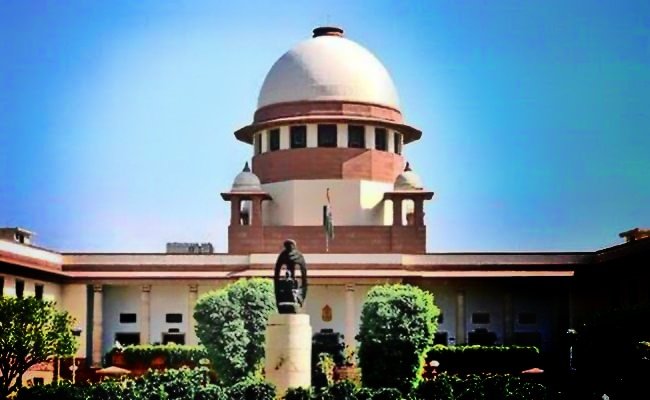
Commercial vehicles entering the National Capital Territory of Delhi will now face increased environmental compensation charges following a Supreme Court directive. The apex court has approved an enhancement of these charges, coupled with a mandatory 5 per cent annual increase, aimed at reinforcing deterrent measures against vehicular pollution.
Information was available with The Chenab Times indicating that the Supreme Court, in its order uploaded recently, has sanctioned the revised rates of the Environment Compensation Charge (ECC) based on the recommendations of the Commission for Air Quality Management (CAQM). The court has also mandated that these charges will be subject to a 5 per cent annual escalation to maintain their effectiveness.
A bench presided over by the Chief Justice of India, Surya Kant, along with Justices Joymalya Bagchi and Vipul M Pancholi, deemed the CAQM’s proposal to be “reasonable, just, and fair” in its March 12 order. The revised ECC rates reflect a significant increase for several categories of commercial vehicles entering Delhi.
Specifically, the ECC for light-duty vehicles (Category 2) and two-axle trucks (Category 3) has been raised from Rs 1,400 to Rs 2,000. Similarly, three-axle trucks (Category 4) and trucks with four or more axles (Category 5) will now be required to pay Rs 4,000, an increase from the previous charge of Rs 2,600.
The Supreme Court’s order also stipulated a mechanism for continuous adjustment of the ECC. “With a view to discourage entry of diesel commercial vehicles into Delhi and taking into account inflation and increase in vehicle operating costs as well as annual increase in NHAI (National Highways Authority of India) toll rates the Commission recommends that the ECC rates may be enhanced by 5 per cent every year w.e.f. April 1 (rounded off to nearest 10 rupees) and such revision may be notified by GNCTD,” the order stated. This annual revision, effective from April 1 each year, aims to counter inflation and rising operational costs.
Furthermore, the bench directed all stakeholders to actively encourage commercial and other heavy vehicles that do not require entry into Delhi, except for the essential supply of commodities, to utilize the peripheral expressways constructed to bypass the city. This directive is intended to alleviate traffic congestion and pollution within Delhi, while also offering these vehicles an avenue to avoid the revised ECC payments.
The CAQM had also put forth recommendations to the Municipal Corporation of Delhi (MCD) for a rationalisation of its toll structure. This includes aligning existing toll rates with the framework adopted by the National Highways Authority of India (NHAI), addressing disparities in vehicle classification, and undertaking a comprehensive traffic and revenue study. Such a study would assess traffic potential and route diversion patterns, particularly in the context of the newly revised ECC structure.
In relation to these proposals, the Supreme Court has instructed the MCD to obtain specific instructions. The court has also called upon the NHAI and MCD to collaborate effectively to ensure compliance with its earlier directions, issued on January 21, particularly concerning the relocation of toll plazas to more suitable locations outside the city’s core areas.
The Supreme Court has been actively monitoring measures to combat the deteriorating air quality in the Delhi-National Capital Region (NCR). The implementation of the ECC, the diversion of heavy vehicles through peripheral expressways, and the coordination among the CAQM, MCD, and NHAI are all part of the broader efforts being undertaken within the proceedings stemming from the M.C. Mehta environmental litigation.
This judicial oversight comes more than four decades after environmental activist M.C. Mehta filed a Public Interest Litigation (PIL) in 1985 seeking a clean environment for Delhi-NCR. On March 12, the Supreme Court closed the proceedings on his original PIL but directed the Registry to initiate a suo motu case to address the persistent issues of air pollution in the NCR.
M.C. Mehta’s PIL has historically led to numerous landmark judicial pronouncements and orders aimed at preventing, controlling, and managing pollution levels in Delhi-NCR. These have included directives for the relocation of polluting industries from Delhi and the introduction of environmentally friendlier transport options, such as Compressed Natural Gas (CNG)-powered buses and commercial vehicles.
The sustained legal interventions, initiated by M.C. Mehta’s PIL, also contributed to the establishment of the Commission for Air Quality Management (CAQM), an independent body tasked with identifying the root causes of and formulating solutions for the worsening air quality in the Delhi-NCR region.
❤️ Support Independent Journalism
Your contribution keeps our reporting free, fearless, and accessible to everyone.
Or make a one-time donation
Secure via Razorpay • 12 monthly payments • Cancel anytime before next cycle


(We don't allow anyone to copy content. For Copyright or Use of Content related questions, visit here.)

The Chenab Times News Desk