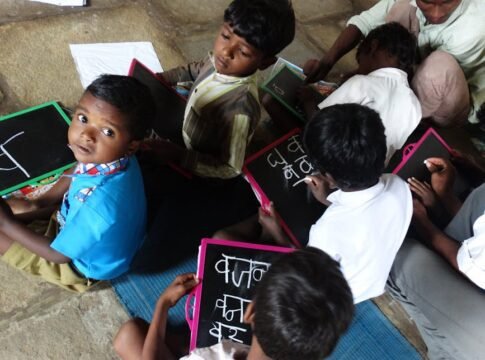
Mumbai: The status of Hindi as a compulsory third language in Maharashtra’s primary schools remains in a state of flux, with the Balbharati (Maharashtra State Bureau of Textbook Production and Curriculum Research) textbook list for the 2026-27 academic year offering no indication of changes to the existing language system. This development comes amidst ongoing debate and the delayed release of government resolutions regarding the state’s three-language policy, which has been a subject of significant political and public discussion since its initial proposal in line with the National Education Policy (NEP) 2020.
Uncertainty Surrounds Hindi’s Mandatory Status
The controversy surrounding the mandatory inclusion of Hindi as a third language for students in Classes 1 to 5 in Marathi and English-medium state board schools began in 2025. The state government’s initial move, aimed at aligning with NEP 2020, triggered sharp opposition from educationists, language experts, and political parties. Critics argued that it amounted to an imposition of Hindi in a non-Hindi speaking region and questioned the necessity of introducing a third language at the primary level.
In response to the widespread backlash, the government issued revised resolutions. Initially, a Government Resolution (GR) on April 16, 2025, made Hindi compulsory. However, following considerable opposition, an amended GR on June 17, 2025, made Hindi an optional language, allowing students to choose any other Indian language as their third language. Further, in July 2025, the government officially scrapped its earlier resolutions mandating Hindi as a compulsory third language. A committee, headed by renowned economist Dr. Narendra Jadhav, was appointed to study the three-language policy and submit recommendations. Despite these developments, the recent Balbharati textbook list for the 2026-27 academic year does not reflect any changes, suggesting the continuation of the current language-learning system for the time being.
Textbook Publication Delays and Lack of Clarity
Adding to the confusion, the process of developing and publishing textbooks for the new language policy has faced significant delays. As of June 2025, it was reported that third language textbooks for students and teachers were not ready, and even the syllabi were not finalized. Officials from Balbharati stated that textbook printing could only commence after receiving work orders. The Maharashtra School Principals Federation highlighted that syllabi approval is a prerequisite for printing, indicating a potential delay of two to three months into the academic year before textbooks could be distributed.
Furthermore, a circular issued by Balbharati in May 2025, which vaguely referenced a Hindi textbook for first-grade students, ‘Khel Khel Mein Seekhein Hindi,’ reignited concerns about the potential indirect enforcement of Hindi. This occurred despite previous government assurances that Hindi would not be made compulsory. The lack of an official Government Resolution (GR) detailing the finalized policy has exacerbated the unease among parents and educators, especially with the academic year set to commence.
NEP 2020 and the Three-Language Formula
The debate is intrinsically linked to the implementation of the National Education Policy (NEP) 2020, which promotes multilingualism through the three-language formula. NEP 2020, however, emphasizes flexibility and explicitly states that no language will be imposed on any state. This principle has been a cornerstone of the discussions and has informed the government’s revised stance, moving away from a compulsory Hindi mandate towards offering regional language choices.
The NEP 2020 also advocates for a restructured school education system, adopting a 5+3+3+4 model. This framework divides schooling into foundational, preparatory, middle, and secondary stages. The policy aims to standardize language education and adapt the schooling structure to national guidelines, with a phased implementation across all grades by 2028-29.
The Maharashtra government’s approach to the three-language policy has been marked by a series of policy shifts and a prolonged period of uncertainty. The current situation, with the Balbharati textbook list indicating no immediate changes, suggests that the state may continue with its existing language education system while awaiting further clarity or decisions on the revised policy by the appointed committee.
❤️ Support Independent Journalism
Your contribution keeps our reporting free, fearless, and accessible to everyone.
Or make a one-time donation
Secure via Razorpay • 12 monthly payments • Cancel anytime before next cycle


(We don't allow anyone to copy content. For Copyright or Use of Content related questions, visit here.)

The Chenab Times News Desk