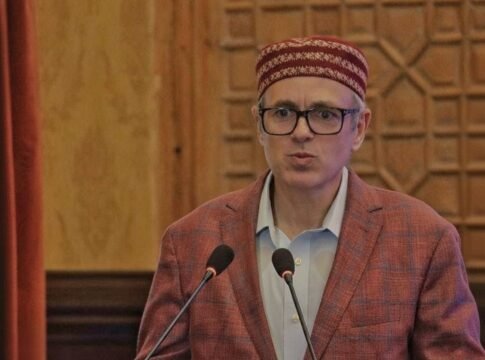
Srinagar, August 15: Jammu and Kashmir’s former Chief Minister Omar Abdullah has echoed President Droupadi Murmu’s assessment that the suspension of the Indus Waters Treaty serves the national interest, emphasizing the long-standing restrictions imposed on the region’s water resources.
Information was available with The Chenab Times that Abdullah’s comments, made in response to remarks by Pakistan’s Prime Minister Shehbaz Sharif regarding water as a “red line,” highlighted the perceived inequity of the 1960 treaty for Jammu and Kashmir. President Murmu, in her Independence Day eve address, had described the treaty’s suspension as a “decisive step” benefiting India, particularly its farmers.
Abdullah articulated a strong sentiment of grievance, stating, “We have always been saying that our blood has been sucked – these are our rivers. We had the first right on this.” He questioned Pakistan’s purported sympathy for Kashmiris, noting that it seemingly evaporated when it came to water rights. “Where was their sympathy when we were denied permission to use our rivers?” he asked.
The crux of the treaty, signed in 1960 with the World Bank’s facilitation, divides the waters of the Indus river system. Under its terms, India gained unrestricted use of the eastern rivers – Ravi, Beas, and Sutlej – while Pakistan was allocated the western rivers – Indus, Jhelum, and Chenab. India, however, retained certain rights for domestic use, agriculture, and hydropower on the western rivers, subject to treaty conditions.
The former Chief Minister contended that Jammu and Kashmir has endured the repercussions of these limitations for decades. “From then until today, we are suffering the consequences of this Indus Waters Treaty,” Abdullah stated, pointing to instances where the region’s ability to fully exploit its water resources was curtailed. He cited specific examples, including the inability to draw drinking water from the Chenab river and restrictions on projects involving the Jhelum, such as the Tulbul Navigation Project.
The Tulbul project, also known as the Wular Barrage, was intended to regulate water levels in Wular Lake and enhance navigation on the Jhelum. Construction was halted in 1987 due to Pakistani objections. India has maintained that the project’s scope falls within its treaty entitlements.
This is not the first time Abdullah has raised these concerns. In 2025, following India’s decision to place the treaty in abeyance after the Pahalgam terror attack, he had urged the central government to approve projects like the Tulbul Navigation Project and the Chenab Water Lift Scheme. He had argued that the latter could significantly address drinking water needs in parts of the Jammu region.
The Indus Waters Treaty has been a cornerstone of Indo-Pakistani water management for over six decades, establishing a framework for allocation and dispute resolution. India’s decision to suspend the treaty was directly linked to Pakistan’s alleged support for cross-border militancy.
Abdullah’s current stance advocates for the permanent cancellation of the treaty, arguing, “Our blood has been sucked, and now that the Indus Waters Treaty has been cancelled, it should remain cancelled so that we can make proper use of this water.” This position aligns his regional water interests with the Centre’s broader national security objectives in suspending the treaty.
President Murmu’s remarks reinforced this perspective, linking the suspension to the nation’s security and economic well-being. “Suspension of the IWT with the country that harbours terrorism is a decisive step in the interest of our nation, especially the farmers,” she stated, implicitly referencing the government’s wider strategy against militancy, including initiatives like Operation Sindoor.
❤️ Support Independent Journalism
Your contribution keeps our reporting free, fearless, and accessible to everyone.
Or make a one-time donation
Secure via Razorpay • 12 monthly payments • Cancel anytime before next cycle


(We don't allow anyone to copy content. For Copyright or Use of Content related questions, visit here.)

The Chenab Times News Desk