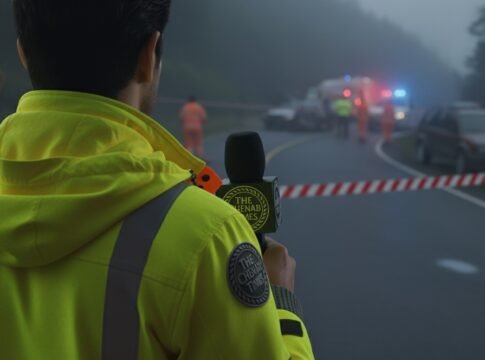
The roads of Chenab Valley have long been associated with difficult terrain, steep gradients and challenging weather conditions. But official accident figures obtained under the Right to Information Act point to a more persistent problem: road crashes have remained a substantial public-safety concern across Doda, Kishtwar and Ramban for years.
According to a six-year compilation of police data covering January 2019 to December 2024, the three districts together recorded 3,475 road accidents, 875 deaths, and thousands of injuries. The figures amount to an average of roughly 579 accidents and 146 fatalities every year across the region.
The data was obtained through separate RTI responses from the police headquarters of Doda, Kishtwar and Ramban. The responses were subsequently consolidated and analysed by the Chenab Times Foundation. The underlying police records, therefore, provide a useful district-level picture of the road-safety situation, although the report itself cautions that the figures cover cases registered with the district police and may not capture every incident occurring in the region.
Ramban accounts for the largest share of accidents
Among the three districts, Ramban recorded the highest number of accidents, with 1,576 cases between 2019 and 2024. That represents approximately 45.4 per cent of all accidents recorded across the three districts.
Doda followed with 1,323 accidents, accounting for 38.1 per cent, while Kishtwar recorded 576 accidents, or 16.6 per cent of the combined total.
Ramban also recorded the highest absolute number of fatalities—341 deaths over the six-year period. Doda reported 307 deaths and Kishtwar 227. In terms of their share of total fatalities, Ramban accounted for 39 per cent, Doda 35.1 per cent and Kishtwar 26 per cent.
The concentration of accidents in Ramban is particularly significant because the district is traversed by the Jammu-Srinagar National Highway (NH-44), one of the principal road corridors connecting the Jammu region with the Kashmir Valley.
The report associates Ramban’s high accident numbers with traffic density on NH-44, the presence of heavy vehicles and the difficult alignment of portions of the highway. These factors are presented as analytical interpretations of the RTI data rather than as findings contained directly in the police responses.
Kishtwar presents a different—and potentially more serious—picture
The most striking feature of the data is not found in the district with the greatest number of crashes, but in Kishtwar.
Kishtwar recorded only 576 accidents during the six-year period, considerably fewer than Doda or Ramban. Yet it registered 227 deaths, giving it the highest reported fatality-to-accident ratio among the three districts.
The report calculates Kishtwar’s rate at 39.4 deaths per 100 recorded accidents, compared with 23.2 in Doda and 21.6 in Ramban. The combined valley figure is calculated at 25.2 per 100 accidents.
The difference raises an important road-safety question: why do crashes in Kishtwar appear, in the available data, to result in fatalities at a considerably higher rate?
The research attributes the pattern to factors including difficult terrain, inadequate roadside protection and distance from emergency trauma care. However, these explanations should be regarded as hypotheses requiring further investigation rather than definitive causal findings from the RTI records themselves. The police data establishes the disparity in outcomes; it does not, by itself, establish precisely why that disparity exists.
That distinction is important for policymakers. If the principal problem is the severity of crashes, engineering measures may be required. If delayed medical intervention contributes significantly to deaths, emergency response and trauma-care capacity become equally important.
Doda: high accident numbers, but a sharp fall in deaths in 2024
Doda’s six-year record sits between Ramban and Kishtwar in several respects.
The district recorded 1,323 accidents, 307 deaths and 1,701 injuries between 2019 and 2024. Its calculated fatality rate of 23.2 deaths per 100 accidents was lower than Kishtwar’s but slightly higher than Ramban’s.
The annual figures show considerable variation.
Doda recorded 258 accidents and 57 deaths in 2019. In 2020, accidents declined to 196 and deaths to 36. The numbers subsequently rose, with fatalities reaching 66 in 2021 and 76 in 2023.
The 2023 figure is particularly notable. Doda recorded 212 accidents that year but 76 deaths, its highest annual fatality figure during the six-year period. By contrast, 2024 saw deaths fall to 27, the lowest annual figure recorded in the district during the study period.
Whether the sharp reduction in fatalities in 2024 represents a sustained improvement, an annual fluctuation or a combination of factors cannot be established from the available data alone. It does, however, merit closer examination by road-safety authorities.
The pandemic explains one dip—but not the broader pattern
Across the three districts, 2019 began with 601 recorded accidents and 206 fatalities.
The following year produced a dramatic decline. In 2020, the valley recorded 464 accidents and 118 deaths. The report links the reduction to COVID-19 restrictions and the associated decline in traffic movement.
The decline proved temporary.
Accidents increased to 588 in 2021 and 621 in 2022 before remaining around the 600-mark in 2023 and 2024. The annual accident totals were:
- 2019: 601
- 2020: 464
- 2021: 588
- 2022: 621
- 2023: 602
- 2024: 599
Fatalities followed a somewhat different trajectory:
- 2019: 206
- 2020: 118
- 2021: 158
- 2022: 129
- 2023: 145
- 2024: 119.
The figures suggest that while the number of crashes returned close to pre-pandemic levels after 2020, annual deaths did not return to the exceptionally high 2019 figure.
That distinction matters. A road network can experience a relatively stable number of crashes while the consequences of those crashes change substantially. Understanding what caused the variations in fatality rates could therefore be as important as simply counting accidents.
Injuries remain a significant part of the story
Fatalities understandably dominate public discussion of road crashes, but the injury figures reveal another dimension of the problem.
The report records thousands of people injured during the six-year period. Annual valley-wide injuries rose from 778 in 2019 to 889 in 2024, despite accident numbers remaining broadly within a similar range. The report identifies this as a potentially important indicator of accident severity or reporting patterns.
There is, however, an important data-quality qualification.
The headline executive summary gives the six-year injury total as 4,687, while the year-wise table totals 4,742. The underlying district figures listed in the report—1,701 injuries for Doda, 856 for Kishtwar and 2,130 for Ramban—also sum to 4,687.
This discrepancy should be resolved against the original RTI records before the injury total is presented as a definitive consolidated figure. The accident and fatality totals, by contrast, are internally consistent at 3,475 and 875 respectively.
For responsible reporting, the discrepancy should be acknowledged rather than silently choosing one number.
Kishtwar’s rising accident count warrants attention
Another pattern emerging from the data is Kishtwar’s increase in recorded accidents in the later years.
The district reported 67 accidents in 2020. The figure increased to 124 in 2024—an increase of roughly 85 per cent over the four-year period.
Kishtwar’s annual figures were:
2019 — 77 accidents
2020 — 67
2021 — 98
2022 — 114
2023 — 113
2024 — 124
The rise coincides with continuing changes in connectivity and traffic movement in the district, but the available RTI material does not establish that improved connectivity caused the increase. It does, nevertheless, provide a basis for authorities to examine whether road capacity, traffic enforcement and safety infrastructure have kept pace with changing traffic patterns.
What the figures say about road safety policy
The data points toward different priorities for different parts of the Chenab Valley.
In Ramban, the immediate challenge is the sheer volume of crashes. With nearly half of the valley’s recorded accidents occurring in the district, identifying and addressing recurring crash locations along major corridors should be a priority.
In Kishtwar, the central concern is different. The district has fewer recorded crashes but a much higher fatality-to-accident ratio. That makes the quality and speed of emergency response particularly relevant alongside conventional road engineering and enforcement.
In Doda, the substantial number of accidents and the sharp year-to-year variation in fatalities indicate a need for continued monitoring rather than reliance on a single year’s improvement.
The research recommends a combination of black-spot identification, crash barriers, rumble strips, improved warning signage, roadway improvements, stronger heavy-vehicle regulation, community road-safety campaigns and improved trauma-care capacity.
These measures are not equally applicable everywhere. Road safety interventions are likely to be more effective when based on the specific causes and locations of crashes in each district.
From accident statistics to accountability
One of the more important aspects of this research is not simply the number of accidents it records, but the fact that district-level information has been brought together over six consecutive years.
The three RTI responses came from District Police Doda, District Police Kishtwar and District Police Ramban. The report states that the information was reproduced as received, while calculations such as fatality rates and percentage shares were undertaken separately by the researchers.
That creates an opportunity for a more systematic approach to road safety in the region.
Authorities could, for example, maintain publicly accessible annual datasets showing accident location, road type, vehicle category, time of accident, weather conditions, suspected cause, fatalities, injuries and emergency-response time. Such information would make it easier to distinguish between crashes caused primarily by driver behaviour, road design, vehicle condition, environmental hazards or delayed medical assistance.
Without that level of detail, the present figures can tell us where the burden is greatest and how it has changed, but they cannot by themselves answer every question about why crashes happen.
A regional problem requiring district-specific responses
The six-year figures present a clear picture: road accidents are not an isolated or occasional problem in Chenab Valley.
Ramban carries the largest absolute accident burden. Doda also records a substantial number of crashes and fatalities. Kishtwar stands out for the high proportion of accidents that, according to the compiled police data, result in deaths.
At the same time, the data does not support treating the three districts as identical road-safety environments. Their geography, traffic patterns, road corridors, emergency access and accident profiles differ.
That suggests that a single valley-wide intervention is unlikely to be sufficient.
The more useful approach would be to combine regional standards with district-specific road-safety plans—mapping black spots, auditing engineering deficiencies, strengthening enforcement where necessary and measuring emergency-response performance.
The numbers demand a closer look
The six-year RTI record does not provide a complete explanation of Chenab Valley’s road-safety problem. It does, however, establish the scale of the issue.
Between 2019 and 2024, the three districts recorded 3,475 accidents and 875 deaths. That is an average of almost 579 accidents and 146 deaths every year.
The figures also reveal that accident frequency and accident lethality are not necessarily the same thing. Ramban has the largest number of crashes, while Kishtwar has the highest calculated fatality rate.
That distinction should shape the policy response.
The next step is not simply to produce another set of statistics. It is to identify the locations, circumstances and causes behind those numbers—and then determine whether engineering, enforcement, driver behaviour, vehicle regulation or emergency medical response is responsible for the preventable portion of the toll.
For a mountainous region where roads are a lifeline for education, healthcare, employment and commerce, road safety is ultimately more than a transport issue. It is a question of public infrastructure, emergency preparedness and the capacity of institutions to learn from repeated crashes.
The RTI data provides a starting point. The more difficult task is turning those numbers into measurable reductions in deaths and serious injuries.
❤️ Support Independent Journalism
Your contribution keeps our reporting free, fearless, and accessible to everyone.
Or make a one-time donation
Secure via Razorpay • 12 monthly payments • Cancel anytime before next cycle


(We don't allow anyone to copy content. For Copyright or Use of Content related questions, visit here.)

Anzer Ayoob is the Founder and Chief Editor to The Chenab Times