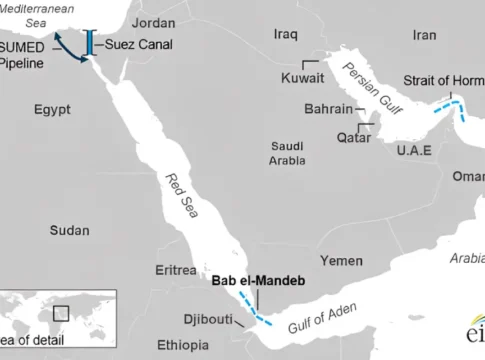
Global maritime security is facing renewed concerns as Yemen’s Houthi group has escalated its actions in the Bab al-Mandeb Strait, a critical chokepoint for international shipping. The group, aligned with Iran, confirmed ballistic missile launches targeting Israel, raising fears of further disruption to shipping lanes and energy flows connecting the Red Sea to the Gulf of Aden.
The Chenab Times has learned that the Houthi announcement follows a period of relative calm in the Red Sea, signaling a potential resumption of their operations in the vital Bab al-Mandeb corridor. This escalation occurs amid ongoing tensions in the broader Middle East, with the Houthi actions drawing attention to their role within Iran’s regional ‘Axis of Resistance,’ which also includes groups like Hamas and Hezbollah.
The Bab al-Mandeb Strait, known as the “Gate of Tears,” is strategically located at the southern end of the Red Sea, separating Yemen from the Horn of Africa nations of Djibouti and Eritrea. Its significance lies in its role as a crucial link to the Suez Canal and the SUMED pipeline, facilitating approximately 10–12% of global oil and natural gas shipments, alongside substantial container and bulk cargo traffic between Asia and Europe.
The strait, measuring approximately 100 kilometres in length and narrowing to about 29–30 kilometres at its most constricted point, handles millions of barrels of crude oil, liquefied natural gas (LNG), and containerised goods daily. The Houthis’ control over Yemen’s capital, Sanaa, which is geographically proximate to the strait, grants them a strategic advantage in influencing global energy transit.
Previous Houthi attacks on shipping in the Red Sea between November 2023 and January 2025 saw over 100 vessels targeted, with two sunk and several others severely damaged. Following a partial ceasefire in late 2025, these operations had paused, making the recent missile strike on Israel a significant indicator of a potential resurgence of activity affecting maritime trade routes.
Experts warn that a significant increase in Houthi attacks on commercial shipping could lead to further surges in oil prices and broader destabilization of maritime security, extending beyond the energy market. The group’s involvement in the wider Middle East conflict is viewed as a serious escalation with potentially profound impacts on key commercial routes like the Red Sea and the Bab al-Mandeb strait, potentially exposing vital economic and military infrastructure in the Gulf region.
Should the Bab al-Mandeb strait face closures or significant disruptions, coupled with existing issues at the Strait of Hormuz, global shipping companies would likely face the necessity of rerouting vessels around the Cape of Good Hope in Africa. Such a diversion would add an estimated 4,000–6,000 nautical miles to voyages, leading to delays of up to 20 days. This would invariably result in substantially increased freight costs, disruption to global trade, and intensified pressure on oil markets already strained by regional conflicts.
For India, the Red Sea route is of paramount importance, accounting for approximately 80% of its merchandise trade with Europe, valued annually at around $450 billion. Disruptions to this corridor have direct implications for India’s economy and trade flows.
The Houthis, supported by Iran, have demonstrated a capacity to rebuild their capabilities following sustained airstrikes. They have relied on various networks for arms procurement and indigenous manufacturing, reportedly targeting commercial and military vessels more than 190 times between November 2023 and June 2024. Despite their aggressive stance, analysts suggest the Houthis might avoid direct attacks on Saudi oil facilities due to a 2022 truce, although external pressures could alter this strategic calculation.
International efforts, including operations like Operation Prosperity Guardian led by the United States and the United Kingdom, have aimed to protect shipping in the Red Sea. However, many shipping companies have continued to opt for rerouting around Africa to mitigate risks, despite the added time and increased fuel costs.
The Bab al-Mandeb Strait’s historical role as a vital artery for global trade and energy underscores its current vulnerability. The Houthi group’s increasing involvement in regional conflicts poses a significant threat of renewed disruption, with potential ripple effects across global shipping, energy markets, and economies reliant on stable maritime corridors.
❤️ Support Independent Journalism
Your contribution keeps our reporting free, fearless, and accessible to everyone.
Or make a one-time donation
Secure via Razorpay • 12 monthly payments • Cancel anytime before next cycle


(We don't allow anyone to copy content. For Copyright or Use of Content related questions, visit here.)

The Chenab Times News Desk