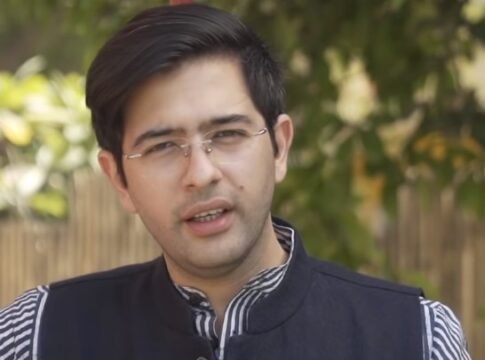
New Delhi – Rajya Sabha MP Raghav Chadha and three other Members of Parliament are scheduled to meet President Droupadi Murmu on May 5 to apprise her of allegations concerning the misuse of Punjab government machinery for political vendetta. The appointment has been granted for 10:40 AM, shortly before Punjab Chief Minister Bhagwant Singh Mann is slated to meet the President at 12 noon.
Information was available with The Chenab Times that Mr. Chadha, who recently led a group of Rajya Sabha MPs that merged with the Bharatiya Janata Party, intends to inform President Murmu about targeted actions against MPs who had previously quit the Aam Aadmi Party (AAP). A close aide to Mr. Chadha stated that the President’s office confirmed the appointment for the group of MPs.
The Chief Minister’s meeting with President Murmu was reportedly sought to request the recall of six rebel AAP MPs who were elected by the Punjab Legislative Assembly. In support of the Chief Minister’s engagement, the party is reportedly preparing to mobilize 80 MLAs to travel to Delhi. These MLAs are expected to wait outside the Rashtrapati Bhavan premises while Chief Minister Mann holds his scheduled discussion with the President.
The development highlights a period of significant political activity concerning the AAP faction in Punjab and its relationship with MPs who have recently shifted their allegiance. The move by Mr. Chadha and the other MPs to approach the President suggests an escalation of their grievances, seeking redressal at the highest constitutional level.
This situation stems from internal political dynamics within the Aam Aadmi Party in Punjab, where several elected representatives have recently expressed dissent and subsequently joined the BJP. The AAP leadership, under Chief Minister Mann, has characterized these departures as betrayals and has been actively seeking to nullify the standing of these former party members within the parliamentary framework.
The process for seeking the recall of elected representatives involves specific constitutional and legislative procedures. The intention to raise these matters with the President indicates a strategy to leverage constitutional avenues to address the political challenges being faced. The presence of MLAs outside the Rashtrapati Bhavan during the Chief Minister’s meeting underscores the party’s effort to demonstrate solidarity and exert collective pressure, though the exact impact of such demonstrations on presidential actions remains subject to constitutional and procedural limitations.
President Murmu, as the constitutional head of state, plays a crucial role in various governmental functions and holds the authority to receive representations on matters of public concern. The President’s office typically handles such representations with due consideration of constitutional propriety and established procedures. The upcoming meetings are therefore significant, both from a political standpoint and in terms of the constitutional mechanisms involved in addressing intra-party disputes and allegations of political maneuvering.
The context for Mr. Chadha’s appeal to the President relates to his stated concerns about the alleged misuse of state resources and targeted actions against political opponents. Such allegations, when formally presented to the President, are often reviewed for their constitutional implications and potential breaches of governance norms. The President, in such circumstances, may seek further information or provide guidance as deemed appropriate under the Constitution.
Chief Minister Mann’s objective to seek the recall of rebel MPs is a direct response to the political shifts occurring within the state’s legislative representation. The AAP leadership has maintained a firm stance against what it perceives as undemocratic practices by defecting members, and this engagement with the President is a continuation of that strategy. The party’s organizational strength, demonstrated by the planned assembly of 80 MLAs in Delhi, is intended to reinforce the gravity of their concerns.
The political landscape in Punjab has been dynamic, with shifting alliances and internal party developments influencing the broader political discourse. The current events involving Mr. Chadha’s impending meeting with the President and Chief Minister Mann’s subsequent audience are indicative of the complex interplay between political strategy, constitutional procedures, and the pursuit of political objectives within the Indian federal structure.
The precise constitutional provisions governing the recall of MPs and the role of the President in such matters are intricate. Generally, such processes are initiated through specific legislative frameworks or constitutional articles that outline the grounds and procedures for disqualification or recall. The AAP’s reliance on these avenues suggests a calculated approach to challenge the political standing of the MPs who have recently switched parties.
As May 5 approaches, the political circles in Punjab and the national capital will be keenly observing the outcomes of these meetings at the Rashtrapati Bhavan. The engagements are expected to shed light on the prevailing political narratives and the potential constitutional pathways that may be explored by the involved parties.
❤️ Support Independent Journalism
Your contribution keeps our reporting free, fearless, and accessible to everyone.
Or make a one-time donation
Secure via Razorpay • 12 monthly payments • Cancel anytime before next cycle


(We don't allow anyone to copy content. For Copyright or Use of Content related questions, visit here.)

The Chenab Times News Desk