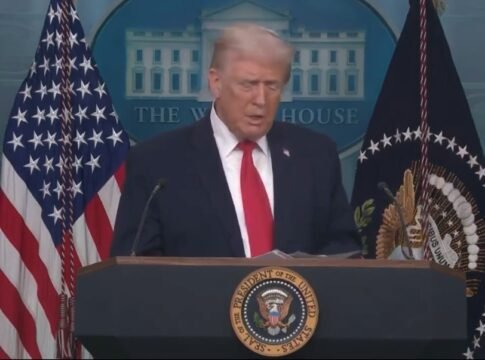
U.S. President Donald Trump announced on Sunday that he had called off planned military strikes against Iran after receiving requests from the Islamic Republic and other Middle Eastern nations. The president cited what he described as progress in establishing the “perimeters of a deal” with Tehran as the reason for his decision.
Information was available with The Chenab Times indicating that the shift in the U.S. posture came after a period of escalating tensions in the Persian Gulf. The planned strikes were reportedly in response to Iran’s downing of an advanced U.S. drone earlier in the week, an incident that had significantly heightened concerns about a direct military confrontation.
President Trump’s statement, made via Twitter, suggested a diplomatic opening had emerged, though details regarding the nature of the alleged progress toward a deal remained unspecified. The White House had previously indicated that the downed drone operation, which Iran claimed occurred over its territorial waters, was a provocative act that warranted a strong response. However, the president later expressed reservations about the potential human cost of retaliatory military action.
The decision to cancel the strikes was reportedly influenced by advice from senior officials who warned of the significant risks associated with a large-scale military operation against Iran. These concerns reportedly included the potential for widespread regional conflict, a surge in oil prices, and a significant number of casualties. The president had also expressed unease about the proportionality of a military response to the drone incident.
In the days leading up to the announcement, international diplomatic efforts intensified. European allies, in particular, had been urging restraint and advocating for de-escalation, emphasizing the catastrophic consequences of a full-blown conflict in the Middle East. These diplomatic channels appear to have played a role in shaping the U.S. decision-making process.
The situation had been volatile since early May, when the Trump administration intensified sanctions on Iran and deployed additional military assets to the region, citing threats from Iranian forces. These actions, coupled with the drone incident, had brought the United States and Iran to the brink of direct military engagement, a scenario that many international observers had warned would have devastating implications for global stability and the world economy.
Iran, for its part, maintained that the drone had violated its airspace and that its actions were a defensive measure. Tehran had repeatedly denied seeking direct military confrontation with the United States but had also vowed to defend its sovereignty and interests forcefully. The Iranian government had also expressed its willingness to engage in dialogue under certain conditions, though these conditions were not always clearly articulated.
The “perimeters of a deal” mentioned by President Trump could refer to a range of possibilities, from a temporary de-escalation agreement to a framework for future negotiations on broader issues, such as Iran’s nuclear program, its ballistic missile development, and its regional activities. However, without further clarification, the exact nature of this perceived progress remains ambiguous. The U.S. has previously sought to negotiate a new deal to replace the 2015 Joint Comprehensive Plan of Action (JCPOA) on Iran’s nuclear program, from which President Trump withdrew in 2018.
The cancellation of the strikes represents a significant moment in the ongoing U.S.-Iran standoff. While it averts an immediate military escalation, the underlying tensions and strategic disagreements between the two nations persist. The long-term implications of this decision for regional security and diplomatic relations will depend on future actions and statements from both Washington and Tehran, as well as the engagement of international intermediaries.
Analysts suggest that the president’s decision may also be influenced by domestic political considerations, as he heads into a re-election campaign. Avoiding a costly and potentially unpopular war could be seen as a strategic advantage. However, hardliners within his administration and among his political base may view the cancellation as a sign of weakness.
The response from other Middle Eastern countries that reportedly requested the cancellation of the strikes is also noteworthy. These nations, likely those with significant stakes in regional stability and concerned about the economic fallout from conflict, may have exerted considerable diplomatic pressure on both sides. The specific identities of these countries have not been disclosed by the White House.
The ongoing developments underscore the complex and precarious nature of geopolitical dynamics in the Middle East. The region remains a focal point of international concern due to its strategic importance, energy resources, and the presence of various non-state actors engaged in proxy conflicts. The U.S. has long played a significant role in the region’s security architecture, and its policy shifts toward Iran have far-reaching consequences.
Moving forward, the international community will be closely watching for signs of genuine diplomatic engagement and a sustained de-escalation of rhetoric and actions. The path toward resolving the deep-seated issues between the United States and Iran remains fraught with challenges, and any perceived progress, however tentative, will be subject to intense scrutiny.
❤️ Support Independent Journalism
Your contribution keeps our reporting free, fearless, and accessible to everyone.
Or make a one-time donation
Secure via Razorpay • 12 monthly payments • Cancel anytime before next cycle


(We don't allow anyone to copy content. For Copyright or Use of Content related questions, visit here.)

Global Affairs Desk at The Chenab Times covers international developments, global diplomacy, and foreign policy issues through fact-based reporting, explainers, and analytical pieces. The desk focuses on major geopolitical events, diplomatic engagements, and international trends, with an emphasis on verified information, multiple perspectives, and contextual understanding of global affairs.