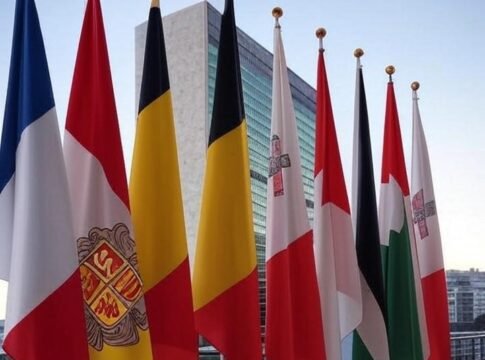
New York, September 22 — France, along with Andorra, Belgium, Luxembourg, Malta and Monaco, formally recognized Palestinian statehood during a high-level summit on a two-state solution at the United Nations headquarters, joining over 80 percent of UN member states in a diplomatic push amid Israel’s ongoing war in Gaza, according to details received by The Chenab Times.
The summit, co-convened by France and Saudi Arabia ahead of the UN General Assembly, saw French President Emmanuel Macron declare, “Today, I declare that France recognises the state of Palestine,” emphasizing the need to preserve the two-state solution. “We have gathered here because the time has come. It falls on us, this responsibility, to do everything in our power to preserve the possibility of a two-state solution,” he said, as reported by Al Jazeera. Leaders from Australia, Canada, Portugal and the United Kingdom, which recognized Palestine a day earlier, also addressed the meeting.
The move brings the total recognizing nations to about 147 of 193 UN members, ramping up pressure on Israel, which boycotted the event. Israel’s UN ambassador Danny Danon called it a “circus,” while U.S. officials, including White House press secretary Karoline Leavitt, described it as a “reward to Hamas.” Palestinian Authority President Mahmoud Abbas, denied a U.S. visa by the Trump administration, commended the step via video, urging others to follow and demanding full UN membership for Palestine.
UN Secretary-General Antonio Guterres affirmed that Palestinian statehood “is a right, not a reward,” rejecting claims it benefits Hamas. Saudi Foreign Minister Prince Faisal bin Farhan Al Saud highlighted Israel’s “aggression and brutal crimes” in Gaza and recent attacks, including on Qatar, as threats to regional peace. Spanish Prime Minister Pedro Sanchez stated a two-state solution is impossible amid “genocide” in Gaza, where over 65,300 Palestinians have been killed since the war began nearly two years ago.
Macron outlined a post-war framework for a “renewed Palestinian Authority,” including an International Stabilisation Force to aid governance in Gaza. Professor Sultan Barakat of Hamad Bin Khalifa University noted the recognition provides “real, practical support” to the Palestinian cause. Al Jazeera correspondent Hashem Ahelbarra reported building momentum for UNGA discussions, though U.S. support remains elusive for a viable Palestinian state. Israel, under Prime Minister Benjamin Netanyahu, has vowed not to allow a Palestinian state, following a UNGA resolution last year calling for an end to occupation within a year. No immediate response from the U.S. or Israel beyond earlier criticisms was available at the time of reporting.
❤️ Support Independent Journalism
Your contribution keeps our reporting free, fearless, and accessible to everyone.
Or make a one-time donation
Secure via Razorpay • 12 monthly payments • Cancel anytime before next cycle


(We don't allow anyone to copy content. For Copyright or Use of Content related questions, visit here.)

Global Affairs Desk at The Chenab Times covers international developments, global diplomacy, and foreign policy issues through fact-based reporting, explainers, and analytical pieces. The desk focuses on major geopolitical events, diplomatic engagements, and international trends, with an emphasis on verified information, multiple perspectives, and contextual understanding of global affairs.