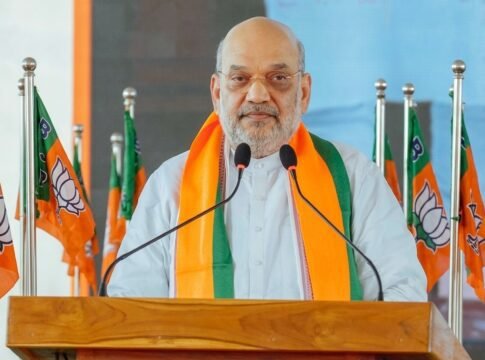
Ghaziabad, Uttar Pradesh: Union Home Minister and Minister of Cooperation Amit Shah emphasized the National Disaster Response Force’s (NDRF) crucial role in saving lives and strengthening India’s disaster management capabilities during the NDRF’s President’s Colour Award ceremony held in Ghaziabad, Uttar Pradesh. The event recognized the collective efforts of various agencies and volunteers in mitigating the impact of natural disasters across the country.
Information was available with The Chenab Times that the President’s Colour award signifies not only the commendable services of the NDRF but also acknowledges the contributions of State Disaster Response Forces (SDRFs), the entire governmental machinery from Panchayats to States, the National Cadet Corps (NCC), National Service Scheme (NSS), and thousands of disaster volunteers. Minister Shah lauded the NDRF’s motto, “Aapda Seva Sadaiv Sarvatra” (Always in Service of Disaster, Everywhere), stating that personnel have earned widespread trust and affection through their deployments both domestically and internationally.
NDRF’s Extensive Operations and Impact
The Union Home Minister highlighted that over its 20-year history, the NDRF has garnered the trust of 140 crore citizens through successful operations during floods, earthquakes, cyclones, and other calamities. The presence of NDRF personnel instills a strong sense of security, with the force credited for saving over 1.5 lakh lives and evacuating more than 9 lakh people to safer locations. The President’s Colour is seen as a testament to the service, courage, valor, and dedication of the entire NDRF, establishing India as a prominent nation in disaster response on the global stage.
During the ceremony, projects worth over Rs. 116 crore were inaugurated, with foundation stones also laid for new initiatives. These developments are expected to further enhance the NDRF’s capacity to protect citizens from diverse disaster threats. The Minister expressed optimism that these advancements would bolster the force’s operational effectiveness.
Government’s Vision for Zero Casualty and Disaster Resilience
Under the leadership of Prime Minister Narendra Modi, India has progressed significantly in Disaster Risk Reduction (DRR), aiming for the goal of zero casualties in disaster events. The focus is on utilizing forecasting and meteorological data to ensure the protection of lives and property. The National Disaster Management Authority (NDMA) has been instrumental in implementing policy decisions, issuing guidelines, and promoting public awareness to foster a national culture of disaster preparedness. Minister Shah specifically mentioned the NDRF’s commendable efforts in rescuing not only humans but also animals during emergencies, underscoring the aim of achieving zero loss of human life and minimizing property damage.
The Ministry of Home Affairs, in collaboration with the NDRF, is actively preparing to tackle challenges such as heatwaves, with a stated objective to reduce heatwave-related deaths to zero. The government’s approach integrates capacity building and community participation, evidenced by the extensive training provided to NDRF personnel, civil defense workers, volunteers, and boatmen. This shift from a primarily relief-oriented response to a more preventive and productive strategy has been a hallmark of the current administration’s disaster management philosophy.
Evolution of Disaster Management in India
Recounting India’s past experiences with devastating natural disasters like the Odisha Super Cyclone, Gujarat earthquake, and the Indian Ocean tsunami, Minister Shah noted the subsequent enactment of the Disaster Management Act and the establishment of the NDMA and NDRF. The NDRF, with its 16 battalions, has evolved into a formidable force, enhancing its capabilities through training support to SDRFs and joint operations. Proactive deployment and pre-positioning of resources have proven effective in damage mitigation.
The Union Home Minister recalled significant disaster response efforts by the NDRF, including the Kosi floods in Bihar, flash floods in Dharali, cloudbursts in Chasoti, floods in Jammu, Punjab, and Delhi, and cyclones Montha and Ditwah. The NDRF has also played a vital role in ensuring safety and facilitating major religious and public gatherings such as the Amarnath Yatra, Mahakumbh, Char Dham Yatra, and others. Prime Minister Modi’s 10-point agenda and a 360-degree approach have redefined disaster risk management, strengthening areas like risk mapping, early warning systems, and community engagement. India has emerged as a global leader and first responder in disaster management, embodying the principle of ‘Vasudhaiva Kutumbakam’ (the world is one family) and promoting disaster-resilient infrastructure through initiatives like the Coalition for Disaster Resilient Infrastructure (CDRI), which now includes 48 member countries.
Concluding his address, Amit Shah congratulated personnel of the Central Armed Police Forces (CAPFs) nationwide for their environmental consciousness and humanitarian outlook, citing their contribution of planting over 7 crore trees since 2021.
❤️ Support Independent Journalism
Your contribution keeps our reporting free, fearless, and accessible to everyone.
Or make a one-time donation
Secure via Razorpay • 12 monthly payments • Cancel anytime before next cycle


(We don't allow anyone to copy content. For Copyright or Use of Content related questions, visit here.)

The Chenab Times News Desk