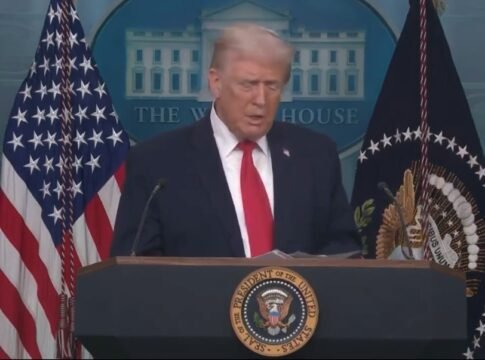
Former U.S. President Donald Trump has defended a proposed agreement intended to end hostilities with Iran, asserting it is superior to the 2015 accord negotiated under his predecessor, Barack Obama. Trump issued a stern warning, indicating that the United States would resort to bombing Iran again should the nation violate the terms of the new pact.
The Chenab Times has learned that the former president’s remarks come amidst emerging details of the deal, which aims to de-escalate tensions in the Middle East. Critics have raised concerns that the agreement might not achieve as much as the Joint Comprehensive Plan of Action (JCPOA) signed in 2015, which sought to curb Iran’s nuclear program in exchange for sanctions relief.
During his presidency, Trump unilaterally withdrew the United States from the JCPOA in 2018, reimposing severe economic sanctions on Iran. He argued at the time that the deal was flawed and did not sufficiently address Iran’s ballistic missile program or its regional activities. The subsequent “maximum pressure” campaign by the U.S. led to significant economic hardship for Iran and heightened geopolitical friction in the region.
The current statements by Trump suggest a potential shift in U.S. foreign policy under a future administration, should he be re-elected. His defense of the new proposed deal, while simultaneously threatening military action, presents a complex and potentially contradictory stance. The specifics of the agreement, including verification mechanisms and the scope of concessions, remain central to the ongoing debate among policymakers and international observers.
The 2015 Iran nuclear deal, officially known as the JCPOA, was a landmark agreement brokered by the P5+1 countries (China, France, Russia, the United Kingdom, the United States, plus Germany) and the European Union with Iran. It involved Iran agreeing to limit its uranium enrichment and stockpile in exchange for the lifting of international sanctions. However, the Trump administration argued that the deal’s “sunset clauses,” which would eventually allow Iran to resume certain nuclear activities, were unacceptable, and that it failed to address Iran’s support for militant groups and its missile development.
Following the U.S. withdrawal and reimposition of sanctions, Iran gradually began to exceed the limits set by the JCPOA, citing the non-compliance of other signatories. This has led to renewed concerns about Iran’s potential to develop nuclear weapons, a prospect that the international community has consistently sought to prevent. Efforts to revive the JCPOA have been ongoing but have faced significant obstacles, including disagreements over the scope of sanctions relief and the extent of Iran’s nuclear activities.
Trump’s rhetoric about bombing Iran, even while defending a deal, echoes past threats made during his presidency. Such statements often contribute to heightened regional instability and can complicate diplomatic efforts. The Middle East remains a volatile region, with multiple ongoing conflicts and proxy rivalries involving Iran and its adversaries, including Saudi Arabia and Israel.
The proposed deal, if it materializes, would need to navigate a complex landscape of domestic politics in both the U.S. and Iran, as well as international consensus. The reactions from European allies, who largely remained committed to the JCPOA, will be crucial. Furthermore, the impact on regional security dynamics, including the relationships between Iran, its neighbors, and global powers, will be a significant consideration.
The details of the agreement are expected to undergo further scrutiny by Congress and the international community. The effectiveness of any such deal will ultimately be measured by its ability to prevent Iran from acquiring nuclear weapons, promote regional stability, and adhere to international norms and agreements. The former president’s strong assertions suggest he believes his approach, combining deterrence with negotiation, offers a more robust path forward compared to the previous administration’s policies.
The threat of renewed military engagement carries substantial risks, including the potential for a wider regional conflict that could disrupt global energy markets and have far-reaching humanitarian and economic consequences. International law and the principles of sovereignty also come into play when considering unilateral military threats. The United Nations and other international bodies typically advocate for diplomatic solutions to such disputes.
As the situation evolves, the international community will be closely watching the diplomatic maneuvers and the eventual terms of any agreement. The legacy of the 2015 JCPOA and the subsequent U.S. withdrawal continues to cast a long shadow over efforts to address Iran’s nuclear program and its role in regional affairs. Trump’s latest statements underscore the persistent challenges in achieving lasting peace and security in the Middle East.
❤️ Support Independent Journalism
Your contribution keeps our reporting free, fearless, and accessible to everyone.
Or make a one-time donation
Secure via Razorpay • 12 monthly payments • Cancel anytime before next cycle


(We don't allow anyone to copy content. For Copyright or Use of Content related questions, visit here.)

Global Affairs Desk at The Chenab Times covers international developments, global diplomacy, and foreign policy issues through fact-based reporting, explainers, and analytical pieces. The desk focuses on major geopolitical events, diplomatic engagements, and international trends, with an emphasis on verified information, multiple perspectives, and contextual understanding of global affairs.