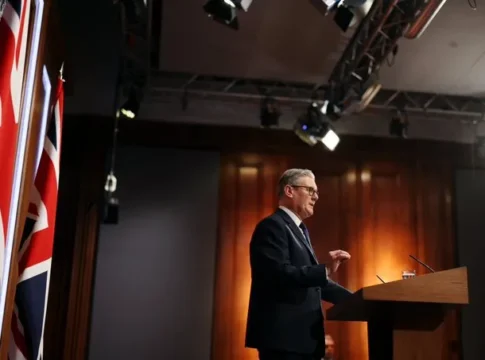
Keir Starmer announced his resignation as Prime Minister of the United Kingdom on Monday, succumbing to immense pressure from within his own Labour Party following significant local election losses. His departure marks the end of a tumultuous premiership and will trigger a leadership contest to select his successor.
Starmer, who led the Labour Party to a historic landslide victory less than two years ago, stated in a televised address outside 10 Downing Street that he had heard the answer of his parliamentary party regarding his leadership and accepted it with “good grace.” He informed King Charles III of his decision on Monday morning.
The immediate catalyst for the intensified pressure on Starmer appears to be the recent success of Andy Burnham, the Mayor of Greater Manchester, who secured a decisive victory in a special parliamentary election in Makerfield. Burnham’s return to the House of Commons positioned him as a strong contender to challenge Starmer for the leadership of the Labour Party.
Sources indicate that Starmer will remain in his post as caretaker prime minister until the Labour Party concludes its leadership election. Nominations for the leadership are expected to open on July 9 and close on July 16, with a new leader slated to be in place before Parliament reconvenes after the summer recess in September. Starmer pledged to offer his successor his “full and unequivocal support.”
Starmer’s tenure has been marked by challenges, including criticism over his handling of national affairs, controversies, and a series of electoral setbacks. Some reports suggest that his popularity had declined significantly, leading to disagreements within the Labour Party. Specific issues cited include the party’s stance on the conflict in Gaza, its economic policies, and the appointment of Peter Mandelson as the UK’s ambassador to the United States, a decision that drew scrutiny due to his past associations.
The resignation sets the United Kingdom on course to potentially see its seventh prime minister in the past decade. Wes Streeting, who was widely considered a potential leadership challenger, announced he would instead support Andy Burnham, making a coronation for Burnham a strong possibility.
In his resignation speech, Starmer reflected on his inheritance of a Labour Party he described as “politically, financially and morally bankrupt” six years prior. He asserted that he had worked to restore trust in areas such as the economy, defense, and national security, and that his decisions were consistently made with the country’s best interests at heart.
The political landscape in Britain has been characterized by considerable turmoil in recent years. Starmer’s premiership, while beginning with a significant electoral mandate, has faced persistent challenges that ultimately proved insurmountable. The upcoming leadership contest will determine the direction of the Labour Party and the country as it navigates ongoing economic concerns and international developments.
❤️ Support Independent Journalism
Your contribution keeps our reporting free, fearless, and accessible to everyone.
Or make a one-time donation
Secure via Razorpay • 12 monthly payments • Cancel anytime before next cycle


(We don't allow anyone to copy content. For Copyright or Use of Content related questions, visit here.)

Global Affairs Desk at The Chenab Times covers international developments, global diplomacy, and foreign policy issues through fact-based reporting, explainers, and analytical pieces. The desk focuses on major geopolitical events, diplomatic engagements, and international trends, with an emphasis on verified information, multiple perspectives, and contextual understanding of global affairs.