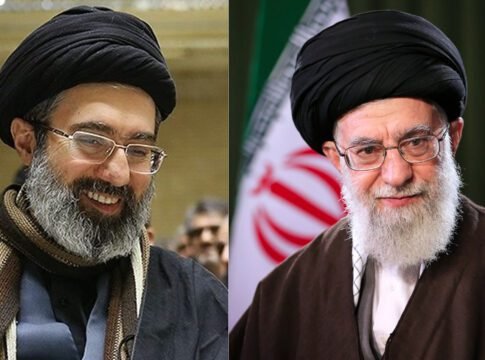
Mojtaba Khamenei, the second son of Iran’s Supreme Leader Ayatollah Ali Khamenei, has reportedly been chosen to assume the country’s top leadership role following the death of his father in alleged U.S.-Israeli strikes, bringing renewed scrutiny to the differences between the two figures.
According to details received by The Chenab Times, Mojtaba Khamenei has long been viewed by analysts and political observers as a powerful yet largely behind-the-scenes figure in Iran’s political and security establishment, with influence extending into the Islamic Revolutionary Guard Corps (IRGC) and conservative clerical networks.
Why this matters
The potential transfer of Iran’s supreme leadership from father to son would be an unprecedented development in the Islamic Republic’s political system, which was originally structured to avoid hereditary rule. The Supreme Leader holds ultimate authority over Iran’s armed forces, judiciary, and major state policies, meaning the personality and political outlook of the officeholder can significantly influence the country’s domestic governance and foreign policy direction.
The contrast between Ali Khamenei and Mojtaba Khamenei has therefore attracted attention from diplomats, researchers and regional observers seeking to understand how Iran’s strategic posture might evolve under new leadership.
Ayatollah Ali Khamenei served as Iran’s Supreme Leader since 1989, succeeding Ayatollah Ruhollah Khomeini after the founder of the Islamic Republic died. During his tenure, Ali Khamenei was often described by analysts as a cautious political operator who balanced competing factions within Iran’s clerical and political system while maintaining the ideological framework of the Islamic Republic.
Mojtaba Khamenei, born in 1969 in Mashhad, Iran, is a cleric who studied in the religious seminaries of Qom. Unlike his father, he has never held an official government position but has reportedly wielded influence within conservative political circles and elements of the security apparatus.
Several Iran specialists and international media reports have suggested that Mojtaba played a role in internal political maneuvering, particularly during periods of domestic unrest and election controversies.
What is happening presently
Reports circulating in international media claim that Mojtaba Khamenei has emerged as the successor following the death of his father in a reported military strike attributed to the United States and Israel. Independent confirmation of these claims remains limited, and Iranian authorities have not publicly detailed the succession process.
Under Iran’s constitution, the Assembly of Experts — a clerical body elected by the public — is responsible for selecting the Supreme Leader. Any transition in leadership would formally require the body’s approval.
Political analysts frequently characterize Mojtaba Khamenei as representing a more hardline ideological current compared to the perceived pragmatism associated with his father’s leadership style. Some observers argue that his close ties with conservative clerical networks and security institutions could lead to a stronger emphasis on ideological consolidation within Iran’s political system.
Others caution that assessments remain speculative due to Mojtaba’s historically low public profile and limited direct statements on policy matters. As a result, analysts say the true direction of Iran’s leadership under Mojtaba Khamenei would only become clearer through official decisions and policy actions in the coming months.
❤️ Support Independent Journalism
Your contribution keeps our reporting free, fearless, and accessible to everyone.
Or make a one-time donation
Secure via Razorpay • 12 monthly payments • Cancel anytime before next cycle


(We don't allow anyone to copy content. For Copyright or Use of Content related questions, visit here.)

Global Affairs Desk at The Chenab Times covers international developments, global diplomacy, and foreign policy issues through fact-based reporting, explainers, and analytical pieces. The desk focuses on major geopolitical events, diplomatic engagements, and international trends, with an emphasis on verified information, multiple perspectives, and contextual understanding of global affairs.