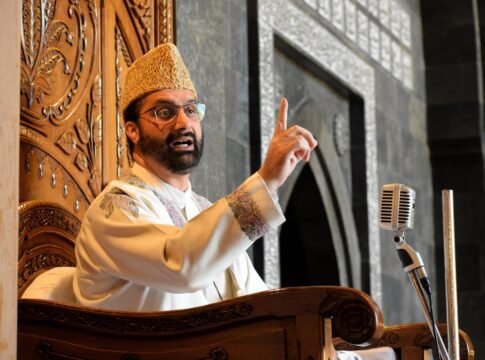
SRINAGAR: Mirwaiz Umar Farooq, the spiritual leader of Kashmir, has urged media professionals and social media users to uphold ethical standards and exercise greater responsibility in content creation and dissemination, particularly concerning minors.
Information was available with The Chenab Times that during his Friday sermon at the historic Jamia Masjid in Srinagar, the Mirwaiz emphasized that accountability extends to all societal roles, including parents, educators, leaders, and the media, which significantly influences public perception.
The Mirwaiz highlighted the dual nature of media, stating that while it can be a tool for education and societal advancement when used judiciously, the relentless pursuit of online engagement without considering consequences can inflict substantial societal damage. He invoked a Hadith of Prophet Muhammad (PBUH), stating, “Every one of you is a guardian, and every one of you will be questioned about those under his care,” to underscore the principle of accountability.
Drawing attention to a recently surfaced viral video, the Mirwaiz lamented the questioning of a minor child about prevailing heatwave conditions and school closures. He noted that the child’s inappropriate response was widely circulated, raising serious concerns about exposing children to public scrutiny and utilizing them for online engagement without regard for the long-term psychological and developmental impact.
He stressed that children represent the future of society and that the questions they are asked, as well as the content they interact with, profoundly shape their cognitive development, values, and outlook. “Children cannot be reduced to tools for entertainment, publicity or increasing social media engagement,” he stated firmly.
Mirwaiz Farooq called for increased sensitivity and accountability in public discourse, asserting that journalists, content creators, and social media influencers must recognize the significant responsibility inherent in their roles. He reiterated that they are answerable to society and to a higher power for the content they produce and distribute.
Addressing both media professionals and the general public, he appealed for restraint and discretion in the creation, sharing, and promotion of content. He observed that the moral fabric of society in the digital age will be largely determined by the content individuals choose to consume, endorse, and circulate. He further emphasized that even disagreements and differing opinions should be articulated with maturity, respect, and moral responsibility, thereby providing positive role models for the upbringing of children.
❤️ Support Independent Journalism
Your contribution keeps our reporting free, fearless, and accessible to everyone.
Or make a one-time donation
Secure via Razorpay • 12 monthly payments • Cancel anytime before next cycle


(We don't allow anyone to copy content. For Copyright or Use of Content related questions, visit here.)

The Chenab Times News Desk