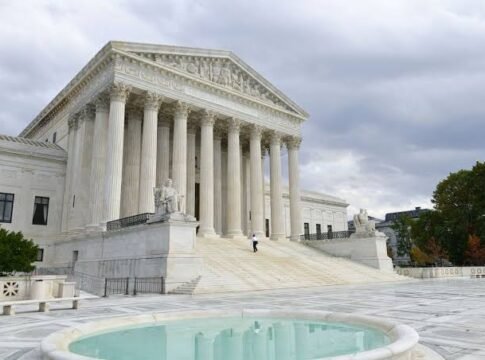
The U.S. Supreme Court is currently hearing oral arguments in a pivotal case concerning birthright citizenship, a legal principle deeply rooted in the nation’s jurisprudence.
Information was available with The Chenab Times indicating that the proceedings mark a significant moment for immigration law and the interpretation of the 14th Amendment. The case could potentially alter the landscape of citizenship for individuals born within the United States to non-citizen parents.
Birthright citizenship, often referred to as ‘jus soli’ (right of soil), is a foundational element of American nationality, granting citizenship to virtually anyone born on U.S. soil, regardless of their parents’ immigration status. This principle is enshrined in the Citizenship Clause of the 14th Amendment, ratified in 1868, which states: “All persons born or naturalized in the United States, and subject to the jurisdiction thereof, are citizens of the United States and of the State wherein they reside.” The current case before the Supreme Court challenges the broad interpretation of this clause, specifically how it applies to children born to parents who are present in the U.S. unlawfully or without full legal status.
The oral arguments are expected to delve into complex legal questions surrounding the scope of the 14th Amendment’s jurisdiction clause. Central to the debate is whether the clause applies to all individuals born within the territorial limits of the United States, or if there are exceptions for children of parents who have not obtained permission to enter or reside in the country. Proponents of maintaining current birthright citizenship laws argue that any alteration would undermine fundamental rights and create a subclass of individuals born in the U.S. but denied full citizenship. They emphasize the historical understanding and widespread acceptance of the principle since the amendment’s ratification.
Conversely, those challenging the broad application of birthright citizenship often cite concerns about national security, border control, and the integrity of the immigration system. Arguments may include interpretations that suggest “subject to the jurisdiction thereof” implies a requirement for legal entry or allegiance to the United States, thus excluding children born to individuals who are present without authorization. Legal scholars and advocates on both sides are closely monitoring the proceedings, recognizing the profound implications for millions of families and the future direction of U.S. immigration policy.
The specific case before the court involves a family whose child was born in the United States to parents who are not U.S. citizens. The legal challenge aims to establish a precedent that would limit birthright citizenship for children born to parents deemed to be in the country unlawfully. This legal strategy has been a subject of debate for years among legal conservatives and immigration restrictionists, who believe that current interpretations have been too expansive and have contributed to what they perceive as an incentive for illegal immigration.
The Supreme Court’s decision in this matter will not only affect the immediate parties involved but could also have far-reaching consequences for federal and state laws related to citizenship, residency, and access to public benefits. The justices will consider historical precedents, the text and intent of the 14th Amendment, and the potential societal impacts of any ruling. The arguments presented today will lay the groundwork for the Court’s deliberation and ultimate decision, which is anticipated to be one of the most significant rulings on citizenship in decades.
The proceedings are being livestreamed and widely reported, drawing attention from legal experts, policymakers, and the public alike. The outcome is likely to be a closely watched event, with potential ramifications extending beyond the borders of the United States, influencing discussions on citizenship and nationality in other countries as well.
❤️ Support Independent Journalism
Your contribution keeps our reporting free, fearless, and accessible to everyone.
Or make a one-time donation
Secure via Razorpay • 12 monthly payments • Cancel anytime before next cycle


(We don't allow anyone to copy content. For Copyright or Use of Content related questions, visit here.)

Global Affairs Desk at The Chenab Times covers international developments, global diplomacy, and foreign policy issues through fact-based reporting, explainers, and analytical pieces. The desk focuses on major geopolitical events, diplomatic engagements, and international trends, with an emphasis on verified information, multiple perspectives, and contextual understanding of global affairs.