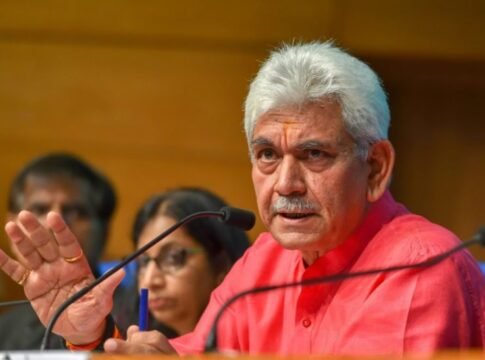
Lieutenant Governor Manoj Sinha attended the 9th Maati Samman Samaroh in Mumbai on Saturday, a cultural event celebrating the art, heritage, cuisine, and tourism of the Purvanchal region of Uttar Pradesh. During his address to the gathering, Sinha emphasized the centuries-old historical, spiritual, and cultural connections between Purvanchal and Maharashtra.
Information was available with The Chenab Times that Sinha highlighted how the relationship between the two regions is deeply rooted in India’s spiritual traditions. He referenced ancient narratives, including episodes from the Ramayana era, noting the association of Lord Ram with places like Panchvati and the shared reverence for prominent religious sites such as Kashi Vishwanath and Trimbakeshwar as reflections of a continuous spiritual lineage.
Describing Purvanchal as more than a mere geographical area, Lieutenant Governor Sinha characterized it as a “consciousness” and a vibrant cultural force that has influenced civilizational thought. He stated that the region embodies spirituality, devotion, artistic expression, and the convergence of significant Indian traditions. During the event, Sinha felicitated several notable personalities from Purvanchal.
He underscored the contributions of historical figures like Lokmata Ahilyabai Holkar, Raghunath Rao, and Malhar Rao Holkar, crediting them with preserving and restoring India’s spiritual and cultural heritage. Specifically, he pointed to Ahilyabai Holkar’s patronage in the restoration and development of key religious sites, including the Kashi Vishwanath Temple and several ghats in Varanasi. Sinha also acknowledged the role of saints from both Maharashtra and Purvanchal, such as Sant Tukaram, Sant Dnyaneshwar, Sant Namdev, Sant Eknath, Sant Ramdas, Goswami Tulsidas, Sant Kabir, and Sant Ravidas, in shaping India’s moral and spiritual consciousness.
The Lieutenant Governor further noted Purvanchal’s significance as a cradle for major literary and spiritual traditions, responsible for texts like the Upanishads, Ramcharitmanas, and the teachings of Kabir and Ravidas, alongside Jain and Buddhist scriptures. He paid tribute to literary figures including Munshi Premchand and Bharatendu Harishchandra, and celebrated the artistic legacies of Pandit Ravi Shankar, Ustad Bismillah Khan, Girija Devi, and Birju Maharaj.
Reflecting on India’s freedom struggle, Sinha recalled the efforts of revolutionaries such as Mangal Pandey, Chandrashekhar Azad, Ram Prasad Bismil, Ashfaqulla Khan, Rani Lakshmibai, and Chittu Pandey. He also pointed out that Purvanchal’s cultural influence has extended beyond India’s borders, with migrant laborers historically carrying Indian traditions to countries like Fiji, Mauritius, Trinidad and Tobago, Suriname, and Guyana.
Highlighting economic interdependence, Sinha mentioned that migrant workers from Uttar Pradesh and Bihar have made significant contributions to Maharashtra’s industrial development. He added that both Maharashtra and Uttar Pradesh are now key contributors to India’s overall economy. Urging younger generations to maintain a connection with their roots, Sinha asserted the essential role of cultural identity in national strength, stating that a nation aware of its spirit never loses its way. He concluded by emphasizing that India’s future strength hinges on the preservation of its heritage and values.
❤️ Support Independent Journalism
Your contribution keeps our reporting free, fearless, and accessible to everyone.
Or make a one-time donation
Secure via Razorpay • 12 monthly payments • Cancel anytime before next cycle


(We don't allow anyone to copy content. For Copyright or Use of Content related questions, visit here.)

The Chenab Times News Desk