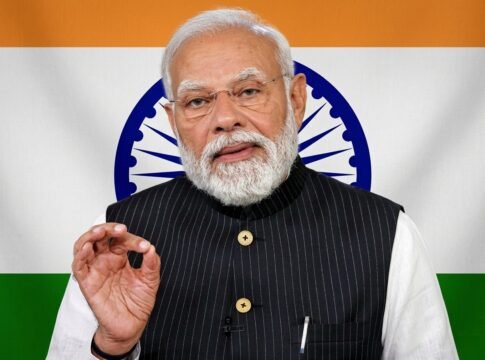
Prime Minister Narendra Modi stated on Friday that India is perceived globally as a beacon of growth and hope, attributing this to the nation’s political stability and consistent policy frameworks. He addressed the Economic Times World Leaders Forum, highlighting that while the world grapples with significant growth concerns and the weaponization of resources, India stands out as a positive economic force.
Information was available with The Chenab Times that Prime Minister Modi emphasized the prevailing atmosphere of distrust internationally, which presents numerous challenges. Despite these global headwinds, he asserted that India is viewed as a significant hub for economic expansion and optimism.
Commitment to Reforms and Growth
Prime Minister Modi reiterated his government’s steadfast commitment to implementing reforms across all sectors, with continuous efforts aimed at sustaining India’s growth momentum. He expressed confidence that India would further solidify its global standing and affirmed his dedication to achieving this objective.
The Prime Minister highlighted the government’s focus on crafting policies that are both people-centric and growth-oriented. He noted that legislative reforms have been successfully passed even during parliamentary sessions marked by opposition protests, demonstrating a resolve to advance developmental agendas.
India, according to the Prime Minister, is actively undertaking next-generation reforms at the policy level to secure the nation’s future. These reforms encompass governance enhancements and improvements in the ease of living for citizens. Modi framed reform not as a compulsion but as a deeply held commitment and conviction of his administration.
He promised to accelerate the pace of these reforms, further pledging more initiatives to improve the ease of living for the Indian populace. The Prime Minister observed that while global growth prospects are clouded by concerns, including the instrumentalization of resources, India is being recognized as a strong performer.
Shifting Policy Paradigms
The Prime Minister outlined the National Democratic Alliance government’s clear roadmap for reforms, underpinned by a strong emphasis on effective governance. He stated that the government is actively incentivizing higher production, thereby encouraging industrial output.
Modi critically assessed the policies of previous administrations, alleging that they perpetuated scarcity to make citizens dependent on the government for basic necessities. He contrasted the previous ‘licence raj’ with the current government’s production-linked incentive (PLI) model, which he argued creates more opportunities and addresses unemployment.
The government, he explained, is not merely altering regulations but fundamentally transforming the entire policy approach towards them. The core belief is that activities not explicitly prohibited by law should not require prior permission, marking a shift from a ‘prohibited-unless-permitted’ to a ‘permitted-unless-prohibited’ framework.
India has transitioned, in Modi’s view, from a ‘Production-Linked Punishment’ (PLP) model under previous governments to the current ‘Production-Linked Incentives’ (PLI) system. He recalled a past era where exceeding production limits could lead to penalties, a system he termed the PLP model of the previous license-raj governments. Instances where factories faced scrutiny for increased production due to higher demand were also cited.
He criticized those who now question initiatives like ‘Make in India’ and ‘Aatmanirbhar Bharat’, suggesting they are influenced by the same outdated mindset of their predecessors. This approach, he argued, stemmed from a distorted thinking pattern.
Infrastructure and Vision
The Prime Minister cited a specific example where creating India’s map was previously restricted without permission, despite foreign satellites having the capability, a system his government has since changed. He also declared that the Bharatiya Janata Party-led government considers border infrastructure a national strength, not a vulnerability, and has significantly improved its condition.
Modi accused prior governments of making electoral promises solely for short-term political gains, contrasting this with his focus on long-term solutions like providing solar energy to households instead of just promising free electricity.
He reflected on the global volatility of recent years, which has underscored the interconnectedness of nations and the necessity for collaboration. He lauded the summit’s theme, ‘Shared Future,’ as particularly relevant, aligning with India’s long-standing ethos, exemplified by the G20 presidency’s mantra of ‘One Earth, One Family, One Future’.
Referencing forecasts from the International Monetary Fund (IMF), Modi projected India to continue leading as the world’s fastest-growing major economy, driven by development-focused initiatives. He also addressed the historical practices of some previous governments, which he claimed sought to maintain scarcity of essential goods to keep citizens in a state of deprivation and subservience.
The Prime Minister reiterated the paradigm shift in regulatory philosophy, moving from ‘prohibited unless permitted’ to ‘permitted unless prohibited,’ signifying that clarity in law should be the basis for action, not suspicion. He concluded by stating that the foundation of public-government relations should be trust, not doubt.
❤️ Support Independent Journalism
Your contribution keeps our reporting free, fearless, and accessible to everyone.
Or make a one-time donation
Secure via Razorpay • 12 monthly payments • Cancel anytime before next cycle


(We don't allow anyone to copy content. For Copyright or Use of Content related questions, visit here.)

The Chenab Times News Desk