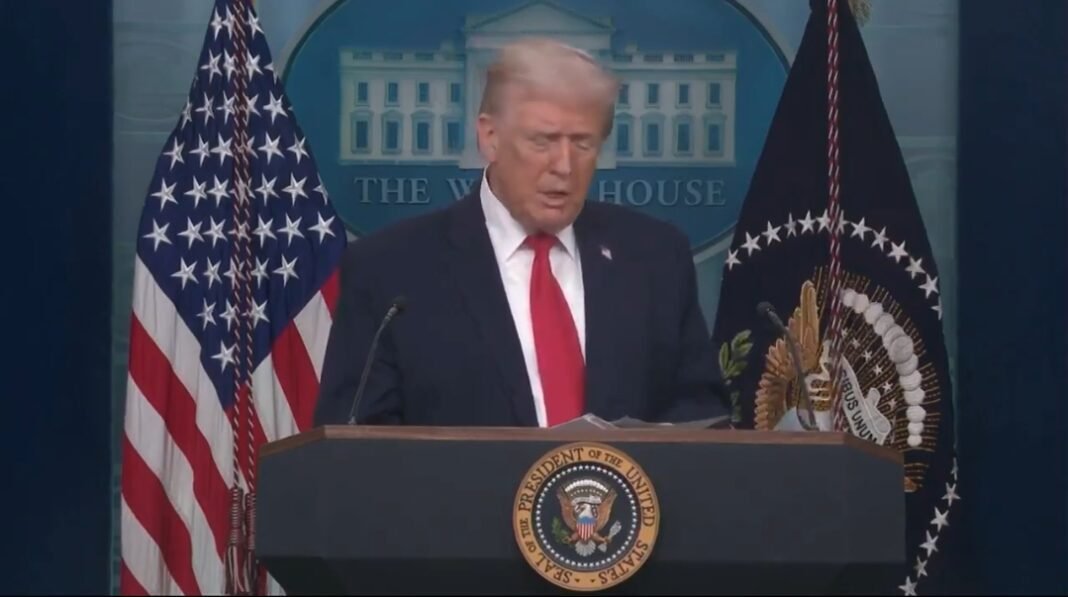
A group of Vietnam War veterans, joined by an architectural historian, has filed a lawsuit seeking to block the construction of a proposed 250-foot “Independence Arch,” or “Great Triumphal Arch,” near Arlington National Cemetery in Washington D.C. The plaintiffs contend that the project, spearheaded by the Trump administration, is proceeding without necessary congressional authorization and will obstruct a historically significant sightline, thereby disrespecting military veterans and the symbolism of the capital’s landscape.
According to details received by The Chenab Times, the lawsuit, filed in the U.S. District Court for the District of Columbia, argues that President Donald Trump’s administration has failed to secure the requisite approvals from Congress and federal review panels for the monumental structure. The veterans, who served as U.S. diplomats after their military service, assert that the proposed arch, slated for completion by July 4, 2026, to commemorate the nation’s 250th anniversary, would disrupt the carefully designed visual axis between the Lincoln Memorial and Arlington National Cemetery.
The plaintiffs, identified as Michael Lemmon, Shaun Byrnes, and Jon Gundersen, along with retired senior architectural historian Calder Loth, argue that this specific line of sight was intentionally established to symbolize the unification of the nation following the Civil War and has existed for nearly a century. They contend that the arch, which would be significantly taller than the Lincoln Memorial, would obscure views to and from Arlington House and the Lincoln Memorial, thereby undermining this historical and symbolic connection. The lawsuit highlights concerns that the project constitutes a “Trump vanity project” and a “continuous visual affront” to the principles of national unity it purports to represent.
The legal challenge, represented by the non-profit watchdog group Public Citizen, seeks a judicial declaration that the planned arch is unlawful and an injunction to halt its construction until all statutory prerequisites, including congressional approval, are met. The plaintiffs’ legal team has emphasized that the arch has not yet begun construction, positioning them to seek an injunction to prevent irreparable harm.
In its defense, the Trump administration, through the Department of Justice, has argued that the plaintiffs lack the legal standing to bring the suit. Government lawyers have asserted that the veterans’ personal and professional experiences cannot transform a mere “distaste for the arch” into concrete injuries required for Article III standing in federal court. The DOJ has also invoked a recent Supreme Court ruling concerning a separate case involving the overhaul of a golf course, suggesting that aesthetic interests alone may not be sufficient to establish standing for such legal challenges.
The administration’s filings point to the Supreme Court’s decision in a case related to the East Wing of the White House, where the court granted the government’s application to stay an injunction. In that instance, the court held that aesthetic interests in viewing the White House likely did not suffice to establish Article III standing. The DOJ contends that the current plaintiffs’ claims regarding view obstruction or landscape destruction are indistinguishable from the arguments rejected in prior cases.
The proposed arch, envisioned for Memorial Circle on Columbia Island, situated between the Lincoln Memorial and Arlington National Cemetery, is part of a broader initiative by the administration to introduce new monuments and commemorate national milestones. Interior Secretary Doug Burgum has previously stated that the administration was preparing to begin excavation work for the arch and a military observation deck. Burgum suggested that the arch was aligned with historical aspirations for the site and that major Western capitals feature such monuments, implying Washington D.C. should have one as well. The plan was reportedly announced in October 2025, with an intention for completion by America’s 250th anniversary.
However, the legal battle underscores a growing tension between the administration’s development agenda and concerns over historic preservation, proper legal procedure, and the symbolic integrity of national landmarks. Critics have questioned the necessity and appropriateness of such a large-scale, potentially costly monument, especially when it faces legal challenges regarding its planning and approval process. The lack of explicit authorization from Congress remains a central point of contention, with federal law typically requiring such approval for major constructions within the capital region.
The architectural historian, Calder Loth, a former senior architectural historian for the Virginia Department of Historic Resources, has added his expertise to the plaintiffs’ arguments, emphasizing how the new structure would undermine the historic relationship between Arlington National Cemetery and other monuments by interrupting long-planned sight lines. His input lends weight to the claim that the project disregards the intentional design and historical context of the area.
The administration’s legal strategy appears to hinge on procedural grounds, aiming to dismiss the case based on the plaintiffs’ alleged lack of legal standing. This approach mirrors tactics used in other challenges to federal projects, particularly those initiated by the Trump administration. The outcome of this lawsuit could have broader implications for how new monuments and public works are proposed, reviewed, and approved within the nation’s capital, particularly concerning the balance between executive authority, public input, and established historical and legal frameworks.
The legal challenge is ongoing, with both sides presenting their arguments before the federal court. The veterans and their allies maintain that the project is an unnecessary and potentially damaging addition to a historically sensitive and symbolic landscape, while the government asserts its right to proceed with projects it deems beneficial for national commemoration and identity.
❤️ Support Independent Journalism
Your contribution keeps our reporting free, fearless, and accessible to everyone.
Or make a one-time donation
Secure via Razorpay • 12 monthly payments • Cancel anytime before next cycle


(We don't allow anyone to copy content. For Copyright or Use of Content related questions, visit here.)
Global Affairs Desk at The Chenab Times covers international developments, global diplomacy, and foreign policy issues through fact-based reporting, explainers, and analytical pieces. The desk focuses on major geopolitical events, diplomatic engagements, and international trends, with an emphasis on verified information, multiple perspectives, and contextual understanding of global affairs.