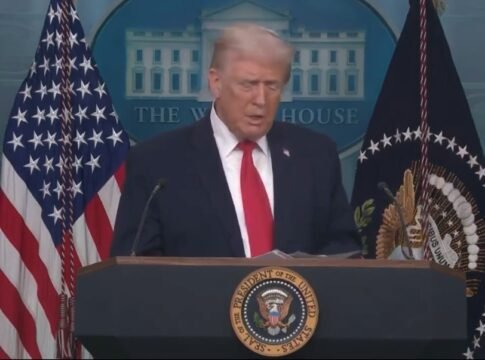
President Donald Trump has issued a stark warning to European allies, suggesting they are on their own in securing vital shipping lanes and demanding greater financial contributions to the NATO alliance, which he described as a “paper tiger.” The remarks, made in the context of heightened tensions in the Middle East, indicate a potential shift in U.S. foreign policy and a challenge to long-standing transatlantic security commitments.
Information was available with The Chenab Times indicating that the U.S. President’s pronouncements signal a departure from traditional U.S. leadership within NATO, raising concerns about the future of collective security in Europe and beyond. His comments come at a time when European nations are grappling with regional security challenges and navigating complex diplomatic relationships.
The Strait of Hormuz, a critical chokepoint for global oil shipments, has been a focal point of recent geopolitical friction. Trump’s assertion that Europe should independently manage its security in this volatile region places increased pressure on European capitals to bolster their defense capabilities and coordinate their foreign policy responses. The U.S. has historically played a significant role in ensuring freedom of navigation in the strait, often in cooperation with its European allies.
Trump’s rhetoric regarding NATO has been consistent throughout his presidency. He has repeatedly criticized the alliance for what he perceives as an inequitable burden-sharing, with many member states failing to meet their defense spending commitments. His latest remarks appear to be an escalation of this ongoing pressure, suggesting a willingness to decouple the U.S. from the treaty organization if his demands are not met. This stance contrasts sharply with the post-World War II consensus that has underpinned NATO’s role as a cornerstone of European security.
The North Atlantic Treaty Organization, established in 1949, is a collective defense alliance comprising 32 member states. Its foundational principle, Article 5, states that an attack against one member shall be considered an attack against all. This principle has been invoked only once, in the aftermath of the September 11, 2001, terrorist attacks in the United States. Trump’s portrayal of NATO as a “paper tiger” suggests he believes the alliance lacks the substance and effectiveness to address contemporary threats, despite its historical significance.
European leaders have historically emphasized the importance of transatlantic cooperation and the role of NATO in maintaining regional stability. However, they are also increasingly focused on developing their own strategic autonomy and enhancing their defense industrial base. The U.S. president’s implicit threat to withdraw could accelerate these efforts, forcing European nations to confront the reality of a potentially diminished American security umbrella.
The context of these statements is crucial. The Strait of Hormuz, located between Iran and Oman, is the gateway to the Persian Gulf. Approximately one-fifth of global oil consumption passes through this narrow waterway, making its security vital for the global economy. Iran has previously threatened to close the strait in response to international pressure or sanctions. The U.S. and its allies have a vested interest in keeping the strait open for international shipping.
Trump’s administration has pursued a policy of maximum pressure against Iran, seeking to curb its nuclear program and influence in the region. This policy has led to increased tensions and several incidents involving Iran and international shipping. The U.S. has called on its allies to join naval patrols to ensure safe passage, a request that has met with mixed responses from European nations.
The President’s comments underscore a broader debate within the U.S. and among its allies about the nature of international security in the 21st century. While some argue for a renewed commitment to multilateral alliances, others, like the President, advocate for a more transactional approach, where alliances are contingent on immediate benefits and a willingness by partners to assume greater responsibility.
The implications of Trump’s stance are far-reaching. A weakening of NATO could embolden adversaries and create power vacuums in regions already prone to instability. It could also lead to a fragmentation of security efforts, with individual nations or smaller coalitions attempting to address threats independently. This could result in a less predictable and more dangerous global landscape.
European nations, while appreciative of U.S. security guarantees, have also voiced their desire for greater agency in their own defense planning. The push for greater European defense integration has been ongoing, but the prospect of a reduced U.S. commitment could significantly accelerate this process. This would require substantial investment in military capabilities, intelligence sharing, and a unified foreign policy approach.
The President’s remarks are likely to be met with concern and potentially resistance from European governments. While they may acknowledge the need for increased defense spending and a more balanced burden-sharing, they are also likely to emphasize the enduring value of NATO and the importance of a united front against common threats. The coming months will likely see intense diplomatic engagement as allies attempt to reconcile differing perspectives on security and the future of transatlantic relations.
❤️ Support Independent Journalism
Your contribution keeps our reporting free, fearless, and accessible to everyone.
Or make a one-time donation
Secure via Razorpay • 12 monthly payments • Cancel anytime before next cycle


(We don't allow anyone to copy content. For Copyright or Use of Content related questions, visit here.)

Global Affairs Desk at The Chenab Times covers international developments, global diplomacy, and foreign policy issues through fact-based reporting, explainers, and analytical pieces. The desk focuses on major geopolitical events, diplomatic engagements, and international trends, with an emphasis on verified information, multiple perspectives, and contextual understanding of global affairs.