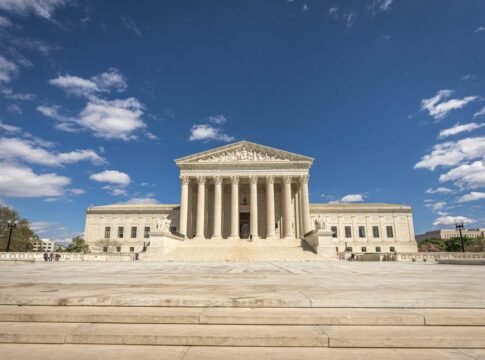
NEW DELHI: A Public Interest Litigation (PIL) has been filed in the Supreme Court seeking the establishment of a judicial commission or expert committee to review the wages and benefits provided to priests, sevadars, and other staff employed in temples that are under state control.
Information was available with The Chenab Times that the petition, filed by advocate Ashwini Upadhyay, argues for the constitution of this body to examine the remuneration and perks for temple staff. The petitioner seeks a declaration that priests and temple staff should be classified as ’employees’ under Section 2(k) of the Code on Wages, 2019, asserting that state administrative and financial control over temples creates an employer-employee relationship. Denial of fair wages, the petition contends, violates the fundamental right to livelihood guaranteed under Article 21 of the Constitution.
Advocate Upadhyay stated that his concern was prompted by a visit to the Kashi Vishwanath temple in Varanasi, which is state-controlled. He learned that priests and staff there were not receiving wages that would allow them to live with dignity, prompting him to highlight the systemic issue.
The PIL points to recent large-scale protests in Andhra Pradesh and Telangana, where priests and temple staff demanded minimum wages. According to the petition, these individuals are often paid less than the minimum wage stipulated by the state for unskilled and semi-skilled workers. This situation is described as systemic exploitation, with the state acting as an employer through its endowments department while allegedly violating the Minimum Wages Act and the directive principles of state policy, specifically Article 43 which aims to secure living wages.
The petition emphasizes the ongoing marginalization of temple staff due to the refusal to provide minimum wages, further compounded by inflation. The petitioner highlighted a specific incident on February 7, 2025, where a circular was issued by a Tamil Nadu department at the Dandayuthapani Swami Temple in Madurai, prohibiting priests from accepting ‘dakshina’ (voluntary donations) in ‘aarti plates’.
The PIL noted that priests in many such temples rely heavily on dakshina for their sustenance, as they often receive no formal salary from the state. The administrative order, even though later withdrawn due to public outcry, illustrated the arbitrary power the state can wield over the survival of these workers. The petition also made a comparative observation, stating that while states control numerous temples, they do not exert similar administrative control over mosques or churches.
Alternatively, the petition requests the Centre and state governments to take appropriate measures for the welfare of priests, sevadars, and other temple staff, in line with the spirit of earlier judgments by the Allahabad High Court.
❤️ Support Independent Journalism
Your contribution keeps our reporting free, fearless, and accessible to everyone.
Or make a one-time donation
Secure via Razorpay • 12 monthly payments • Cancel anytime before next cycle


(We don't allow anyone to copy content. For Copyright or Use of Content related questions, visit here.)

The Chenab Times News Desk