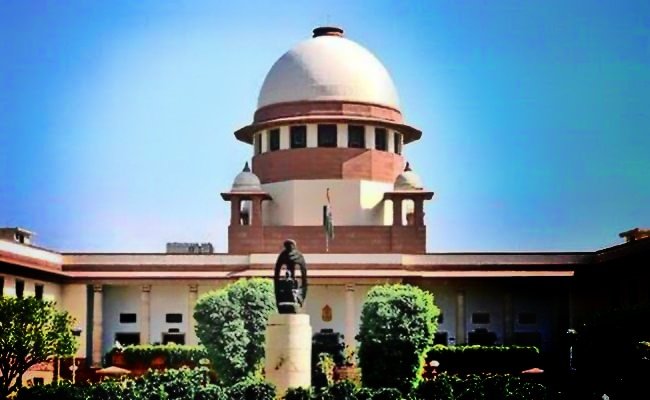
In a landmark judgment, the Supreme Court of India has declared the right to walk on demarcated footpaths as a fundamental right, asserting that this right takes precedence over the movement of motorised vehicles.
The apex court’s ruling, delivered by a bench of Justices P.S. Narasimha and Atul S. Chandurkar, stressed that the existence of a road necessitates a corresponding duty on public authorities to provide and maintain footpaths for pedestrians. This enforceable duty is now judicially recognizable against government agencies that fail to uphold this obligation.
Pedestrian Rights Prioritized
The Supreme Court’s decision stemmed from a motor accident compensation case involving the death of a five-year-old boy. However, the bench expanded the scope of the case to a broader constitutional examination of pedestrian rights and the duties of public authorities. The judgment, now titled ‘Re: Fundamental Right to Walk and Footpath’, underscores that the right to walk is an integral component of the right to life and free movement guaranteed under Articles 21 and 19 of the Constitution.
Writing the judgment, Justice Narasimha stated, “The fundamental right to walk will take within its sweep the right to demarcated footpaths. These rights are primary and shall have priority over movement by motorised vehicles.” The court further elaborated that if a road exists, there is an obligation to ensure that a footpath is demarcated and maintained for walkers. This is an enforceable duty, and the fundamental right to walk on demarcated footpaths shall override the privilege of motorised vehicles.
The ruling places a constitutional duty on urban development authorities, municipal corporations, municipalities, and even panchayats to demarcate, construct, maintain, and safeguard footpaths and other necessary pedestrian infrastructure, recognizing that walking is integral to life.
Gurugram’s Walkability Challenges
The Supreme Court’s declaration casts a fresh spotlight on concerns regarding pedestrian safety and infrastructure in cities like Gurugram. According to the Comprehensive Mobility Management Plan (CMMP) prepared for the Gurugram Metropolitan Development Authority (GMDA) in 2020, walking accounted for a significant 33% of all daily intra-city trips.
Despite this high pedestrian modal share, Gurugram’s average Walkability Index stood at a dismal 0.68 out of 5. The CMMP highlighted that pedestrian facilities, including footpaths and safe road-crossing mechanisms, have been “grossly inadequate” and “deficient not only in quantity but also in quality,” rendering pedestrians highly vulnerable.
Before recent interventions, only 28% of Gurugram’s total road network was covered by footpaths, totaling a mere 153.6 km, primarily in the inner core areas and parts of New Gurgaon. Even in these areas, footpaths are frequently encroached upon by parked vehicles or vendors, forcing pedestrians onto the roads and creating unsafe and inconvenient conditions.
The Gurugram Metropolitan Development Authority (GMDA) is now planning to revamp a 64 km-long footpath network across the district to improve road safety for pedestrians and cyclists. This initiative aims to build and maintain footpaths across residential and commercial sectors, with model stretch projects expected by the end of 2026.
Legal Recourse and Future Legislation
The Supreme Court also stated that any violation of the right to walk, being a fundamental right, would entitle citizens to file writ petitions before the Supreme Court and High Courts to seek remedies against civic authorities and governments for restitution and compensation. This right to approach constitutional courts is independent of the remedies available under the Motor Vehicles Act, 1988.
The judgment urged the Union government and the Law Commission to consider the necessity of a statutory framework to protect this right, identify duty bearers, provide remedies, and establish a full-time regulator. The court emphasized the need for a regulatory body with institutional memory, expertise, and integrity to enhance and effectuate the fundamental right to walk on demarcated footpaths.
The court noted that while the freedom to walk is a constitutional guarantee, it is subject to reasonable restrictions. However, it stressed that common public spaces cannot be monopolized by motorists, and the historical prioritization of motorized transport over pedestrians in Indian cities, leading to inadequate and often encroached-upon footpaths, has been described as a “civilizational problem.”
❤️ Support Independent Journalism
Your contribution keeps our reporting free, fearless, and accessible to everyone.
Or make a one-time donation
Secure via Razorpay • 12 monthly payments • Cancel anytime before next cycle


(We don't allow anyone to copy content. For Copyright or Use of Content related questions, visit here.)

The Chenab Times News Desk