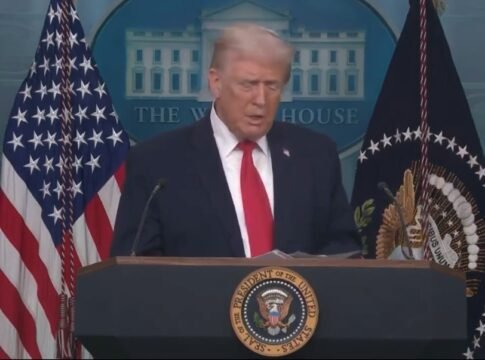
US President Donald Trump has cancelled the planned visit of his envoys to Islamabad, a move seen as a significant setback to diplomatic efforts aimed at de-escalating tensions with Iran. The decision, announced by the President himself, signals a divergence in approach and a lack of immediate progress in ongoing negotiations.
According to details received by The Chenab Times, President Trump stated in remarks to Fox News that he had called off the trip at the eleventh hour. He asserted Washington’s strong negotiating stance, indicating that no further lengthy travel for talks yielding no concrete results would be undertaken. This cancellation comes amidst growing evidence of minimal common ground between the United States and Iran on critical issues such as sanctions and port blockades.
The proposed delegation was described as low-key, with Vice President JD Vance initially only on standby and not scheduled for direct participation. The abrupt cancellation of even this scaled-down visit underscores the widening chasm between the two nations’ positions.
Meanwhile, Iran’s Foreign Minister Abbas Araghchi, who had been in Islamabad for regional consultations, has departed for Muscat, Oman. Pakistani officials, however, anticipate his return in the coming days. During his visit, Araghchi held discussions with Pakistan’s Prime Minister Shehbaz Sharif and Army Chief Asim Munir. Prime Minister Sharif characterized his interactions with the Iranian minister as cordial, with discussions focusing on regional developments and bilateral relations.
Pakistan’s Deputy Prime Minister Ishaq Dar confirmed the meeting’s duration of approximately two hours and emphasized the importance of dialogue and diplomacy for maintaining regional peace and stability. Reports indicate that Araghchi conveyed Tehran’s perspectives on resolving the conflict and expressed Iran’s willingness to continue engaging in Pakistan’s mediation efforts.
However, Iran has consistently maintained that no direct talks with US officials are planned. A spokesperson reiterated that the engagements in Islamabad were strictly bilateral, highlighting the absence of any agreement on the format for potential discussions. Pakistan has positioned itself as a key intermediary, striving to bridge the significant mistrust between Washington and Tehran. Despite claims from the US that Iran is seeking face-to-face negotiations, Iranian officials have denied these assertions, pointing to a fundamental lack of agreement even on the procedural aspects of any talks.
At present, Pakistan’s role appears confined to facilitating indirect communication, as both the US and Iran remain firm on their respective core positions. The diplomatic stalemate persists, even following a temporary two-week ceasefire agreed upon to create space for negotiations after earlier discussions faltered over the US blockade of Iranian ports.
White House Press Secretary Karoline Leavitt had previously expressed optimism for positive developments, but the recent cancellation suggests that the momentum for dialogue has stalled. The situation is further complicated by escalating tensions in the Strait of Hormuz, a strategically vital waterway. Both sides have accused each other of imposing restrictions, indicating a persistent flashpoint that analysts suggest signifies a distant prospect for a long-term resolution.
Domestically, Iran is also grappling with mounting pressures. President Masoud Pezeshkian has urged citizens to conserve electricity amidst ongoing economic strain, suggesting that external pressures are being leveraged to foment public discontent.
❤️ Support Independent Journalism
Your contribution keeps our reporting free, fearless, and accessible to everyone.
Or make a one-time donation
Secure via Razorpay • 12 monthly payments • Cancel anytime before next cycle


(We don't allow anyone to copy content. For Copyright or Use of Content related questions, visit here.)

The Chenab Times News Desk