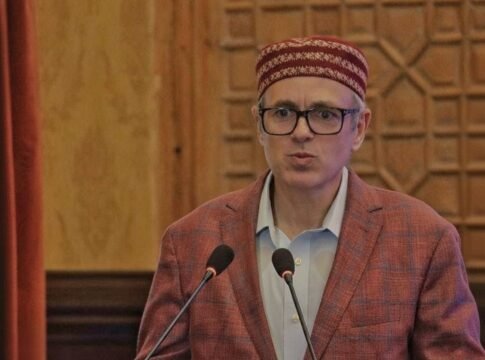
SRINAGAR: A senior political leader from Jammu and Kashmir has publicly questioned the Tamil Nadu Governor’s decision to deny the leader of the Tamilaga Vettri Kazhagam (TVK) party an opportunity to prove his majority in the state assembly, asserting that established legal precedents support such an invitation.
The Chenab Times has learned that the former Chief Minister of Jammu and Kashmir stated that there was no apparent justification for the Governor’s action, especially in light of numerous Supreme Court judgments that advocate for inviting the single largest party to form the government and subsequently test its majority on the floor of the house.
The assertion comes in the wake of Tamil Nadu Governor Rajendra Vishwanath Arlekar’s rejection on Thursday of TVK chief Vijay’s claim to form the government. The Governor cited the party’s perceived lack of requisite numbers as the reason for his decision. The TVK party, despite securing support from the Congress party, which has five MLAs, reportedly falls short of the simple majority of 118 required in the 234-member Tamil Nadu Assembly.
The leader articulated his view that the current situation in Tamil Nadu contradicts the spirit of Supreme Court rulings on post-election government formation. He referenced several instances where the apex court has emphasized that the leader of the single largest party should be invited to form a government and then be given the chance to prove their legislative strength.
Drawing parallels to historical political events, the leader recalled the formation of the government led by former Prime Minister Atal Bihari Vajpayee. He pointed out that in that instance, the President of India invited Vajpayee to form the government without waiting for him to demonstrate his numbers beforehand. The government subsequently operated for 13 days, and it was only after Vajpayee failed to secure the necessary majority that he resigned.
Applying this principle to the current political scenario in Tamil Nadu, the leader contended that the Governor’s office, referred to colloquially as ‘Lok Bhavan’ in this context, had no valid grounds to halt the government formation process. He reiterated that Vijay should be permitted to form the government and subsequently be afforded the opportunity to prove his majority in the assembly.
The political stance taken by the leader from Jammu and Kashmir highlights a broader debate on constitutional propriety and the conventions surrounding government formation in India, particularly concerning the roles of state governors and the interpretation of Supreme Court directives on such matters. The situation in Tamil Nadu remains a focal point of political discussion, with implications for governance and democratic processes in the state.
❤️ Support Independent Journalism
Your contribution keeps our reporting free, fearless, and accessible to everyone.
Or make a one-time donation
Secure via Razorpay • 12 monthly payments • Cancel anytime before next cycle


(We don't allow anyone to copy content. For Copyright or Use of Content related questions, visit here.)

The Chenab Times News Desk