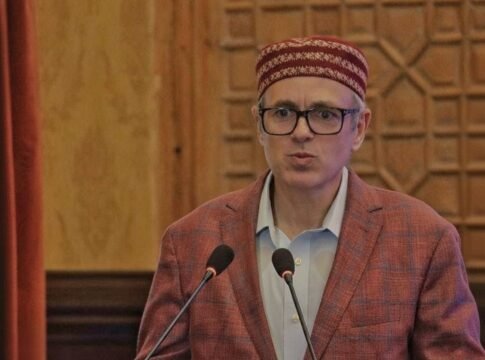
Srinagar, Sep 15: Former Jammu and Kashmir Chief Minister Omar Abdullah has voiced strong reservations regarding the strategy adopted by Bharatiya Janata Party-led state governments to pursue the Uniform Civil Code (UCC), asserting that legislation of such national significance should be deliberated and enacted in Parliament rather than through piecemeal state-level initiatives.
Information was available with The Chenab Times that Abdullah, speaking in Srinagar, questioned the rationale behind the BJP’s approach, stating, “If you have the numbers, bring it to Parliament. Why are you doing it separately in different states?” He argued that the principle of universality inherent in a civil code would be undermined if its application was confined only to states governed by the BJP, emphasizing that the nation comprises many states and territories not under BJP rule.
Abdullah further highlighted internal contradictions within the National Democratic Alliance, pointing out that some allied parties have expressed opposition to implementing the UCC within their respective states. He cited the example of Janata Dal (United) reportedly stating its unwillingness to implement the code in Bihar. “So if their own allies are not ready for it, how can they say that it should be implemented across the country?” he asked.
The former Chief Minister reiterated his belief that a matter of such profound importance requires a national consensus and should be decided by Parliament, which he described as the representative body of the entire country. “Something of this nature should not be decided by individual states. It has to be decided by the country as a whole,” Abdullah stated, adding, “The country as a whole is represented not in the states but in Parliament. Let the legislation come to Parliament.”
He also drew a parallel with other major legislative proposals, questioning why the government was choosing to advance the UCC through states when other significant initiatives, such as ‘One Nation, One Election’ or reservation policies, had been subject to parliamentary discussion. “So far, whenever they have talked about legislation in Parliament, whether it is One Nation, One Election or reservation, they have not brought it to Parliament,” he said. “Now, with this too, they are talking about bringing it in the states. Bring it to Parliament and let us see whether you can pass it.”
In separate remarks, Abdullah addressed the issue of foreign policy, responding to China’s reported commendation of India’s foreign policy. He advised against placing undue importance on assessments from other nations, whether positive or negative. “Our foreign policy is our own. Why do we look for certificates from other countries?” he queried, cautioning against a selective acceptance of foreign comments. He suggested that relying on such external validation could lead to a dilemma if those same countries later offered criticism. “The danger with something like this is that tomorrow, if China says something against our foreign policy, then what will you do?” Abdullah asked. He concluded this point by stating, “We should neither want their praise nor their criticism. Our foreign policy is our own. We should focus on that.”
Turning to border security, Abdullah welcomed reports of a reduction in Chinese military deployments along the Line of Actual Control (LAC). He described any such move as a positive step towards de-escalating tensions, particularly for the residents living in proximity to the India-China frontier. “Anything that reduces tensions on the Line of Control or the Line of Actual Control is a good step, particularly for those people who live close to it,” he said. He acknowledged the difficulties faced by communities living near these borders and expressed hope for similar improvements along the Line of Control with Pakistan. “So, if there is any step that reduces deployments along the Line of Actual Control, that is a good step. Similarly, we hope that, over time, things will get better along the Line of Control as well,” he stated.
Addressing the National Conference’s condemnation of an attack in Pahalgam, Abdullah clarified that while the party had reacted, the primary responsibility for addressing such incidents and their international implications lay with the central government and the Ministry of External Affairs. He noted the significance of the Pahalgam attack being mentioned in international condemnations, especially given the presence of countries considered allies of Pakistan. “The fact that Pahalgam itself was condemned is a big thing,” he remarked. “For even Pahalgam to be mentioned by name, that in itself is a success of our foreign policy. Now, okay, it has happened. Let us move forward. Let’s move on.”
❤️ Support Independent Journalism
Your contribution keeps our reporting free, fearless, and accessible to everyone.
Or make a one-time donation
Secure via Razorpay • 12 monthly payments • Cancel anytime before next cycle


(We don't allow anyone to copy content. For Copyright or Use of Content related questions, visit here.)

The Chenab Times News Desk