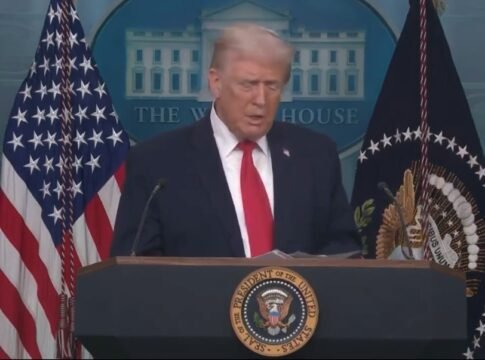
U.S. President Donald Trump was photographed aboard Air Force One looking at a large placard that appeared to show the demolition of the John F. Kennedy Center for the Performing Arts. The image, captured by an AFP photographer as the plane landed at Joint Base Andrews, Maryland, emerged amidst an escalating legal battle over the renaming of the iconic Washington D.C. arts institution.
The placard, with text in red, was partially visible and seemed to read “Kennedy Center DEMOLIS…” followed by an image of a construction vehicle working on rubble. This visual was presented in a federal court filing by lawyers representing a Kennedy Center trustee who is challenging the president’s efforts to have the venue renamed in his honor. The filing characterized the photograph as new evidence in the ongoing legal dispute.
The development comes as President Trump has repeatedly suggested that the Kennedy Center could be “ripped down” if his administration does not receive recognition for its financial support. Speaking to reporters prior to the photograph being taken, Trump argued that his administration’s involvement should warrant naming rights due to the significant financial challenges the center has faced. He stated that without his intervention, the center might have to be torn down, implying a need for substantial subsidies to maintain it long-term.
A federal judge has previously blocked attempts by the Kennedy Center board to add President Trump’s name to the building, ruling that such a change requires congressional approval. The latest court filing by the trustee’s lawyers, including the photograph, was intended to demonstrate the potential consequences of the ongoing dispute and the president’s strong stance on the matter.
The Kennedy Center, authorized by the National Cultural Center Act of 1958, operates through a public-private partnership. While it receives federal funding for maintenance and operations, its programming is largely sustained through ticket sales and private donations. Historically, Congress allocated significant funds for its construction and maintenance, with the federal government providing appropriations for operations and repair of the presidential memorial until 1995, after which the Board of Trustees became fully responsible. In recent years, there have been legal challenges regarding the board’s authority to rename the center, with one lawsuit concerning funds allegedly gathered on behalf of the Washington National Opera.
The center’s financial situation has been a subject of discussion, with some reports indicating financial difficulties and a projected deficit. Internal documents obtained by The Washington Post suggested that ticket revenue and fundraising experienced a significant decline after President Trump’s name was added to the center and its board voted to rename it in December. These documents reportedly indicated that both ticket sales and donations plunged following the board’s decision, leading to a projected deficit of $23 million for the fiscal year.
President Trump installed himself as chairman of the center shortly after beginning his second term. The venue’s board had previously voted to rename it the “Trump-Kennedy” Center and installed signage. However, legal challenges have arisen, with a U.S. representative filing suit against the trustees over their authority to change the name. In a separate but related development, a court ruling on September 15, 2026, blocked the board from inscribing President Trump’s name on the building again. Following this, the board voted to immediately close the center for repairs.
The Kennedy Center was originally designated as a living memorial to President John F. Kennedy. Funding for its construction came from a combination of private contributions, federal matching funds, and U.S. Department of Treasury revenue bonds. Subsequent amendments authorized federal assistance for maintenance, security, and operations. The center’s budget for fiscal year 2025 includes a request for significant funds for operations and maintenance, with a two-year spending authority through September 30, 2026, aligning with a projected closure for renovations. The proposed renovations were projected to cost approximately $257 million, with Congress appropriating similar restricted funding for capital repair, restoration, and maintenance.
❤️ Support Independent Journalism
Your contribution keeps our reporting free, fearless, and accessible to everyone.
Or make a one-time donation
Secure via Razorpay • 12 monthly payments • Cancel anytime before next cycle


(We don't allow anyone to copy content. For Copyright or Use of Content related questions, visit here.)

Global Affairs Desk at The Chenab Times covers international developments, global diplomacy, and foreign policy issues through fact-based reporting, explainers, and analytical pieces. The desk focuses on major geopolitical events, diplomatic engagements, and international trends, with an emphasis on verified information, multiple perspectives, and contextual understanding of global affairs.