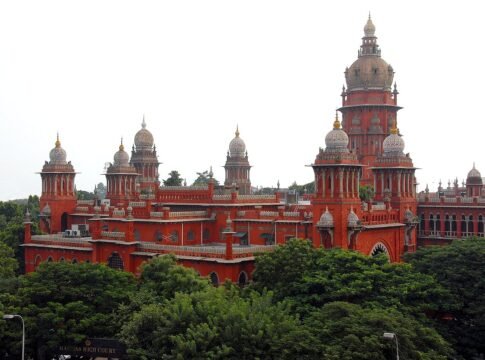
The Madras High Court has directed the police to take comprehensive action against members of all political parties who post defamatory content on social media platforms. This directive came during the hearing of a petition filed by a Dravida Munnetra Kazhagam (DMK) functionary who alleged that complaints regarding objectionable posts targeting the party and its leaders had not been adequately addressed.
Court Seeks Broader Action on Social Media Defamation
The petition was filed by Chandrabose, the deputy secretary of the DMK legal wing, who approached the Madras High Court seeking a probe into several complaints about fabricated digital content being circulated on platforms including X, Facebook, Instagram, YouTube, and WhatsApp. The content allegedly targeted the DMK, its leaders, and public figures. The plea detailed that the impugned material included AI-generated images, morphed photographs, manipulated videos, fabricated news cards, and misleading captions. The petitioner argued that this content not only constituted fair political criticism but also prima facie disclosed cognizable offences such as impersonation of media organisations, public mischief, defamation, circulation of false electronic content, and acts affecting public order.
Information available with The Chenab Times indicates that the petitioner had lodged multiple complaints with the Commissioner of Police, Greater Chennai Police, and other authorities. He alleged that despite the complaints disclosing cognizable offences, the police had failed to register First Information Reports (FIRs), conduct proper investigations, or effectively preserve electronic evidence. The petitioner contended that any delay or inaction could lead to the irreparable loss of volatile cyber evidence.
During a previous hearing, the court had issued notices to DMK president M.K. Stalin and the DMK IT Wing in a ₹1 crore civil defamation suit filed by Tamil Nadu Minister Aadhav Arjuna. Arjuna alleged that a social media post by the DMK IT Wing linked him to an accused in a narcotics case, which he vehemently denied, stating that the individual named was not his relative. Arjuna’s suit claimed that the post was published on the instructions of Stalin, who he described as exercising complete control over the party’s affairs. The minister sought damages for loss of reputation, personal injury, and mental agony, alongside a permanent injunction against future defamatory statements and the deletion of existing posts.
Stalin Denies Responsibility for All Party Social Media Content
In a related development, M.K. Stalin, President of the DMK, informed the Madras High Court that he cannot be held responsible for every social media post made by various DMK handles and functionaries. This statement was made in the context of a defamation case. The court has given the DMK president more time to respond to the defamation petition filed by Minister Aadhav Arjuna, with the next hearing scheduled for September 22, 2026. Senior counsel P. Wilson, representing Stalin, had requested an adjournment to file a counter-affidavit.
The court’s broader directive for comprehensive action against defamatory social media posts by all political parties underscores a growing concern over the misuse of online platforms for political attacks. State Public Prosecutor John Sathyan reportedly informed the court that a detailed procedure was being formulated to handle and remove defamatory content from social media, seeking two weeks to finalize it.
Earlier, the Madras High Court had also dealt with a case where a DMK ‘Gen Z’ wing coordinator sought anticipatory bail over a derogatory Instagram post targeting Chief Minister C. Joseph Vijay. The court expressed its disinclination to grant relief, observing that the post had crossed the limits of permissible political criticism and affected the societal conscience.
In another instance, a DMK functionary lodged a complaint with the police and the Tamil Nadu cybercrime wing against an X account for allegedly posting defamatory content about former Chief Minister M. K. Stalin. The complaint targeted a user handle reportedly associated with supporters of Chief Minister C. Joseph Vijay, accusing them of circulating false and offensive content that falsely claimed Stalin had obtained personal loans and pushed Tamil Nadu into debt.
The High Court has also taken a stance on the admissibility of digital evidence, with a recent ruling stating that photocopies of screenshots from social media posted on news websites cannot be treated as primary evidence without a mandatory certificate under Section 65B(4) of the Indian Evidence Act. This ruling led to the acquittal of BJP leader H. Raja in a case involving alleged remarks against DMK leaders, highlighting the technicalities involved in prosecuting online defamation.
❤️ Support Independent Journalism
Your contribution keeps our reporting free, fearless, and accessible to everyone.
Or make a one-time donation
Secure via Razorpay • 12 monthly payments • Cancel anytime before next cycle


(We don't allow anyone to copy content. For Copyright or Use of Content related questions, visit here.)

The Chenab Times News Desk