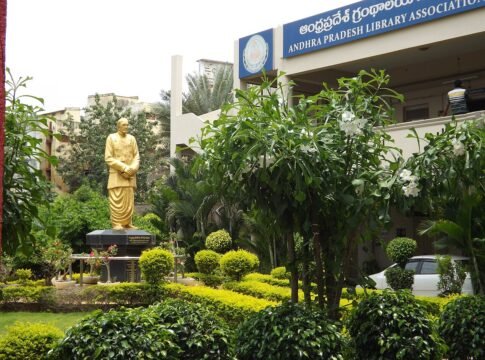
A comprehensive capacity-building program for public library personnel has commenced at Andhra University, while a substantial sum of ₹3.10 crore has been sanctioned for the development and enhancement of libraries across Andhra Pradesh. The initiative aims to bolster library infrastructure and services, ensuring greater access to knowledge and resources for the public.
According to details received by The Chenab Times, the five-day training program, organized by the Department of Library and Information Science at Andhra University, brings together public library professionals from Andhra Pradesh, Telangana, and Chhattisgarh. This program is part of the National Mission on Libraries (NML), which was established in 2014 with the objective of developing a quality library infrastructure nationwide. The NML operates through four key components: establishing model public libraries, conducting surveys of public libraries, organizing capacity-building programs for library professionals, and developing the National Virtual Library of India, now known as the Indian Culture Portal. While the foundation for the first three components lies with the Raja Rammohun Roy Library Foundation (RRRLF), the Indian Culture Portal is managed by IIT Bombay.
The funding allocated to Andhra Pradesh is being directed towards significant upgrades for key libraries within the state. Specifically, ₹2.23 crore has been sanctioned for the State Central Library in Amaravati, and an additional ₹87 lakh has been earmarked for the Sri Gowthami Regional Library in Rajamahendravaram. Information was available with The Chenab Times indicating that the full amount for the Rajamahendravaram library has been released, while the state’s matching share for the Amaravati library is still pending.
Participants in the capacity-building program are also scheduled to visit various public and university libraries as part of their training module, providing them with practical insights and exposure to best practices in library management and services. The program emphasizes drawing a wider audience to libraries, extending their reach beyond individuals preparing for competitive examinations to encompass all sections of society.
The funding structure for libraries, as explained by officials, follows a 75:25 Centre-State ratio, with Central assistance released on the recommendation of the State Library Planning Committee. This collaborative approach aims to ensure that national objectives for library development are met with state-level participation and support.
Beyond the current funding, Andhra Pradesh has seen other significant library development initiatives. In a previous allocation, the State Library Planning Committee discussed the utilization of ₹3 crore from the RRRLF for development projects, including the modernization of libraries in Guntur, Kurnool, and Visakhapatnam, in addition to the Sri Gowthami Regional Library. Furthermore, proposals have been prepared for the modernization of 50 Grade-I and Grade-II libraries across the state under the RRRLF’s Non-Matching Scheme.
Looking towards the future, Andhra Pradesh has ambitious plans for digital library expansion. An initiative was announced to establish 10,960 digital libraries in every village across the state, with an estimated allocation of ₹450 crore. This ambitious project aims to enhance access to education and technology in rural areas, with the first digital library already established in Kadapa.
In a related development, Amaravati is set to house a world-class State Central Library, with an estimated cost of ₹150 crore. This project is envisioned as a major knowledge and cultural hub, with a significant contribution from the Dubai-based real estate company Sobha Group. The library, planned as a G+5 structure with a built-up area of nearly 3 lakh square feet, aims to accommodate over a million books and provide seating for 2,500 people, positioning it among the largest libraries in the country. The architectural designs for this facility, which will also include a Telugu Cultural Centre and a Human Resource Development Institute, have been finalized. The library’s design incorporates various dedicated spaces for learning, culture, and community engagement, including separate sections for general readers, students, researchers, and a children’s library, alongside digital and e-library services.
The ongoing capacity-building program and the substantial financial allocations underscore a focused effort by both central and state governments to modernize and expand library services, recognizing their crucial role in education, knowledge dissemination, and community development.
❤️ Support Independent Journalism
Your contribution keeps our reporting free, fearless, and accessible to everyone.
Or make a one-time donation
Secure via Razorpay • 12 monthly payments • Cancel anytime before next cycle


(We don't allow anyone to copy content. For Copyright or Use of Content related questions, visit here.)

The Chenab Times News Desk