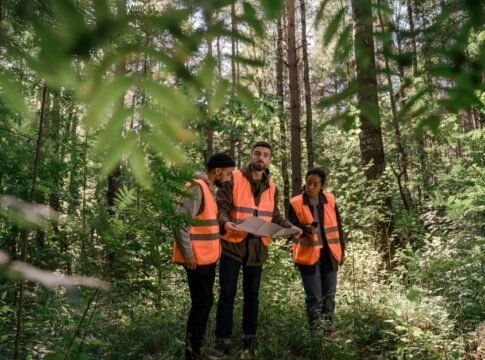
SRINAGAR: Jammu and Kashmir has witnessed a significant increase in its forest cover, adding 224.39 square kilometres over the past four years. This expansion brings the Union Territory’s total forest cover to 21,346.39 square kilometres, according to recent data presented by the Union Government in the Lok Sabha.
Information was available with The Chenab Times indicating that the latest figures from the Forest Survey of India (FSI) show a rise from 21,122 square kilometres in the India State of Forest Report (ISFR) 2019 to the current 21,346.39 square kilometres in ISFR 2023. Kirti Vardhan Singh, Minister of State for Environment, Forest and Climate Change, shared this data during a parliamentary session in response to a question concerning funds allocated and utilized for afforestation initiatives.
Nationally, the forest cover across India has also seen an upward trend, increasing by 3,093.14 square kilometres between 2019 and 2023. This brings the total forest cover in the country to 7,15,342.61 square kilometres, which constitutes 21.76 per cent of India’s total geographical area.
The Union Government detailed financial allocations made to Jammu and Kashmir for green initiatives. Under the Green India Mission, the Union Territory received ₹10.99 crore over five financial years, from 2021-22 to 2025-26. Additionally, the National CAMPA (Compensatory Afforestation Fund Management and Planning Authority) approved ₹28.54 crore for compensatory afforestation during the same period.
Further support for urban green spaces came through the Nagar Van Yojana, with Jammu and Kashmir receiving ₹15.09 crore allocated for the period between 2020-21 and 2025-26. These funds are part of broader national efforts to bolster forest cover and ecological health.
The Ministry of Environment, Forest and Climate Change indicated that financial assistance is provided to States and Union Territories through various Centrally Sponsored Schemes. These include the Green India Mission, CAMPA, MISHTI (Mangrove Initiative for Shoreline Habitats & Tangible Incomes), and Nagar Van Yojana, all aimed at promoting afforestation, reforestation, ecological restoration, and forest conservation.
Nationwide, 652 projects under the Nagar Van Yojana have received approval between 2020-21 and 2025-26, encompassing a total area of 19,348.591 hectares, with an approved cost of ₹699.33 crore, of which ₹564.39 crore has been disbursed.
However, the government acknowledged that a centralized database for the survival rates of saplings planted under all forest conservation and tree plantation programs is not maintained. The survival of these saplings is contingent upon a multitude of factors, including the selection of species, site-specific and climatic conditions, rainfall patterns, soil moisture levels, protection from biotic interference, and effective post-plantation maintenance.
Monitoring of these plantation drives is typically carried out by the implementing agencies and their respective State Forest Departments, adhering to the guidelines set forth by the concerned schemes. The Ministry also highlighted the nationwide campaign ‘Ek Ped Maa Ke Naam’ (#Plant4Mother), launched on World Environment Day in 2024, which aims to enhance green cover through public participation from government departments and various stakeholders.
❤️ Support Independent Journalism
Your contribution keeps our reporting free, fearless, and accessible to everyone.
Or make a one-time donation
Secure via Razorpay • 12 monthly payments • Cancel anytime before next cycle


(We don't allow anyone to copy content. For Copyright or Use of Content related questions, visit here.)

The Chenab Times News Desk