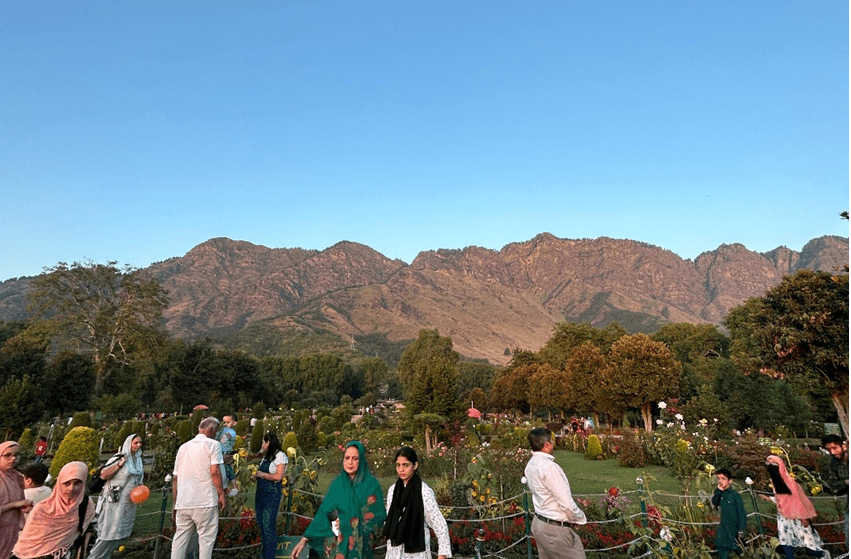
SRINAGAR: A seminal scholarly work dedicated exclusively to the landscape heritage of Kashmir’s historic Mughal gardens has been unveiled, sparking renewed hope among conservationists and historians for the preservation of the region’s invaluable cultural assets. The comprehensive study aims to serve as a vital blueprint for safeguarding these iconic sites.
The Chenab Times has learned that the anticipation surrounding this groundbreaking research was palpable at a pre-launch event and panel discussion held at the Amar Singh Club in Srinagar. Belgian landscape architect and researcher Professor Jan Haenraets presented his forthcoming 600-page book, titled Kashmir’s Mughal Landscape of Gardens: Creation and Decline of a Golden Age, 1586–1753.
Experts attending the event highlighted that the publication addresses a significant void in existing scholarship. It meticulously documents the historical evolution, intricate design principles, ecological contexts, and pressing conservation challenges faced by Kashmir’s Mughal gardens. Crucially, the study also brings to light lesser-known and previously overlooked garden sites across the Valley.
Professor Haenraets’ research, the culmination of over 16 years of dedicated work, scrutinizes approximately 80 Mughal garden sites throughout Kashmir. The findings are poised to become an indispensable reference for heritage professionals, urban planners, and policymakers directly involved in conservation initiatives.
During his address, Haenraets emphasized that Kashmir’s gardens transcend their status as regional monuments. He asserted that they functioned as pivotal models for Mughal landscape architecture across the entirety of South Asia.
“Kashmir gardens were essential to what was practiced by the Mughals outside,” Professor Haenraets stated. He pointed out that design elements found in celebrated sites such as the Taj Mahal in Agra and Bagh-e Babur in Kabul bear the imprint of concepts that were initially conceptualized and developed in Kashmir.
He specifically drew attention to the Valley’s unique terraced layouts, its advanced hydraulic engineering systems, and its characteristic elongated garden designs. Haenraets argued that these distinctive features played a crucial role in shaping the imperial garden traditions that extended far beyond Kashmir’s borders.
The author characterized the gardens as “essential elements of Kashmir’s identity and heritage.” He underscored that his book is intended not merely as a historical chronicle but as a practical manual to guide future conservation efforts.
Professor Haenraets issued a cautionary note regarding the potential threats posed by rapid urbanization and extensive infrastructure development. He warned that the integrity of these historic landscapes could be jeopardized if crucial preservation concerns are not adequately addressed and integrated into development planning.
The book meticulously details over 50 Mughal gardens spread across Kashmir. It incorporates detailed maps, archival photographs, extensive field surveys, and in-depth historical analysis. Furthermore, it examines the broader network of gardens established by Mughal emperors, empresses, governors, and nobles who significantly influenced the Valley’s landscape over a period of nearly two centuries.
Saleem Beg, the convener of the Jammu and Kashmir chapter of the Indian National Trust for Art and Cultural Heritage (INTACH), described the publication as a monumental contribution to the field of heritage studies. He noted that the work offers novel perspectives on Kashmir’s cultural landscape and establishes a vital foundation for future restoration and preservation endeavors.
“The stage has come to restore these gardens to respectable levels and preserve them as collective heritage spaces,” Beg remarked, adding that numerous interventions over the decades had regrettably compromised the historical authenticity of many of these sites.
Historian Sameer Hamdani echoed these sentiments, hailing the publication as a significant addition to the existing literature on Kashmir’s built heritage. He observed that while Mughal architecture has been a subject of extensive study, the surrounding landscapes associated with these monuments have historically received comparatively limited scholarly attention.
Attendees from diverse academic, architectural, and conservation backgrounds welcomed the study. They expressed a shared hope that it would stimulate greater public awareness, encourage further research, and prompt increased policy focus on the crucial task of preserving Kashmir’s historic garden network.
The event facilitated a robust discussion on the future trajectory of Kashmir’s cultural landscapes and the multifaceted challenges involved in their protection amidst the pressures of contemporary development. The book is slated for official release in August.
❤️ Support Independent Journalism
Your contribution keeps our reporting free, fearless, and accessible to everyone.
Or make a one-time donation
Secure via Razorpay • 12 monthly payments • Cancel anytime before next cycle


(We don't allow anyone to copy content. For Copyright or Use of Content related questions, visit here.)

The Chenab Times News Desk