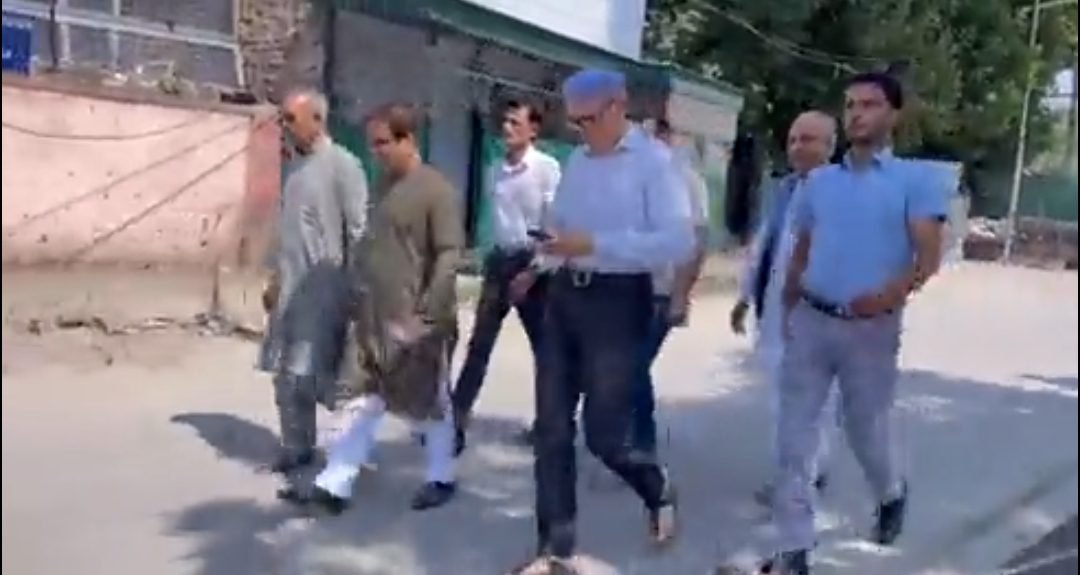
Former Jammu and Kashmir Chief Minister and National Conference vice president, Omar Abdullah, embarked on a foot journey to his office on July 13, after allegedly being denied security arrangements on the occasion of Martyr’s Day. Omar expressed his determination in a tweet, stating that the refusal to provide escort vehicles and ITBP cover would not deter him from reaching his destination.
Accompanied by his personal bodyguards, Omar Abdullah shared a video of himself walking along the Gupkar road in Srinagar. He announced his arrival at the National Conference (NC) office on the banks of Jhelum and affirmed his intention to proceed with his scheduled program. Omar also revealed that the Jammu and Kashmir Police had adopted similar tactics of preventing his senior colleagues, including Abdul Rahim Rather, Ali Mohammad Sagar, Ali Mohd Dar, and others, from reaching the JKNC office by stopping them in their homes.
July 13 has traditionally been observed as Martyr’s Day in Jammu and Kashmir, commemorating the killing of 22 unarmed civilians by the armed forces of Maharaja Hari Singh, the last Dogra ruler, in 1931. Prior to August 2019, when Jammu and Kashmir’s special status was revoked by the Central Government, July 13 was a designated holiday in the official calendar.
Previously, both the J&K government and mainstream political and separatist parties observed Martyr’s Day. Leaders would visit the graves of the victims, adorning them with flowers and offering prayers. Despite the closure of the Martyrs’ Graveyard by authorities, the day passed relatively normally in Kashmir, with regular traffic on the roads and shops remaining open. Security forces were deployed along the roads leading to the graveyard.
Various political parties, including the Jammu & Kashmir Awami Action Committee (AAC), Jammu and Kashmir National Conference (NC), Jammu and Kashmir Peoples Democratic Party (PDP), and Jammu and Kashmir Apni Party (AP), issued statements paying tribute to the martyrs of July 13, 1931. These parties emphasized the significance of the day in the history of Jammu and Kashmir and urged the public to be well-informed about the struggle against oppression and tyranny.
Dr. Farooq Abdullah, President of the National Conference, and Omar Abdullah, the party’s Vice President, honored the martyrs and highlighted the perseverance and non-violent nature of the Kashmiri struggle for justice and dignity. The People’s Democratic Party (PDP) reiterated its commitment to restoring the dignity and democracy of Jammu and Kashmir, while the Jammu and Kashmir Apni Party (JKAP) emphasized the values of freedom, equality, and peace associated with the martyrs’ sacrifice.
Omar Abdullah concluded his statement by recognizing the martyrs’ role in inspiring oppressed Kashmiris to unite against oppression, reaffirming their commitment to overcoming challenges through kindness, non-violence, and peace.
The denial of security on Martyr’s Day to Omar Abdullah, a prominent political figure, has drawn attention to the ongoing dynamics in Jammu and Kashmir. The incident underscores the delicate balance between security concerns and the rights of political leaders to engage with their constituents on significant occasions.
(Inputs from ETVBharat)
❤️ Support Independent Journalism
Your contribution keeps our reporting free, fearless, and accessible to everyone.
Or make a one-time donation
Secure via Razorpay • 12 monthly payments • Cancel anytime before next cycle


(We don't allow anyone to copy content. For Copyright or Use of Content related questions, visit here.)

The Chenab Times News Desk