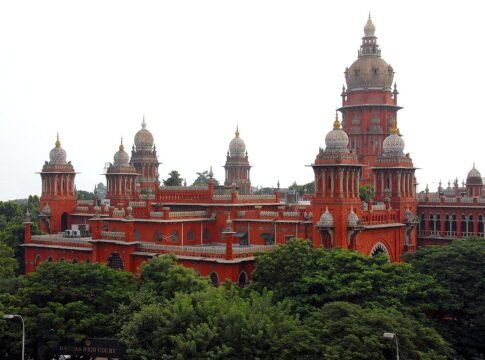
The Madras High Court has reserved its orders on a plea seeking the rejection of an election petition challenging the victory of Tamilaga Vettri Kazhagam (TVK) MLA R. Seenivasa Sethupathi in the Tirupattur Assembly constituency by a single vote. The DMK candidate, K.R. Periyakaruppan, had filed the election petition after narrowly losing the election, with Sethupathi securing 83,375 votes against Periyakaruppan’s 83,374 votes.
Background of the Plea
MLA Sethupathi filed an application to reject Periyakaruppan’s election petition, contending that it failed to disclose a cause of action and did not meet the requirements of Section 83 of the Representation of the People Act. His plea argued that the petition lacked a concise statement of material facts and did not plead sufficient grounds under Section 100 of the Act to declare the election void. Sethupathi’s legal team led the arguments on this application before the court.
Information was available with The Chenab Times indicating that the DMK candidate, Periyakaruppan, has opposed Sethupathi’s plea. In his response, Periyakaruppan maintained that his election petition does indeed disclose a complete cause of action. The DMK candidate has raised several allegations concerning the counting of postal ballots and Electronic Voting Machine (EVM) votes, which he believes warrant a closer examination.
Allegations of Irregularities
According to Periyakaruppan’s counter-affidavit, 2,276 postal ballots were polled, of which 2,275 were counted. He asserts that 306 of these were rejected, while 1,969 were treated as valid. A significant allegation pertains to a postal ballot that was allegedly meant for the Tiruppattur Assembly constituency (No. 185) but was mistakenly sent to the Returning Officer of another constituency also named Tirupattur (No. 50). This, he claims, led to its rejection.
Furthermore, Periyakaruppan has alleged an 18-vote discrepancy between the round-wise EVM figures and the figures recorded in Form 20 and the Election Commission’s records. These discrepancies, along with the issue of the misplaced postal ballot, form the crux of his challenge against Sethupathi’s victory.
Previous Court Orders and Developments
Earlier, the Madras High Court had passed interim orders in relation to this case. In May 2026, a bench had restrained R. Seenivasa Sethupathi from participating in Assembly proceedings and voting in any confidence motion, citing the disputed one-vote margin and the pending allegations. The court had emphasized the importance of the floor test in determining the government’s stability and expressed concern that the MLA’s participation, given the disputed mandate, could significantly impact the constitutional governance of the state. The court had clarified that this order did not set aside Sethupathi’s election but aimed to preserve the integrity of the process pending further scrutiny.
However, the TVK MLA had approached the Supreme Court challenging the interim order, and subsequently, the Madras High Court allowed Periyakaruppan to withdraw a plea pending before it, in line with the Supreme Court’s permission. In July 2026, the High Court dismissed this specific plea as withdrawn, noting the Supreme Court’s direction, and closed the case.
Legal Framework and Election Petitions
Election petitions in India are governed by the Representation of the People Act, 1951, and the specific rules framed by various High Courts, such as the Madras High Court (Election Petitions) Rules, 1967. These rules outline the procedure for filing, scrutiny, and trial of election disputes. The Act mandates that election petitions must be filed within a specified period after the declaration of results and requires petitioners to deposit security for costs.
The legal framework also distinguishes between challenging the election of a returned candidate and seeking a recount of votes. Merely having a belief that one’s good public service should have resulted in more votes is not sufficient grounds for a vote recount, as the Madras High Court has previously held. Election disputes require concrete evidence of irregularities or corrupt practices that materially affected the result.
The Madras High Court has seen an unusual surge in election petitions following the 2026 Tamil Nadu Assembly elections, with many challenging the victories of prominent candidates. The process of scrutiny for these petitions is stringent, requiring adherence to both the Representation of the People Act and the relevant High Court rules before they can be officially numbered and taken up for trial.
❤️ Support Independent Journalism
Your contribution keeps our reporting free, fearless, and accessible to everyone.
Or make a one-time donation
Secure via Razorpay • 12 monthly payments • Cancel anytime before next cycle


(We don't allow anyone to copy content. For Copyright or Use of Content related questions, visit here.)

The Chenab Times News Desk